pressure bedding

pj1

Well-Known Member
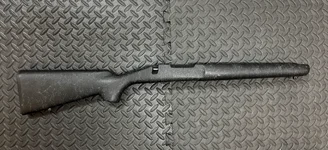
Hi i have a parker hale 1100 lwt in 308. Following on from my thread regarding inconsistency i wonder if having taken the action from the stock and replacing it has caused the problem.

I understand that the 1100 was made with pressure from the end of the stock directly onto the barrel. How much pressure should there be here. I have just got an air rifle out for the morning picked the 308 up and noticed movement between the stock end and barrel.

Im not going to go down the route of fully floating the barrel as ive heard this just makes for more inaccuracy in these rifles

I await your wisdom

Regards pete
 
Trying to bed a wood stock to apply consistant pressure on the barrel is a waste of time. If you want to maintain a constant amount you will need to resort to a synthetic. I have had luck in the past with two screws set in the tip of the forend at about 90 degress from each other once the stock was bedded. they can be adjusted to apply as much pressure on the barrel as you want.

SS
 
Pressure bedding only works if you shoot the rifle off the same position every time. If one rests the rifle on the forend, the resting pressure will be added to the pressure on the barrel. In my opinion pressure bedding might be something for a target rifle which is always shot off the same rest or an experienced hunter who knows the flaw and can hold the rifle the same way as when zeroed.
Hunters who use pressure bedded rifles usually tell other hunters not to shoot live animals at longer ranges...wonder why..
edi
 
Hi

Thought I would share my experience with my rifle.

I have a Parker Hale 1200 (I am led to believe) in 308. It shot okay from the start 1moa I fully free floated the barrel - apart from the first 3 inched in-front of the recoil lug.

It has shot sub 1/2 moa groups with home loads and has been an accurate rifle. However as mentioned above it is hold sensitive, Point of impact will change with position. My general rule with shooting it is to grip or rest it on sticks under the scope objective bell. - The same place. The stock does flex further down the stock so this is where I consistently hold the gun.

Removing the stock and putting it back should not effect the accuracy it can effect the POI (your zero) In my opinion.
 
I've an older parker hale, and have owned several in the past also and I think free floating is a bit hit and miss with these. I find the best procedure to be the following:

1) Free float the barrel and remove all the pressure from the forend, fully bed the action and see if it shoots straight, if it does - sorted. If not then proceed...

2) Bed the last 2" or so of the forend - basically replacing the old wood pressure tip with devcon or whatever you choose. When replacing the action into the stock with your uncured bedding in place you will need to hang the rifle upside down. Secure a 0.5kg weight from the tip of the barrel (I gaffa taped a shopping bag with half a bag of sugar in it!). Tighten the action in fully. Allow to fully cure, take out and replace action tightly and see if it shoots straight. If it doesn't repeat but with 100g or so more weight on the barrel and repeat up to about 750g.

With all the parker hales I've tried this on, if it doesn't shoot well free floated then this has done the trick. Marcbo is right to *some* extent in that wood stocks would swell/shrink and so pressure varies, but then in an older rifle I find this doesn't have any effect as the wood should be pretty stable. It helps to make sure it is very, very well sealed.

I've got a dickson parker hale in .270 with a devcon pressure tip looking at me now - and I have never ever had to correct wandering zero since I did it several years ago. It shoots very, very tight groups indeed. The groups are the same from bipod, sandbag, and rested at any point along the stock so the idea that resting on the forend somehow knocks it out doesn't hold true in my experience. Shoots very well freehand also. I know - I've exhaustively tried.

Digs - if yours is free floated why is it hold sensitive? Are you sure this isn't shooter position?
 
Last edited:
Thanks for the replies. Rebedding is someting i will look into.

Brit when you say it hasnt been reassembled properly is there a correct sequense for doing it, screw tightness etc

Regards pete
 
As I understand it the action is put in making sure the recoil lug is against the recoil bolt then the front screw is tightened. The rear, tang, screw in done up but only nipped up it does not need to be tightened like the front one. I seem to recall this was explained in the American "NRA Gun Smithing guide". Well it has worked for me.
 
Thanks for that brit.

Heres a thought. If i wanted to try more pressure from the fore end could i use some insulation tape as a tempery bedding to see if it helps
 
Thanks for that brit.

Heres a thought. If i wanted to try more pressure from the fore end could i use some insulation tape as a tempery bedding to see if it helps

Glazed business cards work well for this. My P-H 1200 Super in 7.92mm that I acquired new still in it's box from York Guns had rather poor inletting and didn't group as one would expect. According to the adverts years back in Guns Review these were made as a special export order and some over runs were sold to the trade. Judging by the poor inletting I feel this was a quality control reject. Anyway I tried using some compound to tighten up the bedding but in a rush due to lack of time put too much compound under the action and free floated the barrel. On testing at Bisley on Short Siberia we found that the rifle now shot 8"+ patterns. One could really not call them groups.

So I cut a glazed business card up and added it under the barrel just short of the Rosewood tip and continued adding card until the group had shrunk to a normal acceptable size. Then the rifle was sent to Bob Harvey who bedded it to have this pressure. Using Privi Partisen 196 SP ammunition the rifle shot groups inline with P-H's normal acceptance standard. The bedding work is not noticeable to the eye unless one removes the stock.

Of course this was quite some time back as the testing at Bisley was before my relocating North. It took a while to find someone who was able to do the bedding job using the factory Pressure Point bedding method. Some well know "Gunsmiths" were simply not interested, one whom is known on these very forums told me over the phone that the barrel was shot out without even seeing the rifle and suggested fitting a take off Remington barrel. Even when I explained that the rifle had only just come out of it's original box and had not been fired except for proof so simply could not be "shot out" he then changed the "tune" slightly and said it would have to be bore scoped ...................................... well yes I can understand inspecting for damage as it had been stored in a warehouse for many years so rust could be a possibility. He then stated that only a free floatig barrel would ever shot any acceptable groups and that he only ever free floated them. When questioned further it became clear that he had not idea how to actually bed a rifle any other way he also could not answer as why I should pay to have a probably inferior button rifled Remington barrel that had been taken off so that a decent quality barrel could be fitted and why I would want someone discarded barrel on my new rifle. Of course he could not answer.

Funnily enough a few years later I had a PM discussion with Redmist about bedding and although he prefers to free float when it was explained what I wanted and why, restoration really, he understood. The bedding on the P-H 1200C could do with restoration as it has compressed slightly probably to being over tightened. The intention was to get him to do this for me but of course events got in the way. In truth the 1200C would probably benefit from a new barrel as the bore is heat cracked for about half it's length as Mr Kershaw discovered with his bore scope.

But I digress :oops: many promote free Floating as it's easy to do, if one does not rush it that is :doh: pressure point bedding is harder and it seems many simply do not understand the hows and whys. In an old book there is an article on Elmer Keith having a new rifle made and it explains just how the stocker set up the pressure point bedding in the fine walnut stock. of course this was so far back the stock would have been Air Dried Walnut and not the poorer, cheaper Kiln Dried stuff we get today. The stocker used a "Sweeny Collimeter" to set the pressure point as I recall. I would check but not all the books were returned so am unsure as to if I still have the book now.
 
I agree there Brithunter.
I think there's a certain amount of "fashion" involved here. Many seem to think free floating is the only way but I feel this is quite a modern fad - maybe for the last 30 years or so. With the advent of 2 part epoxy resins, bedding an action and free floating a barrel has become very easy, well within the capabilities of the hobby gun mechanic and , on the whole, gives excellent results.


In the past a "Gunsmith" was highly skilled, having serving many years of apprenticeship and regulating and bedding a rifle was a specialised job. Now the average "gunsmith" fits together off the peg bits and calls it a custom rifle, find an action, maybe a Tikka, Remington or Mauser, buy in a barrel blank or even a pre-chambered one, fit a Jewel or Timney trigger, stick it in the stock of your choice, perfectly bedded with a splodge of devcon and away you go.

Many lightweight sporting rifles have thin whippy barrels and slim fore-ends and pressure bedding were the norm. If you ever have the opportunity to examine a Fulton regulated .303 target rifle, all pressure bedded, based on a service Enfield you will see how much skilled work is involved and why it's so much easier, but not necessarily better, to free float the barrel.
 
For the life of it, I cannot understand how bending a Barrel and stock can make a rifle more accurate.
If one has to Resort to pressure bedding, then there are more flaws with the rifle. Really accurate and reliable rifles are not pressure bedded. Only old wooden stocked, badly bedded and carboard underlayed......etc.
The world has moved on and accuracy has stepped up to another Level. Wake up.
edi
 
For the life of it, I cannot understand how bending a Barrel and stock can make a rifle more accurate.
If one has to Resort to pressure bedding, then there are more flaws with the rifle. Really accurate and reliable rifles are not pressure bedded. Only old wooden stocked, badly bedded and carboard underlayed......etc.
The world has moved on and accuracy has stepped up to another Level. Wake up.
edi

How then would this brave new world apply a similar 21st Century approach to bedding a full stock (stutzen) should this fast handling design once again become the must-have woodland stalking rifle?

K
 
Free floating is marketed to us because it is easy to do, just as front wheel drive cars are less expensive to manufacture, so marketed as if they are innately superior to rear wheel drive. And, with flexible synthetic stocks, it is better to leave some air around the barrel, rather than have all sorts of uneven pressure applied from how the stock is held, or rested, or twisted by a bipod.

Some 40 years ago, the American Rifleman magazine, the publication for members of the NRA, was a bit more technical and less commercial than today. They ran a series of articles on regulating double rifles, stock inletting, barrel bedding, and tuning the .303 Enfield - all of them by skilled gunsmiths who built fully bedded sporting rifles with no fiberglass. One of the articles on the .303 was by a gunsmith at Holland & Holland, quite complete, with photos and drawings.

The reason bedding the barrel or having a pressure point can work to improve accuracy is that the barrel vibrates, and the bullets exit it at instants in its oscillation. If you can tune it so they exit near the end of oscillation, as it is slowing and stopping and reversing direction, rather than in the midst of its travel, the bullets will be less scattered.

Bedding the barrel does several things:
- it can dampen the amplitude of the oscillation, and all the vibration in the barrel-action assembly, actually ending some frequencies while the bullet is still in the barrel
- it can dampen the amplitude of the oscillation, so the muzzle is moving less.
- it can shorten the vibrating barrel, which increases the frequency and decreases the amplitude, like shortening a guitar string by half -effectively stiffening it.

I once bedded a .22 semiauto full length in glass, and left the receiver and trigger free, as an experiment. Group sizes shrank in half.
 
One question:
will the POI Change if one changes the ammout of pressure at the pressure Point?
edi
 
One question:
will the POI Change if one changes the ammout of pressure at the pressure Point?
edi

That depends....
on how much pressure.... A little may just dampen the amplitude of vibration and tighten up the spread around the current locus of impacts. A lot will move the impact, but it may also tighten it up to a new locus ( center of a group of bullet holes ).

As someone mentioned before, just test it with some business cards, about halfway between the chamber end and the muzzle, trying to get 7 to 10 lbs of upward pressure.
 
That depends....
on how much pressure.... A little may just dampen the amplitude of vibration and tighten up the spread around the current locus of impacts. A lot will move the impact, but it may also tighten it up to a new locus ( center of a group of bullet holes ).

As someone mentioned before, just test it with some business cards, about halfway between the chamber end and the muzzle, trying to get 7 to 10 lbs of upward pressure.

You see and that is just the flaw, this pressure bedding might mimic a thicker barrel slightly in certain cases however only if the shooter is very disciplined in which way he holds the rifle. If you lay up a pressure bedded rifle at the tip of the forend it is almost exactly the same as resting the rifle on the barrel in front of the forend. This is a fact and laws of physics. I and many others expect a hunting rifle to shoot under all shooting positions (except resting on the barrel of course), why would I want to buy such a flawed pressure bedded "hunting" rifle if I can buy one without this problem. Of course one can hunt with a pressure bedded rifle, one has to adapt somewhat and maybe keep the shots closer.

Harmonics, can you explain somewhat? where do they come from? the cartridge only pushes backwards upon firing...not up down. ..so are the harmonics not a counter reaction to the acceleration that the rifle will have upon firing, in other words recoil behaviour. I believe the important stage of recoil is the initial stage, the phase at which the bullet is traveling down the barrel. In this stage the rifle might only move something like a mm maybe less backwards, depending on the weight. How it moves back depends on the centre of gravity of the rifle. Centre of gravity below the line of bore (like most rifles) the barrel will travel upwards. Also see revolver/pistol. In this instance the barrel might bend somewhat (rifle) due to the rotational acceleration and one will see a whipping action....however the bullet going down the barrel will only notice an upward stroke, not a vibration or up-down movement. If one has a rifle with the centre of gravity below the line of bore it will dive. Perfect is centre of gravity on the line of bore. That is how I build my hunting rifles. Recoils straight back and torques somewhat. A few target shooters are starting to work down that line and one UK rifle manufacturer I know to.
edi
 
ejg -
The angular movement of the rifle you discuss is another bending force due to overcoming inertia, but rather slow compared to the vibration of the bullet being forced down the bore.

Every structure has a natural frequency, or frequencies, on which it can resonate when excited by anything of sufficient force, continuous forces, or of a complementary frequency.

A tall building will sway in the wind at a certain frequency, which can be calculated from its materials and structure. A very tall building in Chicago needs to be engineered differently for the winds there, than a building in Tokyo, with earthquakes in a known frequency range.

An airplane, as it takes off or lands, passes through its First Mode of Vibration, or flutter speed. The goal of the designers, and pilot, is to pass through this speed quickly, so the plane does not shake for long. As it accelerates, you may feel it pass through another mode of vibration.

A rifle barrel is a cantilevered beam, so it does not vibrate quite like a string on guitar, but more like a tuning fork. It is fixed and one end. It has three undampened natural modes of vibration:
1. It can vibrate from where it is fixed to the action, in one bend to the muzzle.

2. It can vibrate in a bend, where part of the barrel is on one side of the axis, and the other part ( a little less than halfway from the muzzel ) is on the other side of the axis. They they swap. This point will be more than halfway from the action for a uniform ( bull ) barrel, and shifted further for a tapered barrel.

3. It can vibrate where, at its peak, both about 1/3 of the bean ( barrel ) is on one side of the axis, about half is on the other side, and the muzzle is back on the same side as the first - so it is sinusoidal.

All these points, frequencies can be calculated using the material density, Young's modulus, matrix algebra, etc. What changes most is the amplitude, due to excitation. That is why different loads result in different groups with the same bullet.
 
why would i buy a such a flawed rifle. ? it is in mint condition and its all i can afford. i would love a sako or manlicher but they are way beyond me. this rifle as far as i understand was made to be pressure bedded near the tip and i want to make sure its were it needs to be since removing the action from the stock. joseph whitworth produced a rifle that would halve the group size of the then government rifle but it was rejected as the bullet was to small.
its easy to reject a rifle as not good enough just because its not the same as modern rifle
 
Back
Top