
You are using an out of date browser. It may not display this or other websites correctly.
You should upgrade or use an alternative browser.
You should upgrade or use an alternative browser.
Any ideas peeps ?..
- Thread starter chaz243
- Start date


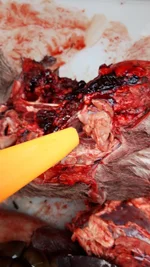

I'd call that mesenteric mass pretty damn suspicious!Its hard to tell from the photos but I’m not seeing anything that’d cause me to condemn the carcass

Dunwaters
Well-Known Member
Yes, but it’s not pussy or granulated and it’s only one .I'd call that mesenteric mass pretty damn suspicious!
What was the overall condition of the animal, was it behaving normally, are there any other abnormalities? If not I’d be happy with it.
I would put a comment in the remarks column if it was going to the dealer though.
Yes, but it’s not pussy or granulated and it’s only one .
What was the overall condition of the animal, was it behaving normally, are ther any other abnormalities?
I would put a comment in the remarks column if it was going to the dealer though.
Are you looking at the same photos?
Dunwaters
Well-Known Member
Think so, what have I missed?Are you looking at the same photos?
If I saw something iffy in a carcass I wouldn't be sniffing it. I'd be wearing a mask if I had one! Don't want to catch anything!
Ian
Ian

It looks a bit like a worm cyst to me; it's VERY hard to tell from the photos. Worm cysts are frequently in the mesenteric area but can occur almost anywhere on a carcass. If you hung the carcass did it set, by which I mean has it gone into normal rigor mortis? If so then I would be unwilling to condemn the carcass instantly. If any liquid in that sac was clear then I feel you can be fairly sure it was a worm cyst but ask @srvet for his opinion. He is a wise and experienced man whose judgement I would trust implicitly every time. A wiser man than me, a vet who was an animal pathologist working for what was the then Veterinary Investigation centre in Cumbria, told me, and students on the courses we took to the VI centre, to "recognise the normal, AND the variations in the normal" because they are many and (no pun intended) normal or usual or varied even. It was probably one of the most valuable lessons I learned.
Last edited:
Think so, what have I missed?
The big cheesy lesion? That ain't a worm cyst.

chaz243
Well-Known Member
The orange /yellow knife scabbard is pointing to one .... it's huge compared to what I'm used to seeing .The lungs were rather lumpy too ...How were the sub maxillary and retro pharyngeal nodes? They tend to be the ones that really indicate all is well or not
S
chaz243
Well-Known Member
The mesenteric lump was hard and white plus another on wad swollen and 7unusual colour .The submaxillary (orange knife scabbard pointer) was huge and the lungs were rather lumpy too. Thanks for your interest .Yes, but it’s not pussy or granulated and it’s only one .
What was the overall condition of the animal, was it behaving normally, are there any other abnormalities? If not I’d be happy with it.
I would put a comment in the remarks column if it was going to the dealer though.
chaz243
Well-Known Member
The orange /yellow knife scabbard is pointing to one .... it's huge compared to what I'm used to seeing .The lungs were rather lumpy too ...How were the sub maxillary and retro pharyngeal nodes? They tend to be the ones that really indicate all is well or not
S
Would love to hear his opinion... Other nodes in the mesenteric were swollen plus the lungs had distinct lumps in them. Otherwise the Doe was relatively healthy but old 5_6 + . The neck seemed bony though. Lungs, mesenteric.retro and subs all gone off to lab for analysis watch this space but not for,a while. Takes weeks to grow a culture if TB ..It looks a bit like a worm cyst to me; it's VERY hard to tell from the photos. Worm cysts are frequently in the mesenteric area but can occur almost anywhere on a carcass. If you hung the carcass did it set, by which I mean has it gone into normal rigor mortis? If so then I would be unwilling to condemn the carcass instantly. If any liquid in that sac was clear then I feel you can be fairly sure it was a worm cyst but ask @srvet for his opinion. He is a wise and experienced man whose judgement I would trust implicitly every time. A wiser man than me, a vet who was an animal pathologist working for what was the then Veterinary Investigation centre in Cumbria, told me, and students on the courses we took to the VI centre, to "recognise the normal, AND the variations in the normal" because they are many and (no pun intended) normal or usual or varied even. It was probably one of the most valuable lessons I learned.
Thanks for your interest ...C
chaz243
Well-Known Member
Didn't notice any unusual smell but 5hen I generally wasn't doing too much sniffing...All quite alarming really and,off puttingAnother aspect not to be missed but seldom discussed, smell.
Can't upload that on the internet unfortunately (yet)!
Dunwaters
Well-Known Member
The 2 lines above contain rather more information than I was able to glean from the phots’s, so my answer to your question now changes to No, I wouldn’t put it into the food chain, that smell you mention would also be significant.The mesenteric lump was hard and white plus another on wad swollen and 7unusual colour .The submaxillary (orange knife scabbard pointer) was huge and the lungs were rather lumpy too. Thanks for your interest .
It sounds like TB , dispose of the carcass appropriately.

Hard to say for certain, it appears to be a walled off mass attached to the mesentery but there could be many causes but bacterial, mycobacterium, neoplastic or parasitic seem possible to varying degrees of probability. If material has been submitted for histology this should clarify the cause.

geoffw
Well-Known Member
@Oldstalker Hi, can you tell me more about the rigor mortis angle you refer to? Are you saying a carcass won't go into normal rigor mortis if infected/diseased?It looks a bit like a worm cyst to me; it's VERY hard to tell from the photos. Worm cysts are frequently in the mesenteric area but can occur almost anywhere on a carcass. If you hung the carcass did it set, by which I mean has it gone into normal rigor mortis? If so then I would be unwilling to condemn the carcass instantly. If any liquid in that sac was clear then I feel you can be fairly sure it was a worm cyst but ask @srvet for his opinion. He is a wise and experienced man whose judgement I would trust implicitly every time. A wiser man than me, a vet who was an animal pathologist working for what was the then Veterinary Investigation centre in Cumbria, told me, and students on the courses we took to the VI centre, to "recognise the normal, AND the variations in the normal" because they are many and (no pun intended) normal or usual or varied even. It was probably one of the most valuable lessons I learned.
Similar threads


- Replies
- 13
- Views
- 1K

