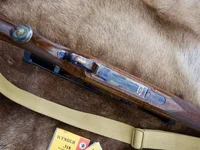
.318 Westley Richards Load Development

Jura

Well-Known Member
Hi guys, any of you reloading gurus explain my latest reloading development for .318 WR as I have never had such confusing results before with other calibres?

OK, I started very conservatively, so much so I didn’t fire a lot of rounds NF (not fired) because I did not see an increase in velocity or in fact reach the desired velocity (Westley Richards quote 2,400FPS) which I think is somewhat optimistic; 2,200FPS would be nearer the mark methinks.

It wasn’t until I reached 47grains of N150 that things began to improve (please see screenshot), with no sign of heavy bolt lift although all the primers were flattened even at the first load of 41.5 grains of N150.
So, my question is should I push it a wee bit more to 49 or 50 grains?
Screenshot 2022-09-03 at 16.33.46.png
 
The very flat primers may be a result of case shoulder to chamber clearance. Compare shoulder positions between new and fired cases.
Thanks Laurie but they were all bumped back two thou after annealing. All headspaces were measured on my Hornady gauge.
 
Flat primers are not a good indicator of pressure. If the primer cup is attempting to enter the firing pin hole however it could getting up there!
Flat primers can be a result of some head space.
The sequence goes thus;
The pin knocks the cartridge forward and starts the primer off.
Max pressure forces the brass to grip the chamber.
The primer cup is free to be jacked out of the primer pocket and up to the bolt face.
It also swells.
As pressure drops the brass let's go of the chamber.
The case now pushes back to the bolt swaging down the the swollen primer cup in the process. Also the case material flows forward .
Primer now looks flat.
 
Bullet weight? Barrel length?

Assuming a 250 grain bullet and a 22 inch barrel, I played around with my online internal ballistics simulator P-Max to see what you might expect. (I used the .338 calibre from the drop down list as .330 is rather an oddball calibre and is not listed.) I used 59 grains H2O for the powder space (space in the case behind the loaded bullet).

Westley Richards may well have achieved 2400 ft/sec., but were probably using some form of Cordite propellant, which was double base.

What I found was that you would not expect to get more than 2200 ft/sec using N150 powder, a single base propellant. If you want to approach 2400 ft/sec then you need to step up to a double base powder like N550 with a fairly stiff load.
 
What I found was that you would not expect to get more than 2200 ft/sec using N150 powder,
Many thanks for that @borbal, this is pretty much what Trigger is saying on the Westley Richards website. I have cut and pasted it below.

"In truth the .318 Westley Richards cartridge shooting a 250 grain bullet at 2250 feet per second is still a great and fun cartridge to use for general plains game hunting and even driven boar in Europe. The long torpedo bullet has phenomenal sectional density and with its moderate velocity (by modern standards) proves a deep penetrating round, at one time capable of tackling every type of big and dangerous game on the planet."
 
Certainly. More is not always better. At this velocity the bullet will be less stressed and penetrate more.
Folk are far to obsessive about velocity and some kind of notion of nothing but dropping to the shot will do.
 
This might help, see image of Woodleigh data for the .318 WR.
Many thanks for that @karamoja I also have The Woodleigh Loading manual but unfortunately it does not have any load data for Vihtavuori powders which I am gradually switching to.

I do however have a few tubs of H4831sc and H4350 which are listed in their manual but I am keeping those for other calibres.
 
Yes, I am to gradually moving over to European powders and bullets. I have enough rem no9 primers but experimenting with rws primers. I see Vhitorvouri is/has opened a primer making factory. Good news!
Good luck, it looks like your on the right track. I found n135 in my 9.3 a fantastic powder and load. When I got the load to where I wanted it I had it pressure tested. The proof house will do this and it is not terribly expensive to do.
K
 
I see Vhitorvouri is/has opened a primer making factory. Good news!
Absolutely, great news.
When I got the load to where I wanted it I had it pressure tested. The proof house will do this and it is not terribly expensive to do.
Interestingly enough when I first developed a load for the 318WR using Ramshot Magnum I took them down to Birmingham proof house 20 years ago for pressure testing because there was scant information on this cartridge back then.

I had also acquired some original Kynoch 318WR Cordite which the proof master tested first and the results were off the scale, so much so that the cases imploded after firing, they actually looked as if someone had stamped on them.

He (the proof master) reckoned they had come back from a hot country and it was a good thing I hadn't fired them in my rifle. Lesson learned.
 
Last edited:
Flat primers are not a good indicator of pressure. If the primer cup is attempting to enter the firing pin hole however it could getting up there!
Flat primers can be a result of some head space.
The sequence goes thus;
The pin knocks the cartridge forward and starts the primer off.
Max pressure forces the brass to grip the chamber.
The primer cup is free to be jacked out of the primer pocket and up to the bolt face.
It also swells.
As pressure drops the brass let's go of the chamber.
The case now pushes back to the bolt swaging down the the swollen primer cup in the process. Also the case material flows forward .
Primer now looks flat.
Well said, this is the very reason service ammunition has crimped in primers.
 
Back
Top