Lynx reintroduction workshop Dunfries and Galloway

I highly doubt a lynx would kill an adult badger. Cubs maybe, eat a dead one sure. I'd guess they'd not kill many red deer either?
Just one of the things I saw on the list of pray species, I guess they'll get what they can.
Most of the Highlands where you'd mainly find red deer would be unsuitable habitat, they need a minimum of 35% forest cover.
 
Yes, lets spend our time and money trying to save what endangered species we have. Not waste it on the reintroduction of another predator. Out countryside is over run with predators, most of which are protected!
Aye!!! Nearly 1000 of them in Westminster alone, as well as Edinburgh and Wales.
 
In studies Lynx have had a diet of 70%-80% cloved game mostly roe, rein deer and in finland whitetail deer then they fill up with other small game mostly hares and grouse. Some lynx have fallow deer on their menu, red deer but not adult males, moose up to 125kg, fox, beaver, domestic cats. On average scandinavian Lynx takes a cloved game every 5-6 days.
 
To be fair to the lass she makes it very clear she is not linked with any lynx groups, just a lass wanting info for a post grad study thing.
Someone did ask her opinion but I think she sidestepped ….
Thanks for taking the time to give a brief précis of the meeting for those who couldn’t attend - genuinely helpful👍

I have to admit that I’m not totally against the argument that ‘we erased them so we should have a responsibility to reintroduce them’ but I’m also not naive enough to buy into the idealism of such a suggestion.

The critical failure with the majority of these projects is the obvious fact that they all advocate releasing these animals into an ecosystem that is massively different from the one that they previously existed in! In addition human generational knowledge of co-existing with such predators has also gone. You only have to look at similar rewilding attempts, e.g. the brown bear project in Trentino Italy, to start to appreciate the true scale of associated problems & costs involved

As with any predator - survival is all about maximum calorific intake for minimal effort? How do these ‘pro’ groups honestly believe Lynx or wolves will adopt the habits of their long extinct predecessors once they discover that they can just pop down to the nearest Croft for a woolly McDonalds!!🤣👍
 
In studies Lynx have had a diet of 70%-80% cloved game mostly roe, rein deer and in finland whitetail deer then they fill up with other small game mostly hares and grouse. Some lynx have fallow deer on their menu, red deer but not adult males, moose up to 125kg, fox, beaver, domestic cats. On average scandinavian Lynx takes a cloved game every 5-6 days.
They ear domestic cats!!! Mmmmmmm they might not be all bad then!!
 
1 of my main points is while they do need more the 38% forest cover, I'm sure plenty of places in Argyll, kielder, ae, gallowy Eskdalemuir will be up there cover wise.
And big big areas but still only big enough for a small number of lynx, even if do well hard to see them forming a stable breeding population thats not inbred with so few animals and longish distances to the next heavily wooded area..

Also and most on here will know this only too well, esp in uk with commercial forestry is that really viable habitat?
U can look on a map at a big blob of green forestry adding up to thousands and thousands of acres of potentially 'prime habitat'
U get out there and stick ur head inside the trees and all uve got is thousands of acres of darkness no vegetation no cover for ambushing food, little other wildlife actually living there.
So the lynx will be hunting 100% on the edges/rides and if outside edges will be just where the sheep are

I'd seriously question wether we have as much suitable habitat as we think.
Any photos u see of them tracking kynx seem to be in far more open forestry.

Like I said still not completely against them but hard to see that many positives and a lot of negatives which will be very real for the folk living/farming beside them.

In scotland esp with right to access a massive problem for both the locals and the lynx themselves will be the amount of bobble hats that will come to try and spot them.
Disturbing nature everywhere in valley, no doubt leaving gates open, driving up forest tracks ( no doubt getting lost as those big blocks are a bloody nightmare at times(.

Seemingly lynx will return to a kill no problem but tend not to if they see humans at it, so if bobble hats are stumbling over kill sites lynx will have to kill more, not great if on sheep or it may starve move due to disturbance.
But even deer will be hard to shoot because of disturbance too, habits changing folk on ground very late/early and concealing themselves in hides.
With the best will in world when checking a back stop never going to see someone in a hide.
 
1 of my main points is while they do need more the 38% forest cover, I'm sure plenty of places in Argyll, kielder, ae, gallowy Eskdalemuir will be up there cover wise.
And big big areas but still only big enough for a small number of lynx, even if do well hard to see them forming a stable breeding population thats not inbred with so few animals and longish distances to the next heavily wooded area..

Also and most on here will know this only too well, esp in uk with commercial forestry is that really viable habitat?
U can look on a map at a big blob of green forestry adding up to thousands and thousands of acres of potentially 'prime habitat'
U get out there and stick ur head inside the trees and all uve got is thousands of acres of darkness no vegetation no cover for ambushing food, little other wildlife actually living there.
So the lynx will be hunting 100% on the edges/rides and if outside edges will be just where the sheep are

I'd seriously question wether we have as much suitable habitat as we think.
Any photos u see of them tracking kynx seem to be in far more open forestry.

Like I said still not completely against them but hard to see that many positives and a lot of negatives which will be very real for the folk living/farming beside them.

In scotland esp with right to access a massive problem for both the locals and the lynx themselves will be the amount of bobble hats that will come to try and spot them.
Disturbing nature everywhere in valley, no doubt leaving gates open, driving up forest tracks ( no doubt getting lost as those big blocks are a bloody nightmare at times(.

Seemingly lynx will return to a kill no problem but tend not to if they see humans at it, so if bobble hats are stumbling over kill sites lynx will have to kill more, not great if on sheep or it may starve move due to disturbance.
But even deer will be hard to shoot because of disturbance too, habits changing folk on ground very late/early and concealing themselves in hides.
With the best will in world when checking a back stop never going to see someone in a hide.
I have seen lynx tracks in the fells with sparce birch cover they follow the reindeers up on bare fell. Its normal for a lynx to walk 20km /night so they will find both prey and cover.
 
Don’t suppose anyone knows till they try but not convinced it would be fair on the lynx but if habitat truly favourable and they could adapt give it a go. Sheep worth very little in grand scheme of things and if compensation or subsidy payed could work, personally think more trouble than it’s worth.🤷
 
Before we go off half-cocked on another predator-fest ( - who remembers the golden eagle, in many former haunts now extirpated by the white tail?), might it be worthwhile to gather evidence of the experiences where other countries with domestic stock have fared under similar reintroduction schemes? That may at least alert the shepherds and flockmasters around the country as to what to expect. Had a discussion with a returning Spanish guest of more than 25 years last month on this very subject - quite an eye-opener, beware the ‘unintended consequences’ aspect, baaaaah!
 
Before we go off half-cocked on another predator-fest ( - who remembers the golden eagle, in many former haunts now extirpated by the white tail?), might it be worthwhile to gather evidence of the experiences where other countries with domestic stock have fared under similar reintroduction schemes? That may at least alert the shepherds and flockmasters around the country as to what to expect. Had a discussion with a returning Spanish guest of more than 25 years last month on this very subject - quite an eye-opener, beware the ‘unintended consequences’ aspect, baaaaah!
Hahaha! Another classic post, suggesting there is information to be shared but choosing to share none of it.

At the FC deer day in Worcester recently, there was a talk by David Hetherington. As a presentation of European study results, it wasn't able to answer definitively some of the questions that are of concern in Britain but indicated from a Finnish study that there is the potential for capercaillie (for example) to benefit from the fox predation by lynx. (Though the data presented from Swiss Jura was fox was 3rd on the prey list at 6% after roe (69%) and chamois (21%).)

The other indication was that in cases of high numbers of sheep predation by lynx, there had been the practice of drifting the sheep from lower ground, through woodland and then to higher land. It was during the period of the sheep grazing in the woodland that the losses occurred. In open ground grazing situations, typical in Britain, the losses were small.

The closing section seemed to suggest that for a re-introduction population of 200+, the potential of establishing a large enough area of suitable habitat was severely limited.
 
Kortland’s study of Scottish capercaillie nesting failures suggested a 90% nest predation rate by pine martens; this suggests to me that the foxes will have to either be quick, or rather change their diet away from the easier pickings found outwith the forest...
 
Before we go off half-cocked on another predator-fest ( - who remembers the golden eagle, in many former haunts now extirpated by the white tail?), might it be worthwhile to gather evidence of the experiences where other countries with domestic stock have fared under similar reintroduction schemes? That may at least alert the shepherds and flockmasters around the country as to what to expect. Had a discussion with a returning Spanish guest of more than 25 years last month on this very subject - quite an eye-opener, beware the ‘unintended consequences’ aspect, baaaaah!

There is a lot of studies and it has been successfully re introduced elsewhere.

But I think big issues about how relevant studies are due to different farming and forestry practices in the UK, rsp uplands.
So still a lot to learn and most only by actually releasing them.

There was 1 slide with a graph of sheep losses due to lynx, for some reasons Norway losses were far far higher than Sweden despite it having more lynx.
For me the reasons for such high numbers weren't explained.
And the sheep farmer bloke said they're are instances of lynx entering sheds to kill sheep in Norway. Dunno if rogue lynx or not that's a massive red flag.

I didask the sheep farmer lad hypothetically if
Snh or whoever agreed on some compo even if worth 2 or 3'X value of stock lost and no quibbles,ie taking financial loss out of it he was still dead against it. And said with smaller hefted flocks u can't just buy new stock to replace them.

Just so many variables hard to know wot would happen.

They say a combination of dogs and fencing can seriously reduce predation, but I can't see either working in uk, as sheep are never in forestry and dogs would be a nightmare legally but how many would u need when sheep spread over thousands of acres.

Just thinking dunno how much bracken there is in Europe, that could be the ideal habitat for an ambush hunter, not good for sheep.
 
Possibly a case of look after what we have got that is struggling if viable to do so🤷

Sadly no one else seems to think like that.

Not that it should matter wot an animal looks like or how easy to spot it is.
But wot is the point in an animal that is virtually impossible to see.
How many of Joe public ever seen a badger alive?
But I bet a truly massive % live within 5 or 10 miles of a badger sett.

Spend money on red squirrels or waders black grouse or even caper, things that u can hear and see ( again not that that should make a difference)
 
Sadly no one else seems to think like that.

Not that it should matter wot an animal looks like or how easy to spot it is.
But wot is the point in an animal that is virtually impossible to see.
How many of Joe public ever seen a badger alive?
But I bet a truly massive % live within 5 or 10 miles of a badger sett.

Spend money on red squirrels or waders black grouse or even caper, things that u can hear and see ( again not that that should make a difference)
Guess we’re back to habitat and how it changes influenced greatly by us and the old market forces driving the show, going back to deer forests, grouse moors and the likes and the current rewilding been the flavour for last couple decades.
 
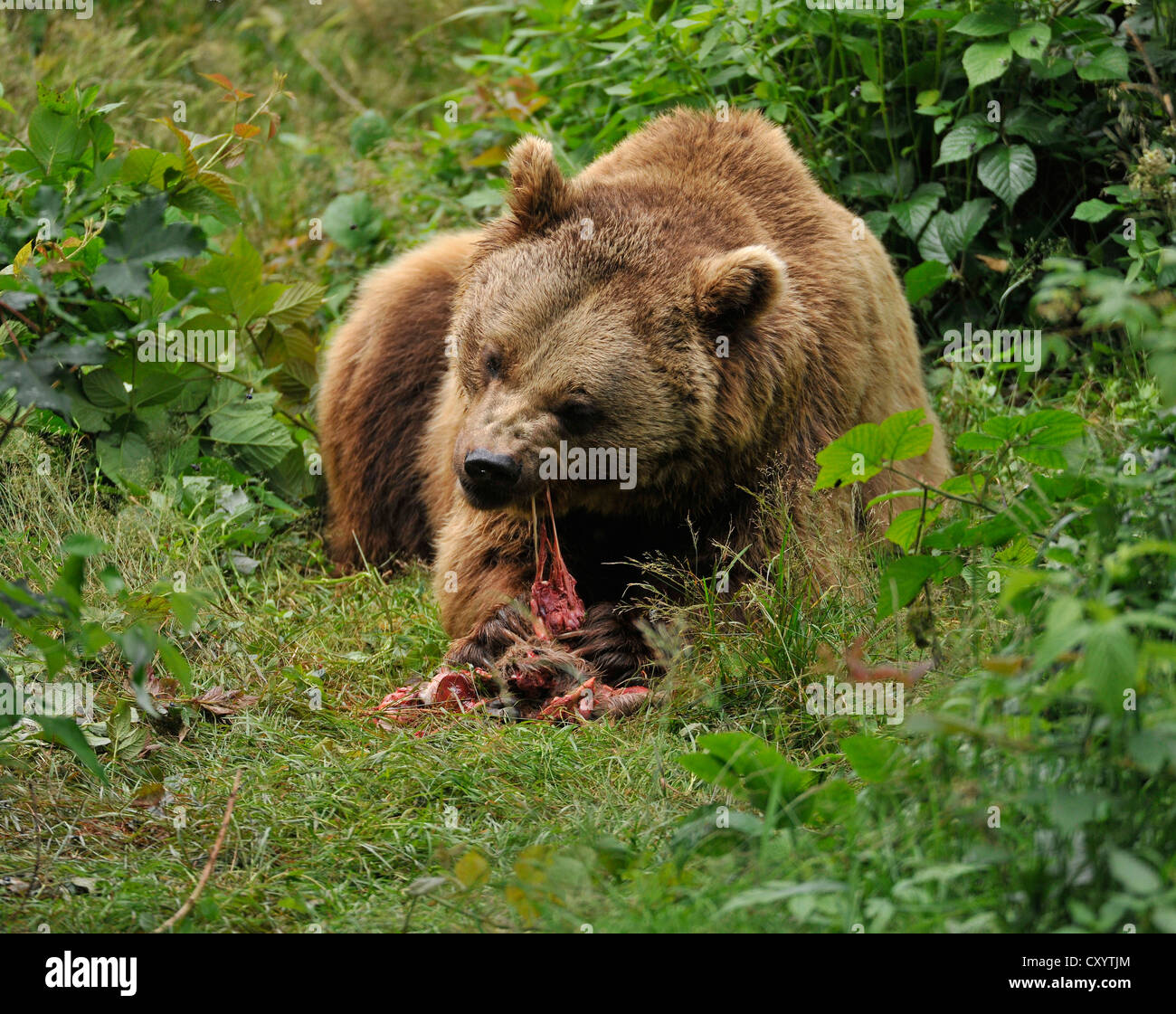
Why not have at it and release some European brown bears?

european-brown-bear-ursus-arctos-eating-a-roe-deer-capreolus-capreolus-CXYTJM.jpg


They predate heavily on recently dropped kids/fawns and will gladly have a go on a deer, fox, hillwalker... :scared:
 
Why not have at it and release some European brown bears?

european-brown-bear-ursus-arctos-eating-a-roe-deer-capreolus-capreolus-CXYTJM.jpg


They predate heavily on recently dropped kids/fawns and will gladly have a go on a deer, fox, hillwalker... :scared:
Plenty of islands not on the main land where initial trials could be done if habitat suitable and could be a great tourist attraction and if numbers increased possible limited trophy culls. Possible fatalities among people but in time would become the norm and accepted.
Don’t know what all the fuss is about🙂
 
Back
Top