New .303 MLE! - powder selection and other quandaries

Mr. Gain

Well-Known Member
My recent acquisition of a Lee Speed based on a Mk I MLE has raised five immediate questions that I hope the learned gentlemen of the SD can answer.

These have to do with:
1. dust cover removal
2. powder selection
3. brass stretching
4. aperture sights
5. trigger tuning

First, how do I remove the dust cover on the bolt? I can see that it will slide to the rear once I lift the near end out of its notch, but how do I do this without damaging the cover? I've looked for YouTube videos on disassembling LM/LE rifles (since this is precisely the kind of thing moving pictures describe better than words), but the ones I've found all seem to dodge the issue, with the covers becoming magically detached/attached between cuts.
Edit: I finally found a video. Not the best, but still helpful.
1000032895.webp

Second, I intend to find some 174-grain round nose bullets for it, but have begun with 125-grain JSPs because I happened to have a box to hand. My initial load was also somewhat ad hoc and sui generis, as I decided to use up my final tub of Varget in honour of the new rifle, and Quickload seemed to think it would be a fair choice. Can you suggest currently available powders that would be good for the 125s and the 174s?

Third, my new PPU brass was a noticeably different shape coming out of the chamber (R) than it was going in (L). Is this normal for early MLEs? If so, would I be wiser to neck size only from now on? If not, I do I have a problem?

1000032888.jpg

Fourth, thanks (!) to ageing eyes, seeing the sights is a challenge. Using an EyePal aperture on a pair of shooting glasses helps, but I would really like to come up with a rifle-mounted solution. The MLE Mk I had the safety mounted on the bolt, and the Speed conversions lack the volley sight: so there are no potential mounting points on the LH side. However, spare bolt covers and cocking pieces are available, and I'm thinking it might be possible to mount an aperture sight on one or the other. Has anyone tried this? I know there were original Fraser aperture sights for the Speeds (which must now be rarer than hen's teeth), that some fine-looking cocking-piece-mounted sights are produced by McLaughlin in the US (but AFAIK only for Mauser and Mannlicher actions), and that PH did a wide range of sights for Enfields (but none look designed to fit a Mk I), which leaves me wondering whether one of Williams" WGRS models might feasibly be fitted to a spare bolt cover. Not attractive or authentic, but the prospect of being able to see, and thus to hit, the target has an obvious compensatory appeal.

1000032894.jpg

Fifth, the trigger breaks cleanly, but is very heavy. As replacement sears and cocking pieces can be had affordably, and as it isn't hard to dismount either, I'm wondering whether acquiring a "new" set to modify by altering the engagement angle might give me a lighter break without having to do anything irreversible to the original parts. Worth a try?

As ever, any help with any of these points will be most gratefully received.

1000032687.jpg
 
Last edited:
Are these gems head spaced via the bolt head and different sizes used.
Just wondering if yours has excessive head space.
Add layers of black tape the the sized case head until it's difficult to close the bolt or feeling resistance. Measure the tape thickness and see if out of spec.
 
I think the different-sized bolt heads are a feature on No.4 (& No.5) rifles only.
The fired cases are the same length as the unfired ones, so the case is not stretching overall: but as can be seen, the shape of the shoulder is very different.
 
I've only ever owned a couple of No4 rifles - so my comments might have little relevance.
The only powders I've used are N140 and RS50 - but I've never used a bullet lighter than 174gr or heavier than 186gr. The usual manuals should provide further info...

As far as the chambers go, and this might apply to older ones as well as to the No4 and SMLE, it is my understanding that as battle-rifles, the chambers are often generously-dimensioned.
Never a mistake to get the headspace checked if in doubt, of course.
Looking at the fired and unfired cases, the expected difference is clear - namely that the shoulder has moved forward a good deal. If you resize that brass back to the original dimensions every time, you will get marked stretching and likely incipient or actual case-head separation after a couple of firings.
The wisdom I absorbed when I got my No4 was to offer the fired brass to the chamber before reloading it to see whether it is still possible to close the bolt on it easily. If it is, then simply neck-size (I use a Lee collet die) before checking length/trimming.
This, along with keeping the charges modest (I only use it at the target) seems to have given me pretty long-lived brass - some of it on its seventh firing.

As to the trigger - how heavy is heavy?
 
Chambers are designed be a little larger than spec. Means it won't jam when full if crap/dust in the heat of battle.

Thats and quality control of ammo back in the day as it came from so many diffrent sources/locations allowed it to account for variations
 
N140 is a go to powder for 303. Vectan TU3000 is great too if you can find some. If you full length resize your fired cases you will get case head separation. The shoulder has moved forward thus stretching the body. Lee collet die is the way forward. If you go this route take them apart and give them a good clean. Not a bad idea to polish the "tapered" sliding parts. Some copperslip or moly grease will help too.
 
It is a war rifle in design so, yes, the chambers will be cut so as to eliminate all possibility of a round not chambering. This will mean, as you have already suggested, neck sizing only. I never used such in my SMLE or No4 as they weren't available at the time but maybe Lee's Collect Sizing Die is the way to do that AND eliminate the need for lubing the case neck.

Powders the competition shooters including myself used either Viht. N140 or N150 with the 174 grain spitzer type bullet. There's none better powder and some preferred N140 others N150. In a longer barrel weapon of the standard 25" or longer then N150 may have merit over N140. Perhaps. But I preferred N140 in my SMLE and No4.

Bullet weight. It may be that your rifle is sighted for the 215 grain bullet? I for sure would not use any round nose 174 grain as it'll drop like a stone and negate any benefit of it being able to leave the barrel at a higher velocity than its 215 grain brother.

Bolt heads are under UK Law classed by some as controlled component parts (they do after all legally need to be proofed) and especially so as it is the first thing you'd try to fond if wanting to recommission a previously old spec deactivate Lee type bolt. But yes they did come in various lengths.
 
I am absolutely no expert in these rifles, I’ve fired a SMLE a few times as a club rifle. However, I have kept the empties from that as I toy with the idea of getting one.

This is a fired case from the club rifle (WW1 SMLE) and the shoulder looks similar to your fired case, I’d also noticed that these have a slight Weatherby-esque rounding to the shoulder.

Make of this what you will.
 

Attachments

  • IMG_8571.webp
    IMG_8571.webp
    32.6 KB · Views: 13
I made public that photo of the Fraser striker mounted sight years ago when l found it in an engineering magazine, l still have that magazine page dated 1909.

As far as l am aware with the evidence I’ve found it’s possible that Fraser only made, in house, approximately 50 such striker mounted aperture sights, they have the serial number marked on the three major components.

They are extremely rare to find and it’s taken me many years to accumulate my small assembly, most importantly they are all made individually to fit particular rifle strikers.


IMG_0726.webpIMG_1817.webp
 
I made public that photo of the Fraser striker mounted sight years ago when l found it in an engineering magazine, l still have that magazine page dated 1909.

As far as l am aware with the evidence I’ve found it’s possible that Fraser only made, in house, approximately 50 such striker mounted aperture sights, they have the serial number marked on the three major components.

They are extremely rare to find and it’s taken me many years to accumulate my small assembly, most importantly they are all made individually to fit particular rifle strikers.


View attachment 433034View attachment 433035
Wow! And belated credit/thanks to you for the magazine image. :tiphat:
That last photo is like seeing Earhart, Franklin, Kitchener and Lucan queueing for a bus!
 
Fettling the trigger components can affect the weights/length of pull of both trigger pull stages. The trigger pull will also be affected by the sear angle on the cocking piece and the striker spring. Good idea to fettle replacement parts and keep the originals.
 
Bullet weight. It may be that your rifle is sighted for the 215 grain bullet? I for sure would not use any round nose 174 grain as it'll drop like a stone and negate any benefit of it being able to leave the barrel at a higher velocity than its 215 grain brother.
Most interesting. I'll see if I can find a 215-grainer.
The choice of a round nose is mostly because I like the way they look (my Mannlicher Schoenauer has taught me to love them): and they only come in 174-grain form.
As things stand, the external ballistics are an unusually low priority, because - and it pains me to say so - I discovered yesterday that I can barely see well enough to obtain a reliable sight picture on a 12" white gong at 74 yards, let alone at any range where the aerodynamic difference between a round nose and a spitzer might matter.
 
Wow! And belated credit/thanks to you for the magazine image. :tiphat:
That last photo is like seeing Earhart, Franklin, Kitchener and Lucan queueing for a bus!

Funny you should mention “queuing for a bus” the last two of the Frasers came almost together, but that was a while back, not seen any recently.

The one on the left of the photo is the earliest one, (it’s numbered No4) it appears to anyone viewing that the elevation adjustment ring is missing, it never had one because elevation had to be achieved manually, I’ve never seen another it’s what l would call a push pattern elevation.

Edited my post……extra information.

IMG_0727.webp
 
Last edited:
Edited my post……extra information.
Most interesting! Especially as regards the means of attachment and the structural components of the sight. I've extracted the text for convenience here:

"Fig. 11 illustrates a sight designed by Messrs. Fraser and Co., Edinburgh and London. The base of the sight consists of a steel block recessed to receive the end of the cocking-piece of the rifle, to which it is attached by means of two set-screws. A second block carrying the sight-pillar is attached to the base-block by a dovetail, and lateral adjustments are made by means of a screw with milled head on the right of the sight. The scales for lateral adjustment are divided by divisions 5/100 in. in width, but the milled head is marked as a micrometer for finer adjustments. The vertical pillar carrying the aperture-sight is again dovetailed into the block with lateral movement. The sight is raised by means of a milled collar working on the pillar, and is held firmly in position by a small clamping-lever. When the rifle is cocked, this sight is brought back quite close to the eye of the firer, and at first sight it would appear that injury from the recoil of the rifle would result. It must be remembered, however, that when the trigger is pressed, the cocking-piece must move forward 3/8 in. (of course, carrying the sight with it) before the explosion of the cartridge can take place."
 
The choice of a round nose is mostly because I like the way they look...
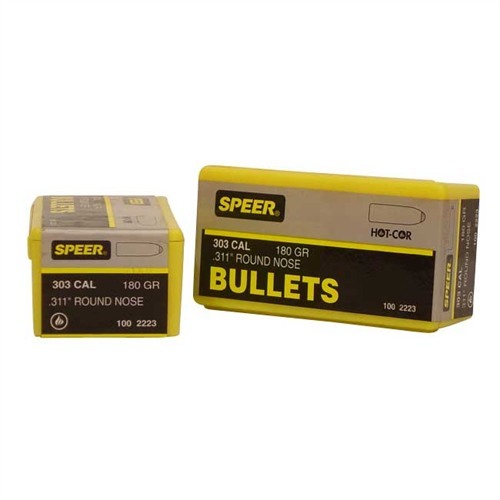
You won't like they way the shoot! Ahahahahaha! Back in the 1970s the only commercial .312" bullet available for handloading .303 in the UK was Speer's 180 grain round nose offering.

At two hundred yards the damn things, even though leaving the barrel at the customary 2,450fps were pretty much hitting the top of the mantlet at Kibworth Rifle Range.

So most of us have a box of sixty not loaded and twenty loaded rounds not fired as after twenty that we had loaded and shot we declared them useless.

These below. Truly awful, awful things a ballistic coefficient of .328 as against what the internet says is a "BC" for the Mk 7 bullet of .467.

 
I wonder if you gave somewhere like Shellhouse Casting a call to see if they could help you…….l can’t help sorry, when l shot my .303’s l never reloaded for them.
 
Back
Top