

Bavarianbrit
Well-Known Member
I just had a thought, depending on if the copper tip is threaded into the brass body either a lh or rh twist could with the acceleration centrifugal forces unscrew the tip.
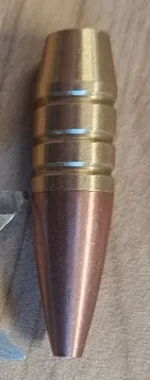
My translation of the intro. :- Here I would like to introduce a new hunting bullet where I was able to test some prototypes. The bullet guide is brass; the bullet tip is made of copper. Brass has excellent guidance properties, but is less suitable than copper as a material for deformation/fragmentation; brass is more prone to fragmentation and uncontrolled splintering. Copper, however, is optimal as a bullet material for deformation/fragmentation; however, it is more prone to problems as a bullet guide, particularly with barrel fouling/deposits. Alternative copper bullets often have the problem of precision: they are often manufactured using a simple press-upsetting process; the concentricity is then often suboptimal, which then results in a loss of precision. Brass is much better suited for this purpose and is easier and more precise to manufacture, making it more cost-effective. Attempts to combine these two materials are not without problems; a molecular bond (welding) is not possible; bonding with questionable chemicals, which are often even more toxic than lead, is not optimally feasible.
Here, the manufacturer has achieved a pure, mechanical connection between the hollow point bullet tip and the brass bullet tail, which requires no chemicals other than contact adhesive.
The hollow point bullet is made of copper.
 forum.wildundhund.de
My translation of the intro. :- Here I would like to introduce a new hunting bullet where I was able to test some prototypes. The bullet guide is brass; the bullet tip is made of copper. Brass has excellent guidance properties, but is less suitable than copper as a material for deformation/fragmentation; brass is more prone to fragmentation and uncontrolled splintering. Copper, however, is optimal as a bullet material for deformation/fragmentation; however, it is more prone to problems as a bullet guide, particularly with barrel fouling/deposits. Alternative copper bullets often have the problem of precision: they are often manufactured using a simple press-upsetting process; the concentricity is then often suboptimal, which then results in a loss of precision. Brass is much better suited for this purpose and is easier and more precise to manufacture, making it more cost-effective. Attempts to combine these two materials are not without problems; a molecular bond (welding) is not possible; bonding with questionable chemicals, which are often even more toxic than lead, is not optimally feasible.
Here, the manufacturer has achieved a pure, mechanical connection between the hollow point bullet tip and the brass bullet tail, which requires no chemicals other than contact adhesive.
The hollow point bullet is made of copper.
Neues Jagdgeschoss Bleifrei
Hier möchte ich nun ein neuers Jagdgeschoss vorstellen wo ich einige Prototypen Testen durfte. Der Geschossführungsteil ist Messing; dier Geschosspitze aus Kupfer. Messing hat hervorragende Eigenschaften für Geschossführung; ist aber als Material für Deformation/ Zerlegung eher...
forum.wildundhund.de
Last edited:


