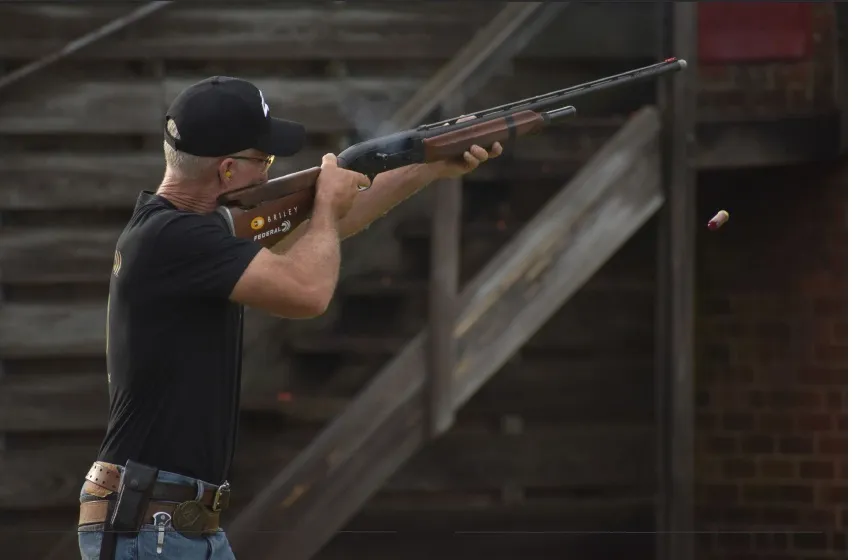
The yips

When I used to shoot competitively a lot of the shooters, including myself, had issues whereby we couldn't pull the trigger when on target - so not technically the yips as in a involuntary movement more like a freeze.

How did I get by it, a lot of practice and effectively clearing the mind when on target, an odd thing worth trying is visualization (sounds a bit "far out man / hippy nonsense" but it is a really effective technique if done correctly.

Questioning if the rifle is zeroed, I'd probably get someone to watch you on aim and taking shots - lots can be seen by others.

Matt
 
When I used to shoot competitively a lot of the shooters, including myself, had issues whereby we couldn't pull the trigger when on target - so not technically the yips as in a involuntary movement more like a freeze.

How did I get by it, a lot of practice and effectively clearing the mind when on target, an odd thing worth trying is visualization (sounds a bit "far out man / hippy nonsense" but it is a really effective technique if done correctly.

Questioning if the rifle is zeroed, I'd probably get someone to watch you on aim and taking shots - lots can be seen by others.

Matt
Practice and more expensive practice....
 
I used to shoot quite a bit of competitive shotgun, and then a few years later tried some competitive high power.

In both cases that you call “yips” exist. The most common reason for me seemed to be overthinking. Especially after an inexplicable miss, which made me analyze then over analyze until almost toxic. And in the opposite direction it seemed my best score were made almost on “autopilot”.
 
  • Like
Reactions: VSS
I used to shoot quite a bit of competitive shotgun, and then a few years later tried some competitive high power.

In both cases that you call “yips” exist. The most common reason for me seemed to be overthinking. Especially after an inexplicable miss, which made me analyze then over analyze until almost toxic. And in the opposite direction it seemed my best score were made almost on “autopilot”.
I found with target shooting I was fine once I'd missed my first target, could clear the rest but the build up of tension was crazy....eventually I just never looked at a scorecard, taught myself to ignore what was going on and just go through the otion, trust in the process of everything you've learnt to be taking the shot in the first place - nerves dissappeared, I cleared a few courses.
 
Yips are involuntary movements affecting motor skills which impact your ability to perform tasks that were previously possible without this involuntary intervention of undesirable movements.

If you are not scared of recoil, it is likely the brain attaching too much significance to result. Take shots with incredibly loose grip on the rifle and work on doing whatever it takes not to flinch. The rifle cannot hurt you. The brain will learn these things and it will become easier to do it on autopilot once
I was taught to putt with the big shoulder/ back muscles to minimise the twitch. So your explanation makes sense.
Put - to place something where you want it
Putt - a hopeless attempt to do the same thing in golf
 
I was taught to putt with the big shoulder/ back muscles to minimise the twitch. So your explanation makes sense.
Put - to place something where you want it
Putt - a hopeless attempt to do the same thing in golf
Massively familiar with this.
 
There is a device known as a release trigger, something I’ve never personally encountered but which was covered during my CPSA safety officer course. Unlike a conventional trigger, it fires the gun when you release the trigger rather than when you pull it. It’s used by shooters who develop a flinch—what we used to call “trigger finger”—where you intend to pull the trigger but your finger simply won’t cooperate. Most people who have shot a reasonable amount of clays have probably experienced this occasionally, but for some shooters it becomes a significant handicap. In those cases, a release trigger can sometimes be an effective solution.

Guns with release triggers, in competition, must have prominent warning labels on them.

 
There is a device known as a release trigger, something I’ve never personally encountered but which was covered during my CPSA safety officer course. Unlike a conventional trigger, it fires the gun when you release the trigger rather than when you pull it. It’s used by shooters who develop a flinch—what we used to call “trigger finger”—where you intend to pull the trigger but your finger simply won’t cooperate. Most people who have shot a reasonable amount of clays have probably experienced this occasionally, but for some shooters it becomes a significant handicap. In those cases, a release trigger can sometimes be an effective solution.

Guns with release triggers, in competition, must have prominent warning labels on them.

That Sounds bloody terrifying

- like in the movies when the guy has a foot on the landmine
 
Yes I have noticed all sorts of trigger related twitches, jitters and yips etc. crept into my shooting after a long layoff for lockdown. Once that mental door has been opened its impossible to go back to the blissful previous state of pulling the trigger like an unthinking robot which is how it should be. You get all lined up then out of nowhere tension spikes and you snatch the shot. But you can mitigate it firstly by putting the safety catch on and doing a few dummy trigger pulls, then taking off the safety catch and consciously making sure the crosshair is totally still on target before starting to squeeze the trigger and consciously not jiggling the rifle while pulling the trigger. Then keeping the trigger pressed and keeping one's eye on the scope for a count of three after the shot has fired.
 
There is a device known as a release trigger, something I’ve never personally encountered but which was covered during my CPSA safety officer course. Unlike a conventional trigger, it fires the gun when you release the trigger rather than when you pull it. It’s used by shooters who develop a flinch—what we used to call “trigger finger”—where you intend to pull the trigger but your finger simply won’t cooperate. Most people who have shot a reasonable amount of clays have probably experienced this occasionally, but for some shooters it becomes a significant handicap. In those cases, a release trigger can sometimes be an effective solution.

Guns with release triggers, in competition, must have prominent warning labels on them.

Release triggers are mostly on single shot high end trap guns (Perazzis and such). They do work well especially on those 200 target competitions

There is also a similar release for archery that relies on releasing back tension rather than triggering it. I hate those, but then my archery is mostly hunting, and I get very bored looking at bright colored circular mats with rings
 
Yips are involuntary movements affecting motor skills which impact your ability to perform tasks that were previously possible without this involuntary intervention of undesirable movements.

I have seen it with others in golf and have experienced it myself with chipping in golf. I play to a high level, yet it can develop seemingly from nowhere when you previously enjoyed entirely good form.

It is very well known in golf and has affected some of the best players in the world, so it is nothing to do with a lack of ability. It is, i believe, to do with the brain becoming sub consciously involved in a movement due to an unseen fear or anxiety attached to the movement. Most likely from recent fear or failure when making the movement. So with golf, it tends to happen with slow movements like putting or chipping rather than fast and explosive movements like driving or iron play. Slowing down to achieve some type of tempo once more can help but basically I believe it is reps and removing the sub conscious doubt by realising good results again, which allows the brain to let go of this attachment to previous failure. Symptoms I felt included things like tension in muscles, hands and shoulders when addressing a chip when it is desirable to be very loose and have a very loose grip on the club. When making changes in golf, I work on the basis of going as much to the extreme as possible. So I started to practice without my thumbs on the grip to promote a very loose attachment to the club. This resulted in less tension and therefore less involuntary jabs at the ball. I also removed the outcome from the practice. So I wasn't chipping towards a target or a flag. I chipping in to a net or hung blanket at home. The ball was only travelling a yard before it hit the net. So everything was simply targeted on club and ball and a lack of tension and it was impossible for me to attach failure to the end result as there wasn't an end result. I was breaking down the task in to smaller chunks and working from there.

For shooting, are you finding you are snatching whilst also feeling very tight? The rifle needs controlling somewhat but you don't want to be hanging on to it.

If you are not scared of recoil, it is likely the brain attaching too much significance to result. Take shots with incredibly loose grip on the rifle and work on doing whatever it takes not to flinch. The rifle cannot hurt you. The brain will learn these things and it will become easier to do it on autopilot once more.

The brain is a funny thing. Yips are no joke in golf. I saw it destroy the putting of someone I knew who was a very a good player a few years ago. They gave up the game despite being a plus index player. They went from shooting mid-high 60's to literally not being able to keep it under 80 due to what i can only describe as carnage on the greens. It was brutal to watch.
Interesting read, well written. I'm not suggesting your golfer or anyone here has, but with some close experience of this, a significant, even some small change in performance can be an early indicator of something serious on the neural degenerative front, my friend who lost her "eye" a bit riding and whose general spatial awareness got a bit crap got diagnosed with Parkinson's 3 years later.
 
Release triggers are mostly on single shot high end trap guns (Perazzis and such). They do work well especially on those 200 target competitions

There is also a similar release for archery that relies on releasing back tension rather than triggering it. I hate those, but then my archery is mostly hunting, and I get very bored looking at bright colored circular mats with rings
Now archery is a whole extra level when it comes to yippage.

I shoot barebow recurve, which seems somewhat less prone to it, probably because it’s so much more instinctive. But the majority of my club shoot compounds with various types of sighting. They constantly battle with mental blocks.
 
Back
Top