
You are using an out of date browser. It may not display this or other websites correctly.
You should upgrade or use an alternative browser.
You should upgrade or use an alternative browser.
Solar powerpack for camping etc
- Thread starter VSS
- Start date

I was referring to to gbr66.I won't be running cooking appliances, hot water, fridge or TV.
All I need to be able to do is the following:
- Recharge hand-held electrical equipment used for data capture.
- Power a laptop (may not be essential).
- Recharge mobile phone.
- Lighting.
- Power a 12-volt coolbox.
I bought a small power bank for recharging phones, thermal etc
Dont think it would be big enough to do a fridge. But battery tech has come on a long way with some tiny battery units capable of big things.

Flexible Solar Panels | www.batteriesandsolar.co.uk
 www.batteriesandsolar.co.uk
Yes agreed. Are you looking for solar on the roof or parcel shelf/dashboard for a few hours?I doubt that would work for 5 weeks of use, hence why I'm looking at solar options.
Yes, I know, its on the shopping list! I like the other nocco chargers.Things moved on from those big bricks
They can fit in your hand now

Can put it anywhere really. On the ground if necessary. Or on roof of livestock trailer. Or pickup cab roof (if there's room in front of roof tent).Yes agreed. Are you looking for solar on the roof or parcel shelf/dashboard for a few hours?
I just ask because you can get pretty solid permanently attached ones that use roof rack fixings and a security key. These have the advanced that you can charge while driving, don't have much setup faff and are harder to steal.Can put it anywhere really. On the ground if necessary. Or on roof of livestock trailer. Or pickup cab roof (if there's room in front of roof tent).

Now, you have me thinking, one of these power banks to charge up the batteries for my electric chainsaw when doing light work in the woods rather than the 20in petrol saw, might be a good idea.


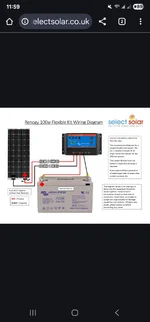
Here's a simple system Tim ,a good panel ,standard controller and Lipo battery.
Your phone etc plug in the controller and the battery covers lack of sunlight.
You being in Wales and all
I won't be using it in Wales.

yetidude69
Well-Known Member
The Ecoflow stuff is good, ive a few of their items for when away camping.
I use their 400w folding panel for charging the delta 3 Pro and the fridge/freezer by them, they've all been very reliable and work very well in the UK, the nice thing is they are all portable so can be used anywhere and in multiple vehicles.
I use their 400w folding panel for charging the delta 3 Pro and the fridge/freezer by them, they've all been very reliable and work very well in the UK, the nice thing is they are all portable so can be used anywhere and in multiple vehicles.

I've been shouting at the Op all afternoon as his post made me dig out my panel, only to find the casing had turned into a sticky mess! It took me some two-hours with white spirit and elbow grease to cut back the rubber & plastic to a hard surface:

K
It took me some two-hours with white spirit and elbow grease to cut back the rubber & plastic to a hard surface:K
yetidude69
Well-Known Member
I had the very same issue when I had the solar gorilla stuff, works well for charging a phone/tablet or smart watch etc, but not got the output for much more.I've been shouting at the Op all afternoon as his post made me dig out my panel, only to find the casing had turned into a sticky mess!
View attachment 466732
K
Mountain Bug
Well-Known Member
I would agree with @muddy42. I have a jump box that has an inverter for 120v and usb outlet plus a small compressor and a work light. It charges by wall outlet but I can also charge by hooking its cables to the battery of a vehicle or hooking the gator clips from a cheap solar panel (harbor freight) to the cable clamps. Mine is old and bulky but still works. My next one will be the new, much smaller type.


Scott
Scott
Last edited:
Thread stealing, Ok, so I need a bit of help on working out power requirements.
2 x 5Ahr batteries 18v. My chainsaw. How big a station would be needed to charge the batteries, 5 times?
This is what I have worked out,
90 w/hrs per battery per charge? So 1,000 w/hrs min or 560 m/amps? Would that be about right?
2 x 5Ahr batteries 18v. My chainsaw. How big a station would be needed to charge the batteries, 5 times?
This is what I have worked out,
90 w/hrs per battery per charge? So 1,000 w/hrs min or 560 m/amps? Would that be about right?
No Bright sparkies able to confirm or deny my math?
I think for that purpose I'd be looking at an inverter on my truck to charge batteries.No Bright sparkies able to confirm or deny my math?
Thread stealing, Ok, so I need a bit of help on working out power requirements.
2 x 5Ahr batteries 18v. My chainsaw. How big a station would be needed to charge the batteries, 5 times?
This is what I have worked out,
90 w/hrs per battery per charge? So 1,000 w/hrs min or 560 m/amps? Would that be about right?
Im not a sparky, but I think you are mixing up battery output (volts and amps) rather than charger input (volts and amps) or what the charger draws from the wall when you plug it in. These aren't the same because of inefficiency/wastage/heat.
18v chargers draw anything from 1amp to 8amps for fast chargers. UK mains is 230 volts AC. Watts = amps x volts. The other thing you need to know is how many hours it takes to charge one battery. It might be easier to just buy more batteries.
No, I don’t think so. But I am also no sparky.
I use a cordless chainsaw. It uses 2 off 5amp hour batteries that run at 18 volts.
I want to buy a power station or bank, that I can plug my charger, when out in the woods, that will charge 2 batteries at least 5 times.
Someone who is into electrickery should be able to work out what I need, including losses.
A lot of the power stations give the output like, 572Wh.
That of course may not be the best way for me to ask the question or course.
I use a cordless chainsaw. It uses 2 off 5amp hour batteries that run at 18 volts.
I want to buy a power station or bank, that I can plug my charger, when out in the woods, that will charge 2 batteries at least 5 times.
Someone who is into electrickery should be able to work out what I need, including losses.
A lot of the power stations give the output like, 572Wh.
That of course may not be the best way for me to ask the question or course.
No, I don’t think so. But I am also no sparky.
I use a cordless chainsaw. It uses 2 off 5amp hour batteries that run at 18 volts.
I want to buy a power station or bank, that I can plug my charger, when out in the woods, that will charge 2 batteries at least 5 times.
Someone who is into electrickery should be able to work out what I need, including losses.
A lot of the power stations give the output like, 572Wh.
That of course may not be the best way for me to ask the question or course.
You are still quoting the output specs of the battery, rather than the charger's specs. In simple terms, this is wrong because it takes more units/volume of electricity to charge a battery than what it outputs to the chainsaw, because of inefficiency/heat. A battery that contains 3amp hours may require more than that at the wall to charge. Plus chargers transform volts and amps up or down.
What is the make and model number of the battery charger? It should say what amps is draws from the mains or google it. Mains voltage is 230v. then use your power (watts) = amps x volts. Then multiply that by how many hours it takes to charge a battery and you have watt hours.
To give you an example, my Makita LXT DC18RC charger draws just over 1A, and says it uses about 240 watts (makes sense as 240w=1a x 240v). It takes 30 mins to charge my batteries........ so I need 120 watt hours to charge one battery.
Generally the faster the charger the more heat and inefficiency, it hardly makes a difference on smaller slow chargers like mine,
Similar threads

- Replies
- 18
- Views
- 7K

