Any electricians??

gixer1

Well-Known Member
With recent events and in the interests of being prepared…I was thinking about having a swap over switch installed in the house where you can swap over from mains to a generator - these were pretty common in the US where I lived due to electrical storms where you could plug a generator into the inlet outside and run the main parts of the house.

It’s not as common here from what I have seen but would anyone know how much work this would entail and would a 2200w honda eu22i run a minimal house consumption ring??

(Obviously not the high output items like microwaves and tumble dryers etc?

Has anyone fitted a generator input to their house??

Regards,
Gixer
 
With recent events and in the interests of being prepared…I was thinking about having a swap over switch installed in the house where you can swap over from mains to a generator - these were pretty common in the US where I lived due to electrical storms where you could plug a generator into the inlet outside and run the main parts of the house.

It’s not as common here from what I have seen but would anyone know how much work this would entail and would a 2200w honda eu22i run a minimal house consumption ring??

(Obviously not the high output items like microwaves and tumble dryers etc?

Has anyone fitted a generator input to their house??

Regards,
Gixer
Now that in your neck of the woods is a bloody good idea!

Got a 150KVA gennie here going cheap 😂
 
I heard stories when I was an apprentice that farmers would make a lead with 2 plug tops, one at each end. The idea being, when the mains went out, they would fire up the genie, plug the lead into the genie, plug the other end into a socket inside the house and then they would take out the main fuse (I suspect they would also isolate the neutral somehow) The idea being that the power would still flow round the socket circuits, back to the mains board where it would then energise the other circuits such as lights etc to get the farmhouse back up and running.

Obviously, hooking up your house to a genie means you really do need to isolate the incoming mains. If you don't and the power comes back on, the AC from the mains will not be in sync with the mains from the Gennie and you'll have a catastrophic meltdown of fuses, mains boards and possibly trip the sub station. (I may be overdramatising it, I'm not sure what damage it could do but it will definitely not be fun!)
 
You wouldn't run much with a 2200 watt generator but if you have worked out your minimum requirements and think that is sufficient maybe give it a go. Obviously you have to completely isolate the incoming mains to avoid killing the poor guys trying to restore your power and I suspect it would be illegal to set it up without a qualified electrician. Unless you have neighbours with no generator how will you know when the power is back on?

Personally I would ask myself if the power went off for a week what would I need. For example I have 100 acre deer farm and we have only boreholes for water so if power is off neither we nor the deer have water. Ok so the water troughs in the fields would last the deer for a week easily in winter but not in summer. Initial start up current on borehole pumps is quite high, then you have freezers, fridge, washing machine, kettle, microwave and boiler. Plus lights computers phone etc.
We used to get a lot of power cuts here years ago so when I ran electricity out to my workshop. about 180 metres from the house, we put in a big 4 core cable and had a change over switch installed in the house. 18 months ago when all this C-sh-t kicked off I reckoned it was time to get sorted so kept an eye on eBay and ended up with a cheap diesel engined 18kva generator rated for continuous run, i.e 1500 rpm rather than 3,000rpm. Once a month we have generator day. Wife saves up all the washing etc and we run the generator for about 4 hours. Everything possible going; 2 washing machines, dishwasher, all the usual house stuff and does all the hoovering as well. It will run the compressor and the welder in the workshop too if need be.
It gives me great peace of mind to know we are independent. Obviously helps that we have red diesel on the farm and I am not likely to run out of that.

Just heard of somebody near Aberdeen that had to move out of her house as it was just too cold to stay there. I think you are sensible to consider the options.
 
With recent events and in the interests of being prepared…I was thinking about having a swap over switch installed in the house where you can swap over from mains to a generator - these were pretty common in the US where I lived due to electrical storms where you could plug a generator into the inlet outside and run the main parts of the house.

It’s not as common here from what I have seen but would anyone know how much work this would entail and would a 2200w honda eu22i run a minimal house consumption ring??

(Obviously not the high output items like microwaves and tumble dryers etc?

Has anyone fitted a generator input to their house??

Regards,
Gixer
I have. Fitted it a few years back due to the power going off frequently.
Its only been used about 4 times over the last 3 years due to Scottish Power now burying cables. The old overhead cables were always getting damaged by geese, trees and cattle rubbing themselves on the pole tension wires and the power would be off, sometimes for a day or two.
Anyway, it's been a great investment with everything in the house being able to operate. Obviously, you need to be sensible with regards to microwaves and electric over and such like.
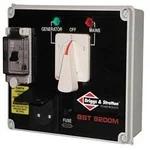
My generator is located behind my log shed and I have a round 3 pin socket mounted on the outside wall and I simply plug the genny into that and throw the switch over box onto "generator".
What I have noticed though is my new central heating boiler when powered from the generator, fails and throws up a fault code.
This is down to my generator producing what the engineer called "dirty power" and I require an invertor type to overcome the issue. For the times I have needed it, I'll stick with my old Honda and use the log burner for heat.Im sure mine is a 3200 output but I'd need to check.
My switch over box was sourced second hand and it was originally installed in a mobile phone relay location.
This photo is very similar in appearance to mine and took around 2 hours to install. The engineer fitting used his own cabling which was very thick and there was a good few running between the switch over box and my main distribution box. That was done as a favour to me and I bought the switch over box for around £75 second hand
 

Attachments

  • briggs-stratton-power-transfer-switch.webp
    briggs-stratton-power-transfer-switch.webp
    7.9 KB · Views: 32
Last edited:
I heard stories when I was an apprentice that farmers would make a lead with 2 plug tops, one at each end. The idea being, when the mains went out, they would fire up the genie, plug the lead into the genie, plug the other end into a socket inside the house and then they would take out the main fuse (I suspect they would also isolate the neutral somehow) The idea being that the power would still flow round the socket circuits, back to the mains board where it would then energise the other circuits such as lights etc to get the farmhouse back up and running.

Obviously, hooking up your house to a genie means you really do need to isolate the incoming mains. If you don't and the power comes back on, the AC from the mains will not be in sync with the mains from the Gennie and you'll have a catastrophic meltdown of fuses, mains boards and possibly trip the sub station. (I may be overdramatising it, I'm not sure what damage it could do but it will definitely not be fun!)
Leads like that will work…they will also cheerfully kill you! There’s no RCB on a generator
 
I have. Fitted it a few years back due to the power going off frequently.
Its only been used about 4 times over the last 3 years due to Scottish Power now burying cables. The old overhead cables were always getting damaged by geese, trees and cattle rubbing themselves on the pole tension wires and the power would be off, sometimes for a day or two.
Anyway, it's been a great investment with everything in the house being able to operate. Obviously, you need to be sensible with regards to microwaves and electric over and such like.
My generator is located behind my log shed and I have a round 3 pin socket mounted on the outside wall and I simply plug the genny into that and throw the switch over box onto "generator".
What I have noticed though is my new central heating boiler when powered from the generator, fails and throws up a fault code.
This is down to my generator producing what the engineer called "dirty power" and I require an invertor type to overcome the issue. For the times I have needed it, I'll stick with my old Honda and use the log burner for heat.Im sure mine is a 3200 output but I'd need to check.
My switch over box was sourced second hand and it was originally installed in a mobile phone relay location.
This photo is very similar in appearance to mine and took around 2 hours to install. The engineer fitting used his own cabling which was very thick and there was a good few running between the switch over box and my main distribution box. That was done as a favour to me and I bought the switch over box for around £75 second hand
Perfect Bob, just the info I was after! 👍🏻
 
You wouldn't run much with a 2200 watt generator but if you have worked out your minimum requirements and think that is sufficient maybe give it a go. Obviously you have to completely isolate the incoming mains to avoid killing the poor guys trying to restore your power and I suspect it would be illegal to set it up without a qualified electrician. Unless you have neighbours with no generator how will you know when the power is back on?

Personally I would ask myself if the power went off for a week what would I need. For example I have 100 acre deer farm and we have only boreholes for water so if power is off neither we nor the deer have water. Ok so the water troughs in the fields would last the deer for a week easily in winter but not in summer. Initial start up current on borehole pumps is quite high, then you have freezers, fridge, washing machine, kettle, microwave and boiler. Plus lights computers phone etc.
We used to get a lot of power cuts here years ago so when I ran electricity out to my workshop. about 180 metres from the house, we put in a big 4 core cable and had a change over switch installed in the house. 18 months ago when all this C-sh-t kicked off I reckoned it was time to get sorted so kept an eye on eBay and ended up with a cheap diesel engined 18kva generator rated for continuous run, i.e 1500 rpm rather than 3,000rpm. Once a month we have generator day. Wife saves up all the washing etc and we run the generator for about 4 hours. Everything possible going; 2 washing machines, dishwasher, all the usual house stuff and does all the hoovering as well. It will run the compressor and the welder in the workshop too if need be.
It gives me great peace of mind to know we are independent. Obviously helps that we have red diesel on the farm and I am not likely to run out of that.

Just heard of somebody near Aberdeen that had to move out of her house as it was just too cold to stay there. I think you are sensible to consider the options.
Great advice on here, we also have a submersible water pump, our Honda genny wouldn't cope with the startup. My father used to have an old lister petrol engine that ran the pump on the well head via a flat belt, you need a good powerful genie for the compressor too, the other problem is battery chargers & digital stuff, they don't like dc power, you need an inverter. Your little Massey will provide tons of power if it has a pto shaft, & pto generators are much cheaper Always good to have a back up.
 
Great advice on here, we also have a submersible water pump, our Honda genny wouldn't cope with the startup. My father used to have an old lister petrol engine that ran the pump on the well head via a flat belt, you need a good powerful genie for the compressor too, the other problem is battery chargers & digital stuff, they don't like dc power, you need an inverter. Your little Massey will provide tons of power if it has a pto shaft, & pto generators are much cheaper Always good to have a back up.

No plans to run any non essentials FG- it would be when power is out and we are on mains water here (I know you wouldn’t think it!!) we used to be on a well but now no problems there so it would just be the main house items.
 
Great advice on here, we also have a submersible water pump, our Honda genny wouldn't cope with the startup. My father used to have an old lister petrol engine that ran the pump on the well head via a flat belt, you need a good powerful genie for the compressor too, the other problem is battery chargers & digital stuff, they don't like dc power, you need an inverter. Your little Massey will provide tons of power if it has a pto shaft, & pto generators are much cheaper Always good to have a back up.
why would a gennie be dc?

i would have thought you need an earth spike not rely on the incoming neutral.

also are you allowed to burn red deisel domestic elec?
 
I heard stories when I was an apprentice that farmers would make a lead with 2 plug tops, one at each end. The idea being, when the mains went out, they would fire up the genie, plug the lead into the genie, plug the other end into a socket inside the house and then they would take out the main fuse (I suspect they would also isolate the neutral somehow) The idea being that the power would still flow round the socket circuits, back to the mains board where it would then energise the other circuits such as lights etc to get the farmhouse back up and running.

Obviously, hooking up your house to a genie means you really do need to isolate the incoming mains. If you don't and the power comes back on, the AC from the mains will not be in sync with the mains from the Gennie and you'll have a catastrophic meltdown of fuses, mains boards and possibly trip the sub station. (I may be overdramatising it, I'm not sure what damage it could do but it will definitely not be fun!)
I have done this for years. My old briges and Stratton I had when I was on the tools which is a constant 2kw with a surge of 2.2kw has kept the lights going etc many times.
I have the lead with two plugs fitted so feed into the ring this way.
Knock off the double pole isolator on the main incoming consumer unit, turn off any large appliances
I boil the kettle with nothing else connected.
Put the large chest freezers on once a day then keep them closed.
I use my microwave if necessary or a ring on the cooker, it's all about knowing the wattage rating of what you want to use.
When the genny is running it runs the heating pump and oil boiler so heating the complete house. I have a wood burner going aswell.
I did this for three days a few years back and didn't lose the contents of my fridge or freezers.
Hope this helps
NH
 
I heard stories when I was an apprentice that farmers would make a lead with 2 plug tops, one at each end. The idea being, when the mains went out, they would fire up the genie, plug the lead into the genie, plug the other end into a socket inside the house and then they would take out the main fuse (I suspect they would also isolate the neutral somehow) The idea being that the power would still flow round the socket circuits, back to the mains board where it would then energise the other circuits such as lights etc to get the farmhouse back up and running.

Obviously, hooking up your house to a genie means you really do need to isolate the incoming mains. If you don't and the power comes back on, the AC from the mains will not be in sync with the mains from the Gennie and you'll have a catastrophic meltdown of fuses, mains boards and possibly trip the sub station. (I may be overdramatising it, I'm not sure what damage it could do but it will definitely not be fun!)
Exactly how we used to do it. Not recommended though, for a number of very sensible reasons.
 
What you are looking for is a changeover switch. There are manual versions (as described) and automatic versions which will switch to mains power whenever it's available. Both need to be connected to the meter tails between your electricity meter and consumer unit. This is sometimes difficult to do- the tails are thick and stiff and space can be at a premium around the meter.

It is definitely worth a chat with an electrician with eyes on the job about earthing arrangements to make sure that all remains safe.

I, too, would be very nervous of the two-plugs type of solution!
 
No plans to run any non essentials FG- it would be when power is out and we are on mains water here (I know you wouldn’t think it!!) we used to be on a well but now no problems there so it would just be the main house items.
You would be surprised at what a small Honda would run, it would struggle with washing machines etc, but fridges lights stereo etc no problem. We ran marquees here with sound systems freezers lighting drink bars on 2 Hondas.
 
Back
Top