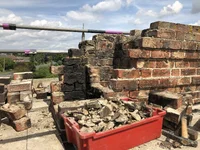
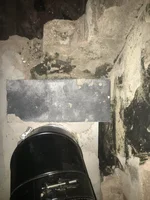
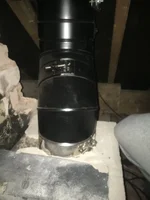
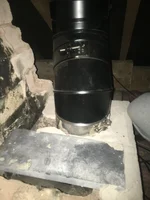
The flexi liner should have been lagged with an insulation jacket. If it hasn't been it should not have passed HETAS regs.
They are insulated to prevent precisely the problem you appear to have of an extremely hot liner melting (or worse, igniting) old tar deposits in the brick flue.
An open unlined flue can be swept and cleaned, and if the worst happens and there is a chimney fire, it is accessible for the fire to be extinguished.
When a liner is fitted and the brick flue is sealed with a register plate in the fireplace and a capping plate at the top, there is no way to access the flue void, so a fire within the void could be catastrophic. Therefore it is imperative that it doesn't become overheated, hence insulation lagging. It is normal practice also to vent the flue void with a vent in the register plate in the fire place and a vent brick at the top of the stack outside above the roof, so any fumes within the void can be vented to the atmosphere (as a bricklayer I usually put vent bricks under the bottom course of corbel bricks on the stack cap just below the pots, where they won't be conspicuous and will have some protection from driving rain). This void venting prevents a build up of toxic fumes within the void which could leak into the living quarters if the mortar joints are old and loose. It helps keep the void cool and allows condensation to be vented, avoiding damp stains forming on the chimney breast from chimney sweat.
Liner insulation should also go right to the top of the stack and even to the top of the chimney pot. If it stops short in the stack, or the loft space if it's a cold roof construction, or the pot is uninsulated, that section of uninsulated liner can chill quickly in very cold weather which causes tars and creosote to solidify, building up layer on layer of rock hard resin, constricting the bore of the liner like a furred artery. I've seen 6" liners that have become so choked due to chilling that at the top of the stack the bore was barely 3" wide and the sweep couldn't get his brush up.
Personally, I don't like the sound of a live lined flue being capped off in the loft and twin wall joined to flexi within the roof space. Never heard of such a thing before and it just sounds like a bodge. In my view the chimney breast should have been rebuilt right up through the loft and out of the roof.
My advice would be to get Building Control to inspect the work. If they condemn it the contractor will have to put it right and if it doesn't comply with regulations he will lose his HETAS accreditation.
It doesn't sound right at all. Get it checked out.
They are insulated to prevent precisely the problem you appear to have of an extremely hot liner melting (or worse, igniting) old tar deposits in the brick flue.
An open unlined flue can be swept and cleaned, and if the worst happens and there is a chimney fire, it is accessible for the fire to be extinguished.
When a liner is fitted and the brick flue is sealed with a register plate in the fireplace and a capping plate at the top, there is no way to access the flue void, so a fire within the void could be catastrophic. Therefore it is imperative that it doesn't become overheated, hence insulation lagging. It is normal practice also to vent the flue void with a vent in the register plate in the fire place and a vent brick at the top of the stack outside above the roof, so any fumes within the void can be vented to the atmosphere (as a bricklayer I usually put vent bricks under the bottom course of corbel bricks on the stack cap just below the pots, where they won't be conspicuous and will have some protection from driving rain). This void venting prevents a build up of toxic fumes within the void which could leak into the living quarters if the mortar joints are old and loose. It helps keep the void cool and allows condensation to be vented, avoiding damp stains forming on the chimney breast from chimney sweat.
Liner insulation should also go right to the top of the stack and even to the top of the chimney pot. If it stops short in the stack, or the loft space if it's a cold roof construction, or the pot is uninsulated, that section of uninsulated liner can chill quickly in very cold weather which causes tars and creosote to solidify, building up layer on layer of rock hard resin, constricting the bore of the liner like a furred artery. I've seen 6" liners that have become so choked due to chilling that at the top of the stack the bore was barely 3" wide and the sweep couldn't get his brush up.
Personally, I don't like the sound of a live lined flue being capped off in the loft and twin wall joined to flexi within the roof space. Never heard of such a thing before and it just sounds like a bodge. In my view the chimney breast should have been rebuilt right up through the loft and out of the roof.
My advice would be to get Building Control to inspect the work. If they condemn it the contractor will have to put it right and if it doesn't comply with regulations he will lose his HETAS accreditation.
It doesn't sound right at all. Get it checked out.
Last edited: