Brass cleaning ... what am I doing wrong

Thank you, I did read of some people putting them in at 250 and then being fine.
I've been in your position trying to find out if I'd overheated my brass. The consensus seemed to be that a normal oven won't get them hot enough - confirmed by cartridge brass heat/strength graphs online. If you're still unsure, just load a couple with starting (minimum) loads to fire and observe before you carry on shooting your normal loads.
 
Brass will not go brittle with heating, the only way you can make it brittle is by shooting it brass work hardens hence split necks. To fully anneal it you need to get it 900 C your average oven gets nowhere near that.
Your cases will be fine
 
Maybe you are over cooking the cases.
Rinse in hand cool tap water & cook in the oven at 130 degrees for twenty minutes works for me after steel pin tumbling with citric acid & ecover detergent.
Nice shiny cases!!!
Ian
Oven WAAAY too hot!!! about an hour @ 55/60 degrees is more than enough, little bit of shaking them around at intervals.
 
Nothing wrong with drying your cases in the oven @Dazza9t9 , just turn down the temperature a whole lot so the cases don't get that blue colour - just the heat that does that. 180 Deg C isn't hot enough to damage the cases so they're fine to use. I've done it once before where I forgot that the cases were in the oven.

You may want to rescue the previous cases that you binned too. Cases that are slightly too short shouldn't be a problem, especially if you're not crimping.
As above, I leave my cases in the sonic cleaner for an hour and then rinse, in a just warm oven for 20 mins on a tray (your just trying to get rid of the water) and mine always look like yours when they come out.
bryn
 
Oven WAAAY too hot!!! about an hour @ 55/60 degrees is more than enough, little bit of shaking them around at intervals.
You might be right Finnbear, I stated what has worked for me with my oven. I wanted to ensure the cases went above boiling to drive out any water.-- I absolutely don't need wet powder! However it may be worth me trying it set a bit cooler to see if I get even shinier cases than I do now. - I will keep going above 100 deg.
Ian
 
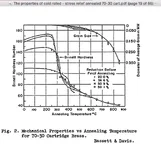
Copper Development association 70:30 Cartridge brass.jpgProperties vs annealing temperatures.jpg

400˚ C is the optimum to ensure thorough stress relief annealing whilst keeping the brass below recrystallisation temperature.

180˚C in itself is not a problem, just unnecessary. But it depends on how your oven controls work...If it blasts at full power until the whole oven is up to 180˚C areas of it may go way over.

Please take the same amount of time that I took on your behalf to answer the questions I asked in my earlier post. The devil is in the detail.

However, given the uneven distribution of the discolouration on both thick and thin parts of the brass it looks like uneven rinsing rather than uneven temperature within the oven.

It is very unlikely in an oven to get hot spots which are so precise that they are able to affect one end of a case and not the other...especially the thick end.

Were the cases spread evenly on the base of the tray, or were they higgledy piggledy and were the discoloured parts sticking up?

To get such a variation of colour across the cases would appear to be caused by poor rinsing rather than some bits becoming much hotter than others...

You will have noticed when you took the tray out that one whole area of the brass was discoloured and you have since muddled them up...ie all the bits at the back were tarnished or all the bits sticking up like the potato whirls on a Cottage pie...

Alan
 
Last edited:
Just keep it simple. Put your brass in a tumbler with either treated walnut or corn cob!
Result, nice clean shiny brass and so simple to do.
 
I gotta admit when it comes to cleaning I just stick them in the tumbler with steel pins and some dish soap - run for an hour, take them out, rinse and then dry in the oven at 50 degrees. They come out shiny as anything.
 
Other than using black powder I never cleaned a case in my life that used smokeless.

There is a chap (retired Judge) in my black powder club uses a 45/110. I had to have a double-take at his brass - it is jet black and I actually thought he had painted them.
He cleans the inside of them all right but never the outside.
He manages to quite happily, lob those big lead bullets into the ring at 1000 yards.
 
Thank you all for your input. It is very much appreciated.

I am pretty sure it comes across, but I am a beginner. I’m yet to load my first round. I’m trying to get the basics right and take my time.

I have done plenty of reading, however that brings its own downfalls due to there being many many different processes and opinions.

I do not have a tumbler, I have a very good medical grade U/S which my wife got me. She works in the dental industry. Maybe in the future I will look at a tumbler

I do not care for shiny bright brass. If I can get it then great. However clean and safe are what matters to me.

the oven I used was a range master, I allowed the oven to get up to 180 and let it settle before spreading the cases evenly on the tray, I allowed them 20 mins in oven before turning the oven off and allowing to cool

the bluing does easily rub off, the cases to look clean and no signs of cracking.

i am just trying to find what works, and what process to follow to achieve the desired results. I am thankful for everyone’s input, however there is always conflicting information. Even in this thread “they are safe to use” and “they are unsafe to use”

i inspect the cases again today once I get home from work.

again thank you and I will revise going forward
 
Thank you all for your input. It is very much appreciated.

I am pretty sure it comes across, but I am a beginner. I’m yet to load my first round. I’m trying to get the basics right and take my time.

I have done plenty of reading, however that brings its own downfalls due to there being many many different processes and opinions.

I do not have a tumbler, I have a very good medical grade U/S which my wife got me. She works in the dental industry. Maybe in the future I will look at a tumbler

I do not care for shiny bright brass. If I can get it then great. However clean and safe are what matters to me.

the oven I used was a range master, I allowed the oven to get up to 180 and let it settle before spreading the cases evenly on the tray, I allowed them 20 mins in oven before turning the oven off and allowing to cool

the bluing does easily rub off, the cases to look clean and no signs of cracking.

i am just trying to find what works, and what process to follow to achieve the desired results. I am thankful for everyone’s input, however there is always conflicting information. Even in this thread “they are safe to use” and “they are unsafe to use”

i inspect the cases again today once I get home from work.

again thank you and I will revise going forward

You are doing the right thing by asking and hopefully you can see from this thread that the overwhelming majority of people are saying your brass is ok which is correct.

Not asking questions would be stupid. Reloading is one of those things that seems daunting but as soon as you have gone through the entire process a few times and made your finished article go bang with the bullets going somewhere close to where they should, you will smile and realise it was all a fuss over nothing. Until then, keep asking questions if it helps.
 
I have never tumbled or cleaned brass in any way apart from a rub with oooo wire wool around the neck and shoulder of the case. Just make sure that your cases don't have any dirt or grit on them before you resize and you'll be fine.
 
Thank you all for your input. It is very much appreciated.

I am pretty sure it comes across, but I am a beginner. I’m yet to load my first round. I’m trying to get the basics right and take my time.


Don't overthink things, you'll only end up second-guessing yourself and tying yourself up in knots. To damage brass you need to be heating it way, way beyond where a domestic oven can take it, and then for an extended period of time. The bluing is almost certainly a chemical reaction of the cleaning fluid due to it not being rinsed away thoroughly (and again, it won't cause you any issues).

If you're thinking about a tumbler, this one is a beauty, and it works brilliantly for smaller quantities (think it takes about 30 .270, and 50 or so .223?) I have one myself, and can vouch for it :thumb:


And yes, you're doing the right thing by asking. nobody will give you a hard time for that :)
 
after the oven
I am not overly concerned on appearing as long as they are safe to use.
but if there are any pointers

They look fine, IMO, and they're not looking annealed as they'd be a much deeper colour.
I've slightly overwarmed mine and they've looked like that. I did tumble them for a bit afterwards.

I now turn the over on and run up to about 120-140 Celcius and then stick the damp cases in after doing a "SeaGreen2" and a wash in tap (acidic) water.
However, after about five minutes I turn the heat down to 80 Celcius and leave them for a while.

I tend to be loosing cases from "old age" despite of regular annealing.
 
snip...
the oven I used was a range master, I allowed the oven to get up to 180 and let it settle before spreading the cases evenly on the tray, snip...
snip...

The fact that they were spread evenly in a preheated oven would indicate/confirm my theory that it was something other than hot spots which caused the thicker metal of the head to discolour on some of them.

As a blacksmith I have spent my life forging lumps of metal from thick bar to thinner cross section and reheating it in a furnace...it is always the thin tips that get hot first. If the partial discolouration was caused purely by heat, it would be on all of the necks and none of the heads.

I have a wonderful book by Richard Hughes and Michael Rowe called the Colouring Bronzing and Patination of Metals which cost me an arm and a leg back in the 1980s. It has thousands of recipes to achieve different colours, mostly with chemicals which combine with and colour the oxides of the metal. A few are accelerated with mild heat...every one of them depends on scrupulous cleaning of the surface in order to achieve an even coluration...

I don't know what is in SeaClean 2, or your water supply, or how thoroughly you rinsed the cases, but it would be easy enough to replicate by warming up a case that had been part dipped in Sea Clean and see what the difference was...

snip...
the bluing does easily rub off, the cases to look clean and no signs of cracking.
snip...

In Brass and most other Copper based alloys, cracking is caused by stress and work hardening. Heating has the opposite effect of making non-ferrous metals softer and less brittle.

Alan
 
Last edited:
Cheers for posting the chart, I've been hoping to see one here one day.

If you are a glutton for punishment there is a happy few hours reading of a couple of interesting discussions...


Alan
 
Thank you I will have a read though all that info.

I’ve got in from work and checked over the brass. It is heavily tarnished, and it won’t rub off. However it looks nice and clean and feels solid.

i have checked my U/S and it’s a 150watt, that shouldn’t case any issues.

I will try collect some “scrap” brass and do some more testing and see what other outcomes I get. I’ll attached a picture of one of the more coloured cases.
 
Back
Top