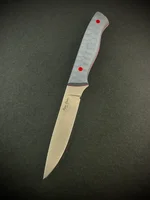
The model shown here is a the Secare in Swedish Elmax Powder steel, details as below.
Developed by Uddeholm of Sweden it’s a high-chromium powder-metallurgy stainless steel alloyed with carbon, vanadium, and molybdenum, a mix that gives it excellent wear resistance, strong corrosion resistance, and impressive toughness. What really sets Elmax apart is how it’s made: instead of being poured as a molten ingot like traditional cast steels, the steel is atomized into microscopic powder, then compacted and sintered under heat and compressed under many tonnes in a pressure in a vessel, the steel molecules literally weld together! This powder-metallurgy process creates an incredibly uniform structure with very fine, evenly distributed carbides, eliminating the weak spots and large carbide imperfections of many common steels at a microscopic level. With cryogenic treatment this means an exceptionally strong three-dimensional edge, this in turn means strength behind the cutting edge. Stability of this level this can only be achieved with a powder steel!
This makes for a clean, consistent microstructure, which as a knife maker I am able to grind to .35mm with ease before even sharpening, that process alone is another four stages of grits and compounds. The final edge is accurate to .2 degrees of angle! Elmax is widely used outside of knives in demanding industries such as precision tooling and high-wear industrial components, such as the North Sea oil industry where standard steel wouldn’t cut it! Elmax takes a surgically sharp edge, holds it longer and has superior corrosion resistance making is excellent for deer work. Hence this isn't a cheap steel
Used by the Navy Seal teams as their go to knife steel and brands like Fällkniven and Bark River have all used it extensively, valuing its reliability, edge performance, and all-around versatility.
Easily stropped back to a razor-sharp edge, I also sell strops impregnated with diamond here For Sale: - MORE STROPS MADE I highly recommend these strops as stropping really is the secret to maintaining an edge.
Due to it already being ground to a thin edge Elmax is easily sharpened with a diamond or ceramic system, I highly recommend the Work Sharp Precision Adjusts models sold by Monarch here on SD.
If you need more advice from a knife manufacture open this link. Artisan Revere Invests 30x More In Elmax Steel
Knife Details
Secare Elmax @62 HRC
Length 219mm
Cutting edge 103mm
Ground to full flat with a hand sanded satin finish
A secondary edge of 18 degrees, accurate to .2 degrees and razor sharp!
Handle is layered orange and black G10
8 x G10 pins
This knife has no sheath at present but the buyer has a choice of sheath which will be a fully wet formed sheath by Gaz Kendall, wet forming it critical to a leather sheath as wet forming ensure the sheath is pre-shrunk to the knife in question, the knife locks into the sheath with a click, non wet formed sheath will stretch over time and the risk of losing a knife isn't worth it.
Price £399 inc secure over 18s postage. ID required.
Developed by Uddeholm of Sweden it’s a high-chromium powder-metallurgy stainless steel alloyed with carbon, vanadium, and molybdenum, a mix that gives it excellent wear resistance, strong corrosion resistance, and impressive toughness. What really sets Elmax apart is how it’s made: instead of being poured as a molten ingot like traditional cast steels, the steel is atomized into microscopic powder, then compacted and sintered under heat and compressed under many tonnes in a pressure in a vessel, the steel molecules literally weld together! This powder-metallurgy process creates an incredibly uniform structure with very fine, evenly distributed carbides, eliminating the weak spots and large carbide imperfections of many common steels at a microscopic level. With cryogenic treatment this means an exceptionally strong three-dimensional edge, this in turn means strength behind the cutting edge. Stability of this level this can only be achieved with a powder steel!
This makes for a clean, consistent microstructure, which as a knife maker I am able to grind to .35mm with ease before even sharpening, that process alone is another four stages of grits and compounds. The final edge is accurate to .2 degrees of angle! Elmax is widely used outside of knives in demanding industries such as precision tooling and high-wear industrial components, such as the North Sea oil industry where standard steel wouldn’t cut it! Elmax takes a surgically sharp edge, holds it longer and has superior corrosion resistance making is excellent for deer work. Hence this isn't a cheap steel
Used by the Navy Seal teams as their go to knife steel and brands like Fällkniven and Bark River have all used it extensively, valuing its reliability, edge performance, and all-around versatility.
Easily stropped back to a razor-sharp edge, I also sell strops impregnated with diamond here For Sale: - MORE STROPS MADE I highly recommend these strops as stropping really is the secret to maintaining an edge.
Due to it already being ground to a thin edge Elmax is easily sharpened with a diamond or ceramic system, I highly recommend the Work Sharp Precision Adjusts models sold by Monarch here on SD.
If you need more advice from a knife manufacture open this link. Artisan Revere Invests 30x More In Elmax Steel
Knife Details
Secare Elmax @62 HRC
Length 219mm
Cutting edge 103mm
Ground to full flat with a hand sanded satin finish
A secondary edge of 18 degrees, accurate to .2 degrees and razor sharp!
Handle is layered orange and black G10
8 x G10 pins
This knife has no sheath at present but the buyer has a choice of sheath which will be a fully wet formed sheath by Gaz Kendall, wet forming it critical to a leather sheath as wet forming ensure the sheath is pre-shrunk to the knife in question, the knife locks into the sheath with a click, non wet formed sheath will stretch over time and the risk of losing a knife isn't worth it.
Price £399 inc secure over 18s postage. ID required.
Attachments


Last edited: