

After having passed on what by all accounts looked like a "nice ibex", back at camp and slightly remorseful it was, but there already I realised sharing lodgings with an experienced hunter who had seen plenty of these animals was reassuring in that he totally agreed with my decision and suggested I don't be pushed on the very first day but instead pull the trigger only when I feel the moment is right. You will find locals often tend to push you to shoot at the first opportunity as this for them represents a successful pursuit and the chance to a healthy tip, but patience and a cold head are good hunting virtues. I felt fortunate to be with someone who had such an honest and generous outlook, and took it in his stride to share his views and give a few tips to a very green capra hunter as myself. Who knows what the experience could have been like had I been sharing camp with a slightly more competitive hunter who would've wanted me off the hill as soon as possible. Again, luck plays a central role in hunting, should we need any more examples! My friend had been shown a couple of billies only a few hundred meters from camp but, due to miscommunication/rush, had left his bipod at camp and couldn't make the shot happen soon enough before the billies disappeared. I was glad to have my bipod fixed at all times to by bino harness!
In any case, dinner was served and given the physical exertion of the last few days, I decided to skip on the now usual regime of nuts, bread and chai, and instead to tuck into one of my high-calorie freeze-dried meals to replenish batteries (the Garmin said I had come close to 4000 calories expended in the last 24hrs and advised rest of the next 72 which wasn't going to happen!!). After some pleasant campfire chit-chat on the merits of handloaded vs factory made ammo, and whether taking up the former is compatible with having a wife and two young kids (it isn't!), off to bed we went, eager to see what the following day had in store for us.
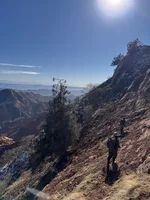
Day 3 at fly camp started with a very windy morning and it didn't take long to get us behind our scopes glassing the surrounding hills in search of a mature billy. As wind was coming in hard and fast, it became impossible to use our high mag spotting scopes for the air was charged with dust particles and everything became a blur. Whilst we could distinguish some ibex on the distant mountains, we weren't going to be able to judge them properly until we got a lot closer, and the decision was made to start walking on the ridge in search of a better spot and hopefully some stalking opportunities. So off we went (you may see my small silhouette with my guide against the vast open mountains on the picture below..) and after a couple of miles instead of descending towards the right and up again on the more mineral and higher mountain cliffs, we veered left back towards the clay-coloured hills in search of animals who, like us, would be looking for a less windy place to lay.
This ended up being a tranquil day without much action, apart from the odd huge wild boar sighting (more on this later!), and the only critter we could spot were females with their young.
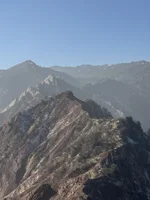
This gave way to Day 4 at fly camp. With a quick update for weather forecast on the Garmin inReach, it was clear a cold weather front was coming our way with expectation for 23 of snowfall. In other words, it was today, tomorrow, or never as once a snow dump occurs, there is no way we can walk anywhere and especially now climb down - meaning getting stuck in camp with rapidly dwindling reserves of food and water. Thankfully, my guide Saybali was quick to call me to the spotting scope he had commandeered earlier on in sign language that's unmistakable amongst hunters and heralds the sighting of something worth rushing for. What I saw revealed a sublime picture-perfect scene of an old mature ibex, bearded like a mujahideen (this is a muslim country after all..), resting on the very top peak of the very tallest mountain opposite our location, surveying its habitat from its regal height and its sweeping horns perfectly visible against the clear sky. That's it. He's the one!! My Dutch friend was right - you will know when you see him, and know I did.
Despite being around 10:00 already, this meant we realistically only had 7 hours of daylight ahead, and it would take us at least 5 hours to get there only to find that the billy may have eluded us! "Ah.. That's capra hunting dear boy! And you wont shoot anything if you stay here..." said the Dutchman, with a demonstrative smile that transmitted a longing for such challenging adventures he had spent happy decades pursuing in his younger years. So off we went, just enough time to get some much needed high-protein scoff from back home (likely we wont see any solids for the entire day...), fresh pair of dry merino socks, an insulating layer and raincoat in case of wind and snow, rifle/ammo (and bipod!), and off we went, on the double.
The hike was a tough one, but one animated by the prospect of getting closer to our quarry, and our energy was only doubled. By the first 2 hours, we had already lost 400m and then gained another 600m of elevation, on shale slopes that would probably better deserve to be called cliffs, for it was the point of your feet (supported by the guides walking stick...!) and also your hands that were needed to get up through the dense adler-like initial layer of dry vegetation and to get the better of the incline before reaching the burnt-grassy reaches. After 3hrs of nearly uninterrupted hiking, everyone needed a quick break and time to stuck in some energy bars and hydration, before getting right under the last rocky wall of the mountain were we had spotted the billy.
Another hour of steep incline later, there he is right under the ridgetop, looking at his kingdom, and offering us a view of his densely muscled body at 550m and a steep angle. Too far for a shot at this angle I tell the guides, plus there's a bit of lateral wind picking up. I'd be comfortable at 350m tops. Ok says the guide. In any case and right under our nose, our ibex decides to stretch his legs, stand up and starts climbing over the ridge and disappears into the ether...!! After all this!
Our local guide, of 61 years of age let's not forget, who had assisted in carrying my backpack all the way up (they almost force you to accept this... and so I had agreed only if I were to carry my own rifle), was probably at the end of his energy and said to my translator to wait here and see if the ibex was going to come back. No chance, said my translator, and in Russian he pushed the old but so experienced guide to accept to do one last push and climb the last rocky face to reach the very top of the mountain before it was too late. We thus left the backpack, grabbed the essentials (I now was always carrying a torch, emergency blanket and a cereal bar with me anyway) and started going up as fast as we could whilst trying to be as discreet as possible on the shale.. which isn't an easy feat.
Exhausted and panting, the 2200m altitude almost starting to thin the air enough that we start feeling it, the translator/guide peaks over, sees the ibex and encourages us to push one last time to get into position before its too late. The coveted ibex is there at 400m on a straight line and is about to go off to the other side and is already in the shadow!!! After a 5 hours hike, first descending 400m, then ascending another 800m, and about to do it all again in reverse to reach the fly camp, there is no way I'm giving this billy a second chance for lack of stamina. These thoughts in my head, and my ibex spirit animal taking over, it didn't take long to muster the last few steps needed to get into position on the ridge that overlooked yet another immense valley of infinite scale and beauty, and to ready the rifle, the sun in our eyes. Bipod out, rifle readied, chamber fed.
- Is that the one??
- Yes that's him. He's about to disappear, do you see him?
- Yes, I've got him. 370m on the rangefinder, that's 20 clicks on the turret at this elevation.
- The local says if he tumbles, we'll loose him in the ravine just under him - get ready to double your shot as soon as you let the first bullet fly - ok ?
- I'll try!! Safety off.
Now remember what the coach said: control the breathing, remember your hands positioning on the grip and trigger, set your bean bag under the stock, adjust parallax, both eyes open, a quick thought to Saint Hubert, breathe out and...... bang, let it fly. Que sera, sera (whatever will be, will be)!
What followed all happened in an adrenaline-fueled flash. The billy fell on the spot with a bullet straight to the heart and cries of joy erupted, Saybali's stern face lightened up for the first time since the start of the journey showing all his gold teeth, and we all hugged in a mix of exhilaration, sweat and incredulity. What a test this had been! For the first time, I got up and started to appreciate my surroundings, the immensity of nature that surrounded us, and the beauty of the red mountain we had started our pilgrimage from with those colossal snowy peaks of Afghanistan and of the Pamirs in the background.
As sunlight was quickly fading, we had better get to the ibex in earnest, and with no time to spare we quickly got closer, which meant having to hike around the mountain top for about 40 minutes, descending to our ibex's location and start the process of skinning and retrieving most of the meat we could get our hands hand before it was too late to get back to camp.
Arriving upon our felled quarry, I couldn't help but be humbled by the sight of this magnificent 40 inches animal of 13 years, and started getting those contradicting feeling of sadness for having caused the early death of a stunning monarch in its kingdom, yet appreciation for the chase it gave me and the superb conservation work the local organisation is doing here in protecting these areas from limitless poaching and human interference, in exchange for a dozen mature animals being taken each year to finance the latter.
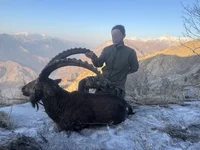
The 13 year old ibex and self, with the sunlit ridge over my left shoulder where we took the shot, and further back the red ridge where we came from that morning. Snowy peaks of the Pamirs in the distance after that.
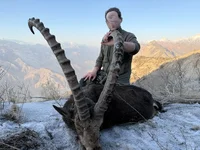
The ibex's crackled horns and scarred face, showing how hard he fought for its place on the mountain. Behind me the sheer cliff where he would have fallen had the shot not been so luckily fatal.
Whilst we now had to go back to camp with an even heavier load but oh so lighter feet and souls, we climbed up the ridge again and then back down the bottom of the valley first surrounded by the warmest of last lights and then under a starlit sky of crystal clarity. The way back to the valley floor and then all the way up again on the opposite mountain was a tough final challenge for the day, assisted by the presence of more local guides and a much welcomed donkey, but when results fill your every expectation, you surmount it with a relaxed disposition and an indelible smile.
A miraculous falling star, a 8 hours and 59 minutes hike of 11.89km and about 5500 calories after, we finally got to fly camp, welcomed by the entire team, my Dutch friend and a much needed fire and boiling chai. Whilst goat has never been number one on the list of gourmet dishes, I can tell you ours, deep fried in oil, tasted like a million dollars after what we had gone through (it was, let's face it, a very expensive steak in all the senses!).
I felt infinitely thankful for such a fulfilling and trying experience and, whilst this ibex is by no means as monstruous as those one may find here or in the other stans, I couldn't be anything but infinitely grateful to providence for the experience and the way everything had gone so far.
That evening went in a second and I woke up the mind still full of picture-perfect images, sore muscles and upon starting the 5 hours descent to base camp, pleased to finally hear the gunshot of my fellow camp-mate who also took his last ibex, just hours after I had taken mine.
What followed was a wonderful rest in base camp and three days stalking giant wild boar in a completely different setting, thankfully managing to bag a 23cm long tusker on the last day before a violent snow storm eventually forced us out of camp and into Dushanbe's exotic bazaar and pre-1991 sights, ahead of our return home, after ten spectacular days of complete disconnection.
In the words of Jens Knuder's in his article on Kazakhstan ibex: In the course of my stories in these pages, I always impose upon myself a duty of honesty. This journey was, in many respects, complex during the approach and acclimatisation phases, and demanding on our bodies, as the altitude and the sudden onset of cold were relentless with us. Venture into such expeditions while your health allows it! Set out, climb, approach these peaks. The hostile lands will always offer you a different perspective, an inner peace. Once you return to modernity, you will grasp its full significance.
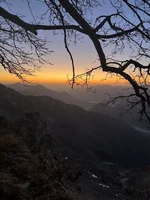
On our way back to camp, nature granting us the most stunning of spectacles.
Thank you for reading this so far and good luck in your future hunting endeavours. Get out there!
CoopT
In any case, dinner was served and given the physical exertion of the last few days, I decided to skip on the now usual regime of nuts, bread and chai, and instead to tuck into one of my high-calorie freeze-dried meals to replenish batteries (the Garmin said I had come close to 4000 calories expended in the last 24hrs and advised rest of the next 72 which wasn't going to happen!!). After some pleasant campfire chit-chat on the merits of handloaded vs factory made ammo, and whether taking up the former is compatible with having a wife and two young kids (it isn't!), off to bed we went, eager to see what the following day had in store for us.
Day 3 at fly camp started with a very windy morning and it didn't take long to get us behind our scopes glassing the surrounding hills in search of a mature billy. As wind was coming in hard and fast, it became impossible to use our high mag spotting scopes for the air was charged with dust particles and everything became a blur. Whilst we could distinguish some ibex on the distant mountains, we weren't going to be able to judge them properly until we got a lot closer, and the decision was made to start walking on the ridge in search of a better spot and hopefully some stalking opportunities. So off we went (you may see my small silhouette with my guide against the vast open mountains on the picture below..) and after a couple of miles instead of descending towards the right and up again on the more mineral and higher mountain cliffs, we veered left back towards the clay-coloured hills in search of animals who, like us, would be looking for a less windy place to lay.
This ended up being a tranquil day without much action, apart from the odd huge wild boar sighting (more on this later!), and the only critter we could spot were females with their young.
This gave way to Day 4 at fly camp. With a quick update for weather forecast on the Garmin inReach, it was clear a cold weather front was coming our way with expectation for 23 of snowfall. In other words, it was today, tomorrow, or never as once a snow dump occurs, there is no way we can walk anywhere and especially now climb down - meaning getting stuck in camp with rapidly dwindling reserves of food and water. Thankfully, my guide Saybali was quick to call me to the spotting scope he had commandeered earlier on in sign language that's unmistakable amongst hunters and heralds the sighting of something worth rushing for. What I saw revealed a sublime picture-perfect scene of an old mature ibex, bearded like a mujahideen (this is a muslim country after all..), resting on the very top peak of the very tallest mountain opposite our location, surveying its habitat from its regal height and its sweeping horns perfectly visible against the clear sky. That's it. He's the one!! My Dutch friend was right - you will know when you see him, and know I did.
Despite being around 10:00 already, this meant we realistically only had 7 hours of daylight ahead, and it would take us at least 5 hours to get there only to find that the billy may have eluded us! "Ah.. That's capra hunting dear boy! And you wont shoot anything if you stay here..." said the Dutchman, with a demonstrative smile that transmitted a longing for such challenging adventures he had spent happy decades pursuing in his younger years. So off we went, just enough time to get some much needed high-protein scoff from back home (likely we wont see any solids for the entire day...), fresh pair of dry merino socks, an insulating layer and raincoat in case of wind and snow, rifle/ammo (and bipod!), and off we went, on the double.
The hike was a tough one, but one animated by the prospect of getting closer to our quarry, and our energy was only doubled. By the first 2 hours, we had already lost 400m and then gained another 600m of elevation, on shale slopes that would probably better deserve to be called cliffs, for it was the point of your feet (supported by the guides walking stick...!) and also your hands that were needed to get up through the dense adler-like initial layer of dry vegetation and to get the better of the incline before reaching the burnt-grassy reaches. After 3hrs of nearly uninterrupted hiking, everyone needed a quick break and time to stuck in some energy bars and hydration, before getting right under the last rocky wall of the mountain were we had spotted the billy.
Another hour of steep incline later, there he is right under the ridgetop, looking at his kingdom, and offering us a view of his densely muscled body at 550m and a steep angle. Too far for a shot at this angle I tell the guides, plus there's a bit of lateral wind picking up. I'd be comfortable at 350m tops. Ok says the guide. In any case and right under our nose, our ibex decides to stretch his legs, stand up and starts climbing over the ridge and disappears into the ether...!! After all this!
Our local guide, of 61 years of age let's not forget, who had assisted in carrying my backpack all the way up (they almost force you to accept this... and so I had agreed only if I were to carry my own rifle), was probably at the end of his energy and said to my translator to wait here and see if the ibex was going to come back. No chance, said my translator, and in Russian he pushed the old but so experienced guide to accept to do one last push and climb the last rocky face to reach the very top of the mountain before it was too late. We thus left the backpack, grabbed the essentials (I now was always carrying a torch, emergency blanket and a cereal bar with me anyway) and started going up as fast as we could whilst trying to be as discreet as possible on the shale.. which isn't an easy feat.
Exhausted and panting, the 2200m altitude almost starting to thin the air enough that we start feeling it, the translator/guide peaks over, sees the ibex and encourages us to push one last time to get into position before its too late. The coveted ibex is there at 400m on a straight line and is about to go off to the other side and is already in the shadow!!! After a 5 hours hike, first descending 400m, then ascending another 800m, and about to do it all again in reverse to reach the fly camp, there is no way I'm giving this billy a second chance for lack of stamina. These thoughts in my head, and my ibex spirit animal taking over, it didn't take long to muster the last few steps needed to get into position on the ridge that overlooked yet another immense valley of infinite scale and beauty, and to ready the rifle, the sun in our eyes. Bipod out, rifle readied, chamber fed.
- Is that the one??
- Yes that's him. He's about to disappear, do you see him?
- Yes, I've got him. 370m on the rangefinder, that's 20 clicks on the turret at this elevation.
- The local says if he tumbles, we'll loose him in the ravine just under him - get ready to double your shot as soon as you let the first bullet fly - ok ?
- I'll try!! Safety off.
Now remember what the coach said: control the breathing, remember your hands positioning on the grip and trigger, set your bean bag under the stock, adjust parallax, both eyes open, a quick thought to Saint Hubert, breathe out and...... bang, let it fly. Que sera, sera (whatever will be, will be)!
What followed all happened in an adrenaline-fueled flash. The billy fell on the spot with a bullet straight to the heart and cries of joy erupted, Saybali's stern face lightened up for the first time since the start of the journey showing all his gold teeth, and we all hugged in a mix of exhilaration, sweat and incredulity. What a test this had been! For the first time, I got up and started to appreciate my surroundings, the immensity of nature that surrounded us, and the beauty of the red mountain we had started our pilgrimage from with those colossal snowy peaks of Afghanistan and of the Pamirs in the background.
As sunlight was quickly fading, we had better get to the ibex in earnest, and with no time to spare we quickly got closer, which meant having to hike around the mountain top for about 40 minutes, descending to our ibex's location and start the process of skinning and retrieving most of the meat we could get our hands hand before it was too late to get back to camp.
Arriving upon our felled quarry, I couldn't help but be humbled by the sight of this magnificent 40 inches animal of 13 years, and started getting those contradicting feeling of sadness for having caused the early death of a stunning monarch in its kingdom, yet appreciation for the chase it gave me and the superb conservation work the local organisation is doing here in protecting these areas from limitless poaching and human interference, in exchange for a dozen mature animals being taken each year to finance the latter.
The 13 year old ibex and self, with the sunlit ridge over my left shoulder where we took the shot, and further back the red ridge where we came from that morning. Snowy peaks of the Pamirs in the distance after that.
The ibex's crackled horns and scarred face, showing how hard he fought for its place on the mountain. Behind me the sheer cliff where he would have fallen had the shot not been so luckily fatal.
Whilst we now had to go back to camp with an even heavier load but oh so lighter feet and souls, we climbed up the ridge again and then back down the bottom of the valley first surrounded by the warmest of last lights and then under a starlit sky of crystal clarity. The way back to the valley floor and then all the way up again on the opposite mountain was a tough final challenge for the day, assisted by the presence of more local guides and a much welcomed donkey, but when results fill your every expectation, you surmount it with a relaxed disposition and an indelible smile.
A miraculous falling star, a 8 hours and 59 minutes hike of 11.89km and about 5500 calories after, we finally got to fly camp, welcomed by the entire team, my Dutch friend and a much needed fire and boiling chai. Whilst goat has never been number one on the list of gourmet dishes, I can tell you ours, deep fried in oil, tasted like a million dollars after what we had gone through (it was, let's face it, a very expensive steak in all the senses!).
I felt infinitely thankful for such a fulfilling and trying experience and, whilst this ibex is by no means as monstruous as those one may find here or in the other stans, I couldn't be anything but infinitely grateful to providence for the experience and the way everything had gone so far.
That evening went in a second and I woke up the mind still full of picture-perfect images, sore muscles and upon starting the 5 hours descent to base camp, pleased to finally hear the gunshot of my fellow camp-mate who also took his last ibex, just hours after I had taken mine.
What followed was a wonderful rest in base camp and three days stalking giant wild boar in a completely different setting, thankfully managing to bag a 23cm long tusker on the last day before a violent snow storm eventually forced us out of camp and into Dushanbe's exotic bazaar and pre-1991 sights, ahead of our return home, after ten spectacular days of complete disconnection.
In the words of Jens Knuder's in his article on Kazakhstan ibex: In the course of my stories in these pages, I always impose upon myself a duty of honesty. This journey was, in many respects, complex during the approach and acclimatisation phases, and demanding on our bodies, as the altitude and the sudden onset of cold were relentless with us. Venture into such expeditions while your health allows it! Set out, climb, approach these peaks. The hostile lands will always offer you a different perspective, an inner peace. Once you return to modernity, you will grasp its full significance.
On our way back to camp, nature granting us the most stunning of spectacles.
Thank you for reading this so far and good luck in your future hunting endeavours. Get out there!
CoopT


