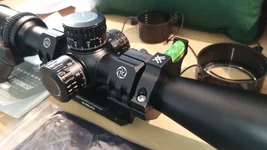
Tightening scope rings: how much torque?

J@son

Well-Known Member
I've just invested in a torque screwdriver so that I can eliminate the guesswork and set up my scopes, swap barrels etc with a bit more precision and consistency.

I've got a Wulf 4K day/night scope, which I will be putting on a rimfire. The manual suggests tightening the screws that attach the scope rings to the gun rail to 30 in-lbs. However, it doesn't give a guide as to how much torque to apply to the screws which hold the rings around the scope.

I've always done this by "feel" so I can't turn this into numbers!

Any and all advice gratefully received. Thanks in advance.
 
I use a feeler gauge as used when I used to gap my own spark plugs and screw each screw down in the same sort of sequence you'd use for a cylinder head or a four stud wheel hub. I screw down to set the same gap on each side of each set of rings to stiff finger tight. In truth on a 'scope ring set you don't need a torque wrench IMHO....it's 'scope rings not a cylinder head for Heaven's sake! I'm 100% with the OP. All you need is "feel". If you haven't a feeler guage use a flat metal strip or a 2p coin, then a 1p coin and then a Stanley knife blade....if you get that far down.
 
Last edited:
It can be dangerous relying on 'feel' alone though, and it can also be dangerous measuring torque 'dry' vs. with lubricant too. With firearms either way can end in a bad day if the worst happens!
 
None of my rifles are in the high recoil category, .223/6.5/308 I torque all my rings down to 15 in/lbs regardless and have never left marks or had problems .that’s with one piece mounts i might add .
 
Last edited:
It can be dangerous relying on 'feel' alone though, and it can also be dangerous measuring torque 'dry' vs. with lubricant too. With firearms either way can end in a bad day if the worst happens!
No worse than a car, if you don't torque something down on a rifle you may injure something or worst case negligent discharge depending what, on a car you've suddenly turned 2 tonnes of steel in to a weapon if something goes wrong 😂

I will also say, 9/10 I will never oil threads that are being torqued, usually because it specifies not to. Oil in threads - over torque and snap. Like grease on wheel bolts, that makes me cringe
 
It can be dangerous relying on 'feel' alone though, and it can also be dangerous measuring torque 'dry' vs. with lubricant too. With firearms either way can end in a bad day if the worst happens!
I have never used torque drivers for scopes, engines yes with many a rebuild but the many jobs I have done over the years you develop a muscle memory from manual milling feed to get a nice finish, filling parts to fit in moulds to adjusting a dive regulator which I appreciate many will have not hence the question.

I made a small square drive spanner in 316 stainless for my dentist friend as the torque devices they had delivered for implants were failing so that is a back up device. There is no torque device for moderators that I have seen which I will bet is the one thing tightened up by hand many times in the week all over the country.
 
I have never used torque drivers for scopes, engines yes with many a rebuild but the many jobs I have done over the years you develop a muscle memory from manual milling feed to get a nice finish, filling parts to fit in moulds to adjusting a dive regulator which I appreciate many will have not hence the question.

I made a small square drive spanner in 316 stainless for my dentist friend as the torque devices they had delivered for implants were failing so that is a back up device. There is no torque device for moderators that I have seen which I will bet is the one thing tightened up by hand many times in the week all over the country.
Many moons ago I was able to use a long bar to tighten wheels within +-2nm of torque and I'd actively check and see how close I could get it 😂
 
I have never used torque drivers for scopes, engines yes with many a rebuild but the many jobs I have done over the years you develop a muscle memory from manual milling feed to get a nice finish, filling parts to fit in moulds to adjusting a dive regulator which I appreciate many will have not hence the question.

I made a small square drive spanner in 316 stainless for my dentist friend as the torque devices they had delivered for implants were failing so that is a back up device. There is no torque device for moderators that I have seen which I will bet is the one thing tightened up by hand many times in the week all over the country.
Steel I think is a little bit different because you can overtighten it more and it forgives you. Aluminium less so.

I'll stick my arm up and say yes, I used to work for aeronautics, and I'm a bit anal about my torque readings. ;)
 
Steel I think is a little bit different because you can overtighten it more and it forgives you. Aluminium less so.

I'll stick my arm up and say yes, I used to work for aeronautics, and I'm a bit anal about my torque readings. ;)
quite right too, however your picture of the grey tractor is quite agricultural ;)
 
Whatever one does NEVER tighten wheel nuts until they "squeal" as some would have you do! It isn't sensible in fact it's downright dangerous! The squeal is for many reasons! Not one of them being because they've gone up "tight and right"!
 
All mine are to blaser recommendations on torque, works for me on all mine, Blaser, Anschutz, Weihrauch and Sako
never had a problem with any of em @ 2.2 Nm max
 
Vortex recommends 15-18 in/lbs of torque (according to my Vortex Venom manual) but i would suggest you check the instructions for your scope
 
Back
Top