


I have been exploring the subject of cartridge case annealing...well more accurately it is Stress Relief rather then full Annealing temperatures that most reloaders advocate for cartridge case necks.
Full annealing of brass (not cartridge cases) when you are working it in the workshop, is heated to a dull red (around 650˚C) whenever it gets too hard to continue cold forming. The Copper Development Association states the full annealing temperature range for 70/30 Cartridge Brass is (450-680˚C).
View attachment cuzn30 Cartridge Brass datasheet Ex.pdf
Some reloaders fully anneal their cartridge brass necks at dull red temps in daylight (around 550˚C whilst others state that this will ruin cartridge cases. I do not believe the doomsayers and cannot see how this will ruin your brass. It may not be as hard and springy (technical term) as low temperature stress-relieved brass, but it is still brass, and still perfectly capable of holding the bullet, and will obviously obturate more readily.
Before I read that stress relief was sufficient for cartridge case necks, I annealed the neck and shoulder of a batch to just getting red colour in a dark room about 500˚C... It felt a similar resistance on the press when seating the bullet as in un-annealed once fired cases.. As long as the batch is all done the same, from one round to the next there will be little POI difference, at least there was not in my case. There may well be a pressure, velocity or POI difference between a fully annealed neck and a stress relieved one of course. But as long as the whole batch are done the same there should not be a problem. I did not notice any problems with the batch I did at 500˚C and am still using. They toughen up with the subsequent work hardening from F/L resizing, factory crimp and firing of course.
The critical problem for overheating is not at the neck but at the other end. That is where all agree that the original brass condition must not be altered by any heat. 450˚F (232˚C) Templac is often used around the case body to show that the heat has not travelled toward the head.
The stress relieving temperature of 70/30 cartridge brass is between 250-350˚C. The advantage for reloaders is that as the recrystallization temperature is not exceeded, no decrease in hardness or strength occurs, good for neck tension.
Stress relieving of brass is a science all of its own. The state of the brass...its molecular and working/manipulated history before you start any stress relieving process affects the outcome hugely. The higher the previous stress and hardness, the lower the temperature that stress relieving starts. None of the systems we as reloaders can do can be based on any solid foundation because of this. We do not know what the manufacturers did…so it is all a bit of an approximation. Luckily I think it is not particularly critical where we end up with the brass. Even fully annealed necks will still work as mentioned above. Just trying to make them all the same is the best we can hope for.
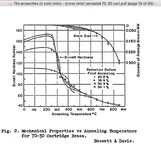
The Properties vs annealing temperatures chart (taken from the paper below) shows the effects on hardness of various annealing temperatures…As mentioned above, the prior work-hardening determines the brass’ Brinel hardness starting point. A lot of the end result depends on the previous work hardened state of the brass and not just the temperature we anneal at. Stress relieving begins to occur at a lower temperature with harder brass and there is a dramatic range of hardness results from very small temperature variations between 250˚C and 350˚C. …worth saying again in slightly different words…There are dramatic differences in working properties produced by small temperature increases between 250˚C and 350˚C. These differences lessen at around the 400˚C mark where they all come together, so that would seem to be the best place to achieve a reasonably repeatable result from the variety of possible starting points.
Constant temperature could be achieved by using either tempstik type crayon or paint on every case. Many of the “annealing” machine manufacturers recommend that you use 750˚F (400˚C) templaq on, or in, the neck to show when that has been stress relieved. But they recommend this only for setting up…the arbitrary time determined is used for the subsequent cases.
The various systems that rely on timing, whether rotating in fingers, drill chuck or commercial machine do not account for brass thickness or precise position in the flame as they rotate. Given that a propane torch flame varies in temperature over 1000˚C from end to end, the slightest variation of position whether caused by wobble of rotation or holding a couple of mm further from the flame cone will have an effect on the temperature achieved by the case in the allotted time.


My simple and cheap solution (and arguably more consistent) is to use the colour change temperature of plain soap at 400˚C as used in the full annealing of Aluminium.
The full annealing temperature of most common Aluminium alloys is between 350 -410˚C. One of the methods I was taught at school for annealing aluminium is to wipe it with a bar of plain soap…(ensure no Moisturising or other additives) and heat until that turns black...around 400˚C. In the workshop I always just put a squiggle down the bar and heat till it turns brown/black
The advantage for cartridge cases of this system over any of the machines or processes relying on time, is that even the slightest wobble to a hotter or cooler part of the torch flame can be compensated for, and the individual pieces of brass are always taken to a similar temperature to one another. In the video I show the brass being spun in different parts of the flame for different lengths of time but the temperature achieved is the same.
I attach a link to one of the reference papers "The properties of cold rolled - stress relief annealed 70-30 cartridge" by Robert F. Hartmann …most of which was heavy going for me as a metalwork practitioner so if any metallurgists can improve on my interpretations and conclusions please do.
As an awful warning….327.462˚C just happens to be the melting point of lead, so some reloaders stress-relieve their brass by dipping oiled cases through a layer of graphite into the molten lead…I just ended up with lead plugs in the cases and ruined too many trying to sort the process... Molten lead of course can be any temperature up to 1749˚C at which point it starts to boil…which is way past even full annealing temperature for 70/30 Cartridge Brass so unless you have a precisely temperature controlled lead bath it is a bit hit and miss anyway.
Alan
Full annealing of brass (not cartridge cases) when you are working it in the workshop, is heated to a dull red (around 650˚C) whenever it gets too hard to continue cold forming. The Copper Development Association states the full annealing temperature range for 70/30 Cartridge Brass is (450-680˚C).
View attachment cuzn30 Cartridge Brass datasheet Ex.pdf
Some reloaders fully anneal their cartridge brass necks at dull red temps in daylight (around 550˚C whilst others state that this will ruin cartridge cases. I do not believe the doomsayers and cannot see how this will ruin your brass. It may not be as hard and springy (technical term) as low temperature stress-relieved brass, but it is still brass, and still perfectly capable of holding the bullet, and will obviously obturate more readily.
Before I read that stress relief was sufficient for cartridge case necks, I annealed the neck and shoulder of a batch to just getting red colour in a dark room about 500˚C... It felt a similar resistance on the press when seating the bullet as in un-annealed once fired cases.. As long as the batch is all done the same, from one round to the next there will be little POI difference, at least there was not in my case. There may well be a pressure, velocity or POI difference between a fully annealed neck and a stress relieved one of course. But as long as the whole batch are done the same there should not be a problem. I did not notice any problems with the batch I did at 500˚C and am still using. They toughen up with the subsequent work hardening from F/L resizing, factory crimp and firing of course.
The critical problem for overheating is not at the neck but at the other end. That is where all agree that the original brass condition must not be altered by any heat. 450˚F (232˚C) Templac is often used around the case body to show that the heat has not travelled toward the head.
The stress relieving temperature of 70/30 cartridge brass is between 250-350˚C. The advantage for reloaders is that as the recrystallization temperature is not exceeded, no decrease in hardness or strength occurs, good for neck tension.
Stress relieving of brass is a science all of its own. The state of the brass...its molecular and working/manipulated history before you start any stress relieving process affects the outcome hugely. The higher the previous stress and hardness, the lower the temperature that stress relieving starts. None of the systems we as reloaders can do can be based on any solid foundation because of this. We do not know what the manufacturers did…so it is all a bit of an approximation. Luckily I think it is not particularly critical where we end up with the brass. Even fully annealed necks will still work as mentioned above. Just trying to make them all the same is the best we can hope for.
The Properties vs annealing temperatures chart (taken from the paper below) shows the effects on hardness of various annealing temperatures…As mentioned above, the prior work-hardening determines the brass’ Brinel hardness starting point. A lot of the end result depends on the previous work hardened state of the brass and not just the temperature we anneal at. Stress relieving begins to occur at a lower temperature with harder brass and there is a dramatic range of hardness results from very small temperature variations between 250˚C and 350˚C. …worth saying again in slightly different words…There are dramatic differences in working properties produced by small temperature increases between 250˚C and 350˚C. These differences lessen at around the 400˚C mark where they all come together, so that would seem to be the best place to achieve a reasonably repeatable result from the variety of possible starting points.
Constant temperature could be achieved by using either tempstik type crayon or paint on every case. Many of the “annealing” machine manufacturers recommend that you use 750˚F (400˚C) templaq on, or in, the neck to show when that has been stress relieved. But they recommend this only for setting up…the arbitrary time determined is used for the subsequent cases.
The various systems that rely on timing, whether rotating in fingers, drill chuck or commercial machine do not account for brass thickness or precise position in the flame as they rotate. Given that a propane torch flame varies in temperature over 1000˚C from end to end, the slightest variation of position whether caused by wobble of rotation or holding a couple of mm further from the flame cone will have an effect on the temperature achieved by the case in the allotted time.
My simple and cheap solution (and arguably more consistent) is to use the colour change temperature of plain soap at 400˚C as used in the full annealing of Aluminium.
The full annealing temperature of most common Aluminium alloys is between 350 -410˚C. One of the methods I was taught at school for annealing aluminium is to wipe it with a bar of plain soap…(ensure no Moisturising or other additives) and heat until that turns black...around 400˚C. In the workshop I always just put a squiggle down the bar and heat till it turns brown/black
The advantage for cartridge cases of this system over any of the machines or processes relying on time, is that even the slightest wobble to a hotter or cooler part of the torch flame can be compensated for, and the individual pieces of brass are always taken to a similar temperature to one another. In the video I show the brass being spun in different parts of the flame for different lengths of time but the temperature achieved is the same.
I attach a link to one of the reference papers "The properties of cold rolled - stress relief annealed 70-30 cartridge" by Robert F. Hartmann …most of which was heavy going for me as a metalwork practitioner so if any metallurgists can improve on my interpretations and conclusions please do.
As an awful warning….327.462˚C just happens to be the melting point of lead, so some reloaders stress-relieve their brass by dipping oiled cases through a layer of graphite into the molten lead…I just ended up with lead plugs in the cases and ruined too many trying to sort the process...
Molten lead of course can be any temperature up to 1749˚C at which point it starts to boil…which is way past even full annealing temperature for 70/30 Cartridge Brass so unless you have a precisely temperature controlled lead bath it is a bit hit and miss anyway.Alan
Last edited:


