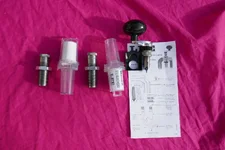
Targetmaster automatic trickler

Woodlander

Well-Known Member
One of my least favourite aspects of hand loading is trickling(after debuting and chamfering),so I bought a Targetmaster trickler and wished I’d bought one when I first started.
Dump you powder in pan,on the scale,press the little red button on top of the unit and it proceeds to trickle up to your given weight,by the means of a beam of light. As soon as the scale arm breaks the beam,it shuts off. Simple,but ingenious.
It takes a few minutes to set up, full instructions are supplied and plenty of YouTube videos available and you’re away. So while the next load Is trickling up,you can seat the bullet and so on,twice as quick and no over trickling and having to pick out the unwanted kernels.
Honestly,for not much over £100,streamline your reloading process and it’s more accurate than a Chargemaster.
 
I have seen them. But being a tight arse I’m building one. So far I have scavenged various parts and spent the princely sum of £8 on the sensor.
It is an impressive setup I must say
 
I have got one,

It is a good piece of kit but just takes a bit to set up to start with.

As you say saves a lot of messing about and whilst it's doing it's thing you can seat the bullet.
 
+1 for the Targetmaster. With the right trickle speed set up, a kernel-perfect charge is ready exactly when you want it. Much better than the Lyman DPS I bought thinking it would do a better job.
 
Sooner or later though others will be along to say that the most accurate loadings are shot using thrown charges not weighed charges. It's a difficult idea to get to grips with as it goes against one's instinct. But it is fact apparently. Thrown charges of a identical volume even with supposedly a weight difference between then are more accurate than weighed charges if the volume of the charges is consistent.
 
Sooner or later though others will be along to say that the most accurate loadings are shot using thrown charges not weighed charges. It's a difficult idea to get to grips with as it goes against one's instinct. But it is fact apparently. Thrown charges of a identical volume even with supposedly a weight difference between then are more accurate than weighed charges if the volume of the charges is consistent.

Really?
I didn't know that. I will do some reading.
 
Sooner or later though others will be along to say that the most accurate loadings are shot using thrown charges not weighed charges. It's a difficult idea to get to grips with as it goes against one's instinct. But it is fact apparently. Thrown charges of a identical volume even with supposedly a weight difference between then are more accurate than weighed charges if the volume of the charges is consistent.

It is, indeed, especially when charge weights, not volumes, are given by every reloading manual, along with advice to throw charges consistently. I can see how throwing the same charge weight at inconsistent densities may affect the burn rate or pressure curve, but not how focusing on volume alone would be more consistent than achieving both consistent charge weight and density. However, I'm prepared to approach this notion with at least a half-open mind, so will willingly follow a link to a reliable source if you could provide one.
 
Sooner or later though others will be along to say that the most accurate loadings are shot using thrown charges not weighed charges. It's a difficult idea to get to grips with as it goes against one's instinct. But it is fact apparently. Thrown charges of a identical volume even with supposedly a weight difference between then are more accurate than weighed charges if the volume of the charges is consistent.
So how do these volume freaks transport their ammo? I'm assuming density is linked with volume and will therefore change according to interlocking grain movement?

K
 
It is, indeed, especially when charge weights, not volumes, are given by every reloading manual, along with advice to throw charges consistently. I can see how throwing the same charge weight at inconsistent densities may affect the burn rate or pressure curve, but not how focusing on volume alone would be more consistent than achieving both consistent charge weight and density. However, I'm prepared to approach this notion with at least a half-open mind, so will willingly follow a link to a reliable source if you could provide one.
Lee Precision are in the thrown Volume loading camp. With lots of data on weights to volume etc. I have done it both ways and don’t seem to get much difference. If I do both consistently either seems to work.
Frankly I don’t really care as long as the bullets go where I point them.
 
Lee Precision are in the thrown Volume loading camp. With lots of data on weights to volume etc. I have done it both ways and don’t seem to get much difference. If I do both consistently either seems to work.
Frankly I don’t really care as long as the bullets go where I point them.

Thanks, I did not know that. (Though I suspected I was going out on a limb with "every".)
 
I find it’s a great piece of kit that guarantees repeatable loads.

Now when is the annealing machine going to be offered for (limited) sale? (to me that is!) :)
 
It’s as accurate as your scales. It can be set to trickle very slowly,so there is very little or no chance of it dropping in a few too many kernels,as was often the case when I trickled by hand. It’s all to do with how much care you take setting it up.
 
It’s as accurate as your scales. It can be set to trickle very slowly,so there is very little or no chance of it dropping in a few too many kernels,as was often the case when I trickled by hand. It’s all to do with how much care you take setting it up.

I use the Chargemaster Lite, which has transformed my reloading. I'll admit to double checking each load on an accurate electronic scale, before filling the case, but apart from a very occasional blip, where it may go over by .12 of a grain, it's +/- .04 of a grain, depending on the powder. On the electronic scales, a single kernel of powder weighs on average 0.02-0.04gn.
 
It takes few minutes setting the target master up but once its done that's it, i throw 0.5 light then press the button, if you get all your gear in a good position you can soon rattle through 50 loads.
 
I can't still get to grips with why it is so, but a Google of weighed v thrown charge will link to many, many threads on it and quite a number of them reference using a Harrell thrower. But I still struggle with the idea as to why it is so that thrown chsrges give better accuracy than weighed. But if you wish you can do a search on the internet as noted.
 
Powders with large extruded kernels will certainly not render the desired results when being thrown vs. weighed, regardless of the thrower.
I own a Harrell type thrower and I would never rely on a thrown charge of IMR 4350 out of it. Weight (and volume) will differ considerably depending on how you operate the handle and/or if a kernel gets caught in the mechanism and you have to force the operation over it. In my many years of using this thrower I have not been able to acquire the proficiency to operate it such that I would trust the results of a thrown charge of a coarse-kernel powder.

Therefore I am tending more and more towards very fine extruded (e.g. N120) or ball type powders such as BL-C(2), Lovex and Ramshot. These you can really dispense accurately to the 10th of a grain, thus making weighing every charge a thing of the past. Once set up I can switch off my scale and proceed all day by hovering my loading tray beneath the thrower.
 
It's made by Allan (1066) - he's a terrific engineer. If the arm that holds the sensor is one piece then I modeled that for him (it's 3D printed) but since then he's bought his own 3D printer and has far exceeded my capabilities
 
1066 is an absolute gent and the trickler is a dream to use.
Throw light, pan on beam scale then hit the button to trickle up. As the machine is trickling up that load I seat the bullet from the last one.
Takes no time at all to do 50 or so.
Jimmy
 
Back
Top