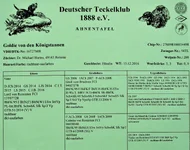
Not directly tracking related but for those with an interest in 'driving' big-game, this might be of interest. I was once told on this forum that there is no such thing as a Spurlaut trial!! The below shows how much importance the German breeders put on this attribute.
An interesting read. Courtesy of the DTK and Working Dachshund Group.
Notes from the Spurlaut webinar aired this morning, sponsored by Royal Canin's "Responsible Breeding Online" project. The speaker was Katrin Maar of the DTK (German Dachshund Club). I did some mild editing, mostly for the sake of smoother translation.
""Spurlaut is the German term for "voice on the track."
Dogs should bark with good audible voice all the track long.
Not only the barking, but also the nose and the will to work are extremely important.
Spurlaut is more than a barking dog. It is an expression of some of the most important characteristics noted by breeders in breeding a hunting dachshund.
There are two special expressions which determine dachshund character. If one or both are lost in breeding, we don't have a Dachshund as we know it in the future.
1. Spurlaut/Tracking
- shows an overwhelming will to follow an animal
- shows an excellent nose
- shows good concentration
- shows the ability to find the way back.
2. Underground work on fox or badger.
*Both together is the difference between other dogs and a Dachshund.*
A small breed pushes the game more slowly and gives the hunter more time to make the shot.
Spurlaut is fundamentally necessary when using dogs in driven hunts.
Why (test) spurlaut specifically on hare?
- We want to breed an extraordinary dog.
- The hare gives less scent compared to clawed [meaning "hoofed" as in deer or boar, I presume] game.
- Some dog breeds accept the work on fox. [I am not sure of the point being made here; maybe that terriers work fox but are not spurlaut. Or that working and barking on fox is not evidence of spurlaut.]
- Spurlaut is evaluated in fields, not in forests or brush where scenting is easier due to less air movement so scent stays longer, and because judges have to be able to see the dogs for 300-400 meters
- A dog that is spurlaut on a hare track will be spurlaut on other game but not [necessarily] vice versa [bullet point 2 above]
Age:
- There is no minimum age!
- There are dogs who begin working spurlaut at less than three months of age.
- The right time to start to practice spurlaut is when the dog is interested in the fresh track.
- We cannot really help, train, or force a dog to be spurlaut - it is an inherited trait!
- The age when a dog begins barking while following a track varies enormously; usually between 10 weeks and 10 months.
Training:
- First training: Dog is allowed to see the hare and follow it directly. This seeing is to link the "charming" hare with its scent.
- When the dog is barking while seeing the hare, he is not allowed to see the hare ever again in his life before the Spurlaut test. Otherwise, the risk is high that the dog only wants to try to follow with his eyes.
- Give the dog good opportunities to work and the dog is either Spurlaut or it is not.
Test:
- Everyone stands in a row and walks over agricultural fields or grasslands
- The plants should not be too high, so it is possible for the judges to see the hare and the Dachshund.
- When a hare is seen, the judge runs to the place where the hare was first seen and calls one handler and Dachshund.
- The dog is not permitted to have seen the hare.
- The handler brings the dog to the hare track and lets it go.
- When a dog follows the track with good voice, accurately, fast, and for more than 400 meters, the dog earns the full 100 points and designation of 1. Prize.
Judges evaluate:
- Nose. Voice. Will. Accuracy. Points given for each category will be from 0 (nothing) to 4 (excellent).
- The 0-4 points given for each category are multiplied: Nose x10, Voice x9, Will x3, and Accuracy x3.
- Some dogs give voice without smelling a fresh track. This is called Waidlaut. We don't want this. If a dog shows Waidlaut in a test, he cannot pass the test.
Breeders Responsibility:
- If you want to have dogs with good voice on tracks in your breed, only breed with dogs that have a Spurlaut test [or have demonstrated good spurlaut].
- The younger the dog is when passing the test, the better.
- Some dogs only start giving Spurlaut at, [for example], 12 months. If you breed with these dogs, the risk is higher that the next generation will bark at 14 months and so on. At the end there is no Spurlaut any more.""
Many thanks to the sponsors and presenter for disseminating this information.
To preservationists, it is important.
An interesting read. Courtesy of the DTK and Working Dachshund Group.
Notes from the Spurlaut webinar aired this morning, sponsored by Royal Canin's "Responsible Breeding Online" project. The speaker was Katrin Maar of the DTK (German Dachshund Club). I did some mild editing, mostly for the sake of smoother translation.
""Spurlaut is the German term for "voice on the track."
Dogs should bark with good audible voice all the track long.
Not only the barking, but also the nose and the will to work are extremely important.
Spurlaut is more than a barking dog. It is an expression of some of the most important characteristics noted by breeders in breeding a hunting dachshund.
There are two special expressions which determine dachshund character. If one or both are lost in breeding, we don't have a Dachshund as we know it in the future.
1. Spurlaut/Tracking
- shows an overwhelming will to follow an animal
- shows an excellent nose
- shows good concentration
- shows the ability to find the way back.
2. Underground work on fox or badger.
*Both together is the difference between other dogs and a Dachshund.*
A small breed pushes the game more slowly and gives the hunter more time to make the shot.
Spurlaut is fundamentally necessary when using dogs in driven hunts.
Why (test) spurlaut specifically on hare?
- We want to breed an extraordinary dog.
- The hare gives less scent compared to clawed [meaning "hoofed" as in deer or boar, I presume] game.
- Some dog breeds accept the work on fox. [I am not sure of the point being made here; maybe that terriers work fox but are not spurlaut. Or that working and barking on fox is not evidence of spurlaut.]
- Spurlaut is evaluated in fields, not in forests or brush where scenting is easier due to less air movement so scent stays longer, and because judges have to be able to see the dogs for 300-400 meters
- A dog that is spurlaut on a hare track will be spurlaut on other game but not [necessarily] vice versa [bullet point 2 above]
Age:
- There is no minimum age!
- There are dogs who begin working spurlaut at less than three months of age.
- The right time to start to practice spurlaut is when the dog is interested in the fresh track.
- We cannot really help, train, or force a dog to be spurlaut - it is an inherited trait!
- The age when a dog begins barking while following a track varies enormously; usually between 10 weeks and 10 months.
Training:
- First training: Dog is allowed to see the hare and follow it directly. This seeing is to link the "charming" hare with its scent.
- When the dog is barking while seeing the hare, he is not allowed to see the hare ever again in his life before the Spurlaut test. Otherwise, the risk is high that the dog only wants to try to follow with his eyes.
- Give the dog good opportunities to work and the dog is either Spurlaut or it is not.
Test:
- Everyone stands in a row and walks over agricultural fields or grasslands
- The plants should not be too high, so it is possible for the judges to see the hare and the Dachshund.
- When a hare is seen, the judge runs to the place where the hare was first seen and calls one handler and Dachshund.
- The dog is not permitted to have seen the hare.
- The handler brings the dog to the hare track and lets it go.
- When a dog follows the track with good voice, accurately, fast, and for more than 400 meters, the dog earns the full 100 points and designation of 1. Prize.
Judges evaluate:
- Nose. Voice. Will. Accuracy. Points given for each category will be from 0 (nothing) to 4 (excellent).
- The 0-4 points given for each category are multiplied: Nose x10, Voice x9, Will x3, and Accuracy x3.
- Some dogs give voice without smelling a fresh track. This is called Waidlaut. We don't want this. If a dog shows Waidlaut in a test, he cannot pass the test.
Breeders Responsibility:
- If you want to have dogs with good voice on tracks in your breed, only breed with dogs that have a Spurlaut test [or have demonstrated good spurlaut].
- The younger the dog is when passing the test, the better.
- Some dogs only start giving Spurlaut at, [for example], 12 months. If you breed with these dogs, the risk is higher that the next generation will bark at 14 months and so on. At the end there is no Spurlaut any more.""
Many thanks to the sponsors and presenter for disseminating this information.
To preservationists, it is important.