Prices of pups abroad and at home

But why is that? Why do you have the only work tested, hip scored and health tested BGS in the UK? There must be a reason why others cannot/have not done the same?

Is it too difficult to get the correct quality BGS into the UK? If it is...That seems more part of the problem than part of the solution.

It’s very simple to get the correct dogs into the country.
Every dog in all our pedigrees have all scores within tests and all relevant information.
FCI dogs are not the correct dogs by the way.....
ISHV dogs are.
The health of the dogs are paramount and if any,I mean any issues arise-lines are locked out of breeding-why ? For the breeds benefit.....

This year due to COVID a lot of breeders within the clubs have postponed breeding.
After all of the above we are still getting 2 BGS and 2 HS into the UK this year,this is quite an achievement considering that means 4 breeeders/people keeping the dogs until 15 weeks to allow import into UK.
So not difficult at all.
The process Lee and I have went through takes time,that’s the only reason that Lee has the only bitch at that standard.
A dog takes a minimum of 4 years to take main test.
There are others within UKSHA that have been asked to breed this year as well so there are more than just Lee and my own dog at a standard to breed.
Slowly slowly catch the “correct” monkey.......
All the best
George
 
Last edited:
I fully appreciate the time and effort the UKSHA guys put in, it is unquestionable. I am still very, very surprised that Lee has the only BGS of the right quality in the UK. If I were on the committee of the breed health club, this point would need to be heavily investigated and a solution created. This is a terrible situation for any breed to be in, here in the UK.
 
Lee has the only female BGS in UKSHA-we have many more male dogs.
That’s up to the individual which sex of dog they wish.If it were up to the Committee of the KBGS or UKSHA we would have more females but it’s down to those wanting the dogs.
We do have more HS than BGS in the UK as well.
Also we have more HS females than males here too.
Just the way it is.
I think HS will be bred in the UK first under the ISHV and the pups will have recognised papers as well-not UK Kennel club papers as HS aren’t recognised in the UK,even if they were,we would not endorse the papers from the UK KC.
All the best
George
 
I fully appreciate the time and effort the UKSHA guys put in, it is unquestionable. I am still very, very surprised that Lee has the only BGS of the right quality in the UK. If I were on the committee of the breed health club, this point would need to be heavily investigated and a solution created. This is a terrible situation for any breed to be in, here in the UK.
Keith as George said it takes time to get the dogs to a standard and the Uk has been part of a breed plan from the start, our dogs have reached the standard required but again most are dogs not bitches but my Hs has to get bloods, hips but I have been asked to do these because they want to use my Hs in the coming breed plan, pups born here at the minute will go directly back to Europe to further the gene pool. A Uk handler would not get one of our pups as it would narrow the gene pool all the dogs coming into uksha are from different breedings to give the whole of the Hs and BGS the widest genes to be Used in future breedings.
This is carefully selected from each country to further the breed so again it all takes time,
The sole purpose for breeding is to further the breed and to give handlers that need a dog from each respective club so it’s carefully worked, regards Wayne
 
Last edited:
Here is the original article of my pals dog testing day. On 21st March 2012.


Here below I have translated the German text as best as I could.
He is BTW located near Saarlouis on the German French border and was my best jagdschein teacher in 1998-9 and we became very good pals.

Looking for– wounded game!
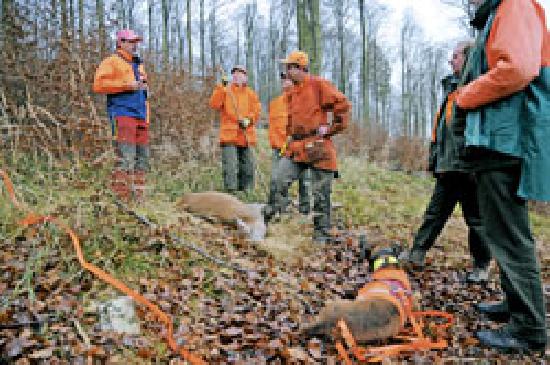
They have their own dog cemetery, state-owned dogs and the abolition of territorial hunting boundaries: tracking work with the Hanoverian bloodhound is a supreme discipline. DJZ hunting magazine accompanied one of the "tracking detectives" on his main test in the Soonwald forest.

The meeting point is a parking lot in the middle of the Hunsrück region. The driven hunt is over in 15 minutes. A report should be made for wounded game. That’s how long there’s coffee and cake left. The mood is a bit tense. Everyone knows: It is important to assess the shot area and the severity of the injury in the shortest possible time in order to then distribute the work for the test dog aspirants.

Enigmatic
In theory, everything is very clear. But in the practice it looks very different:
Case 1: A sow was shot in the neighboring district that had already been previously shot. The shooter of the first round cannot be determined.
Case 2: A calf was shot at, but has died. Later it turns out that two shooters had already spoken of it as having been wounded, but they couldn't shoot because there was no backstop. A special kind of puzzle.

Main exam
The difficulty of this day: Finding a search that is sufficient for an exam assessment. You have to search for at least 400 meters. If there is a hunt afterwards, the dog can also be judged with regard to the sound and location of the game.
The search for the calf (case 2) was successfully completed by René Wiese (44) (now he is over 50) with his male dog “Delf vom Ibengarten”, but lasted only 100 meters. Good for the piece, bad for the team. Too short for an exam assessment. Mr Wiese has been available on call for a main test since 2009. However, a team of auditors would also have to arrive. To this day, it has failed to meet both points.

Herr Wiese has now made around 300 searches with his dog. In his opinion, 25 to 35 difficult tracking jobs are necessary before a main test should be performed. That is why he registered for the main exam of the Hirschmann club in the Soonwald club on November 12th. But, it actually went differently: He should act as support for the examinees in case control searches or simple death searches are pending. But then it became his own test.

The Hirschmann Association has guaranteed enough dogs with guides for this weekend. If you want a test for a dog, and the handler is convinced that it can be an examination candidate, you swap. The exam candidate takes over. It is therefore not surprising that a total of 11 tracking dog teams are on site on this day. The course of the two simultaneous driven hunts cannot be calculated.

Long search
Delf vom Ibengarten is already in his 7th year. This is actually a very old age for a test, but the dog must have the experience to be able to cope with the test conditions. From a breeding point of view, it would make more sense if the dogs came to the test much earlier, for example in their fourth year. However, since the dogs have to be judged in practice during a search, this is very difficult to plan.

The best prerequisites for an exam-relevant search is a high running shot. The wounded game usually flees a few hundred meters before it goes into the wound bed. If the dog finds the piece, pointing and barking is usually necessary. With such a search, the entire range of abilities can be assessed.

René Wiese was already looking with Delf yesterday. A sow was shot at on a driven hunt. Only the group leader was available as a contact person. He could only say what the wild species was, nothing more. The shooter had already left.

During the preliminary search, Delf turned off at once after about 40 meters. The first drop of blood after 50 meters. Plenty of blood over the next 500 meters. But after almost two kilometers, the search leader had to break off because it was getting dark. No wound bed until then. The hit position remains a mystery. Probably a graze shot on the hip.

Odyssey
After the rain during the night, stalking signs are no longer to be expected. Even so, early in the morning the search team is back at the point where it left off yesterday. Before that, she had wandered ten kilometers through forest paths through the bush. There was no local helper there yesterday. Today it is difficult to explain to the locals where this point is.

After 1.5 hours the test group is at the finish and the male Delf is back at the beginning of a difficult search. Like yesterday, he works very calmly and concentrates on the wound track. There are hardly any confirmations for his guide any more, only now and then a stamp which the experts read as a path to wound bed. The layman hardly recognizes this without explanation. There is no more blood. The wound has probably already closed up.

After it went steeply down the mountain, a gate with good cover gives hope. The sow could be stuck here. Suddenly movement. The examiners have problems sinking deeper into the wet ground following the dog and handler. Then cracks and rushes. Delf stays on the track with his nose down. The old animal and the calf have fled.

After 4.5 kilometers of searching over two days, this is the end. No bed of wounds on the entire route. Only once did the piece briefly give way before a path. This sow is not to be found, the dog handler and the examiner agree.

The way back to the car is long. It goes mountain up, mountain down. Thanks to modern GPS technology from those familiar with the area, the entire search is recorded. No wandering around like in the morning. Back in the search bar, there is a stew for refreshment. After the wet bush and the exertion, just the thing. Unfortunately, these efforts were not rewarded: neither an animal found nor an examination award.

Passed
But the search for a red calf turns out to be a suitable test piece. The end is already known because it was the animal already found (case 2). Only the way was longer, as the dog was placed 1.2 kilometers away at the point of the first hit. The two-day search for the sow is of course taken into account by the judges as well as a subsequent search for a sow over a further 2 days.

Working on 3 pieces and 10 kilometers of searching over 4 days were assessed:

René Wiese passed the main test with his male Delf.
Note: You can find his contact on the homepage of the Hirschmann Association

Hirschmann | Home For a list of bloodhound handlers.
 
pups born here at the minute will go directly back to Europe to further the gene pool.

Ok, so you are saying that 'globally', the gene-pool of correct quality BGS or HS is small. That is a revelation to me. I was under the impression that Germany would have ample quantity of correct quality in both breeds.

Why is this the case?

For how many years have the Germans bred to this standard?
 
To add. I am not sure if most stalkers/trackers are aware of the 'long-term' breeding plan. Perhaps I speak out of turn but UKSHA do come over as being exclusive as far as pup opportunities are concerned.
Perhaps the PR is actually out there that, there is a long term plan to increase the availability of correct quality BGS and HS or perhaps it is an area to spend more time on getting the message over correctly.
 
To add. I am not sure if most stalkers/trackers are aware of the 'long-term' breeding plan. Perhaps I speak out of turn but UKSHA do come over as being exclusive as far as pup opportunities are concerned.
Perhaps the PR is actually out there that, there is a long term plan to increase the availability of correct quality BGS and HS or perhaps it is an area to spend more time on getting the message over correctly.

you won’t get ans ISHV papered dog unless you go through the UKSHA.

could you imaging the disaster is these dogs got out into the general hunting public ??!

they would be bred within an inch of their lives for £££££ with no respect for the breed.
 
you won’t get ans ISHV papered dog unless you go through the UKSHA.

could you imaging the disaster is these dogs got out into the general hunting public ??!

they would be bred within an inch of their lives for £££££ with no respect for the breed.

I appreciate that Lee, what I had not realised that there was a plan to widen the gene pool of quality examples within the UK. It is almost a three tier situation where you have a pet/show tier, a general working tier and the at the top a ISHV tier.

Now, if we look at the 'breed' in a holistic manner - not in small specialist silos - How do UKSHA see it's role regarding the improvement of the Bavarian Mountain Hound as an overall 'breed'?
 
Ok, so you are saying that 'globally', the gene-pool of correct quality BGS or HS is small. That is a revelation to me. I was under the impression that Germany would have ample quantity of correct quality in both breeds.

Why is this the case?

For how many years have the Germans bred to this standard?
The breeds have been going for over 120 years the breeding has always been this way within the two breed clubs, the breeding is selective to get the best from each pairing that is why they test to show what each dog can do how they bay or give voice and how they track and each is paired accordingly to the strengths They don’t just breed the dogs from German stock they use the dogs from 13 country’s to breed here we would not breed the few we have here and narrow the genes we would use other dogs from further afield to bring more lines in but all under the breedmasters from the respective clubs, then the pups go back to handlers who need them before any pairing and breeding there is a list for the year of who needs dogs, regards Wayne
 
I will sterilise my bitch before anyone in the U.K. would have one of her pups, her bloodline is too precious.
Forgive my ignorance, but what does the bloodline being too precious have to do with whether or not you breed her? "Sterilise my bitch" seems so offensive somehow, and spiteful.

I am not a dog man and don't claim to be but I don't follow your logic, which is unusual as normally I resonate with most of what you say.
 
The breeds have been going for over 120 years the breeding has always been this way within the two breed clubs, the breeding is selective to get the best from each pairing that is why they test to show what each dog can do how they bay or give voice and how they track and each is paired accordingly to the strengths They don’t just breed the dogs from German stock they use the dogs from 13 country’s to breed here we would not breed the few we have here and narrow the genes we would use other dogs from further afield to bring more lines in but all under the breedmasters from the respective clubs, then the pups go back to handlers who need them before any pairing and breeding there is a list for the year of who needs dogs, regards Wayne

So, if I understand correctly, the two breeds have been bred this way for 120 years and now have bloodlines from 13 different countries then I do not understand why pups bred in the UK would have to go directly back to Europe to further the gene pool.

Why, after 120 years of selective breeding (which includes 13 countries) would UK born pups have to return directly back to Europe?
 
I appreciate that Lee, what I had not realised that there was a plan to widen the gene pool of quality examples within the UK. It is almost a three tier situation where you have a pet/show tier, a general working tier and the at the top a ISHV tier.

Now, if we look at the 'breed' in a holistic manner - not in small specialist silos - How do UKSHA see it's role regarding the improvement of the Bavarian Mountain Hound as an overall 'breed'?

There is no overall breed, some dogs should not be bred from, you would not mix ishv with dogs that have known issues, the dogs that are being sourced from abroad with fci papers would have faults going back, we can not stop breeding here and even the mountain hound society knows how badly the BGS has been bred here with known faults including epilepsy and many other issues.
All we can do is keep the ishv lines and dogs pure and to help the ishv lines, this might come across as being elitist or wrong to people but it is all about looking after a breed and working ability to do what they were designed for, They only go to working homes within ishv not pets or for show they are bred for a purpose regards Wayne
 
Last edited:
So, if I understand correctly, the two breeds have been bred this way for 120 years and now have bloodlines from 13 different countries then I do not understand why pups bred in the UK would have to go directly back to Europe to further the gene pool.

Why, after 120 years of selective breeding (which includes 13 countries) would UK born pups have to return directly back to Europe?
Because the members want a dog and you would not keep breeding the same dogs over and narrowing the gene pool here, this is exactly what happened here in the first place a few dogs had been bred then those pups all being bred to the same dogs creating more and more of the same issues over and over
 
Kieth I'm guessing it's more not to narrow the UK pool than widen the German.

If u bred of the UK ones and kept pups ur starting the breed from only a few individuals ur starting with a very narrow gene pool.

It is the proper way to work
I'm sure u see that with ur teckels see it with a lot of hpr breeds too and using a few stud dogs no matter how good they are only narrows the gene pool too.
Which the UK is terrible for even in dog breeds with massive population relatively small gene pool because everyone using the same stud dogs
 
There is no overall breed, some dogs should not be bred from, you would not mix ishv with dogs that have known issues, the dogs that are being sourced from abroad with fci papers would have faults going back, we can not stop breeding here and even the mountain hound society knows how badly the BGS has been bred here with known faults including epilepsy and many other issues.
All we can do is keep the ishv lines and dogs pure and to help the ishv lines, this might come across as being elitist or wrong to people but it is all about looking after a breed and working ability to do what they were designed for, regards Wayne

Wayne, I appreciate your candid answer but, for me, this is and always will be part of the problem.

The statement 'There is no overall breed' speaks volumes and I understand the sentiment and have watched this model fail in almost every UK terrier breed.

My concern is for entire breeds thus my opinions are based from that perspective.

Small, top quality, working silos will just get smaller and smaller as cultures and laws change across the globe. The number of individual dogs within that silo will be too low to be sustainable.

Meanwhile, the large silo of pet/show and perhaps 'general' working examples will just get larger and larger. This will continue inexorably. There will always be more pet and part time/light working enthusiasts than there are 'hard-core' working enthusiast - that is not an opinion, it is a fact.

As stated at the start, my concern is for entire 'breeds'. I would much rather see a totally united front where everyone is trying to improve the breed than this division that will see the number of elite specimens fall with every decade. That top quality blood has to have a route into the 'general' gene pool for the good of the breed. Otherwise the history is already written.
 
Wayne, I appreciate your candid answer but, for me, this is and always will be part of the problem.

The statement 'There is no overall breed' speaks volumes and I understand the sentiment and have watched this model fail in almost every UK terrier breed.

My concern is for entire breeds thus my opinions are based from that perspective.

Small, top quality, working silos will just get smaller and smaller as cultures and laws change across the globe. The number of individual dogs within that silo will be too low to be sustainable.

Meanwhile, the large silo of pet/show and perhaps 'general' working examples will just get larger and larger. This will continue inexorably. There will always be more pet and part time/light working enthusiasts than there are 'hard-core' working enthusiast - that is not an opinion, it is a fact.

As stated at the start, my concern is for entire 'breeds'. I would much rather see a totally united front where everyone is trying to improve the breed than this division that will see the number of elite specimens fall with every decade. That top quality blood has to have a route into the 'general' gene pool for the good of the breed. Otherwise the history is already written.
Sorry but I don’t agree why keep breeding really bad issues that kill or hurt the dogs, now I watch my Uk bred BGS have seizures on a regular basis and why I would never entertain this again look at the mountain hound society re homing them regular people don’t have a clue and ruin a breed, let’s ask why you can obtain an fci dog cheap from abroad you said it yourself in the Teckel, they are being punted off to people thinking they are getting pukka lines and a top knotch dog in reality you play the gamble of what faults are going to appear. Performance breeding is as much as possible going to get you what you want and god forbid issues arise in a line the whole line is stopped from breeding
 
Sorry but I don’t agree why keep breeding really bad issues that kill or hurt the dogs, now I watch my Uk bred BGS have seizures on a regular basis and why I would never entertain this again look at the mountain hound society re homing them regular people don’t have a clue and ruin a breed, let’s ask why you can obtain an fci dog cheap from abroad you said it yourself in the Teckel, they are being punted off to people thinking they are getting pukka lines and a top knotch dog in reality you play the gamble of what faults are going to appear. Performance breeding is as much as possible going to get you what you want and god forbid issues arise in a line the whole line is stopped from breeding

It's not about breeding from 'bad' stock Wayne. If a dog has a health fault it should not be bred from. If a dog is a carrier then any unions need the strictest of scrutiny. Breeding from 'bad' stock is not my point.

The fact is that there is not a perfect dog on the planet - just like there isn't the 'perfect' of any species, even those tested by Nature will throw 'individual variation' of something that isn't as 'fit' (read perfectly adaptable to varying conditions) as it should be. That for me is a given. I do not own a perfect dog, I have never owned a perfect dog, I will never own a perfect dog and I will never breed a perfect dog.

However, I will endeavour to breed as close to my goal as I possibly can. Accepting that no dog is perfect, I look to use qualities that will bolster what I am looking for, compliment what I already have and in some cases, improve where am lacking. Surely that is the thrust of dog-breeding logic?

Now assuming that there is a physically healthy, health screened bitch that has proven her worth in the field as a competent tracking dog and has a calm, stable temperament. Why oh why would you not allow one of the elite ISHV males serve her?
 
It's not about breeding from 'bad' stock Wayne. If a dog has a health fault it should not be bred from. If a dog is a carrier then any unions need the strictest of scrutiny. Breeding from 'bad' stock is not my point.

The fact is that there is not a perfect dog on the planet - just like there isn't the 'perfect' of any species, even those tested by Nature will throw 'individual variation' of something that isn't as 'fit' (read perfectly adaptable to varying conditions) as it should be. That for me is a given. I do not own a perfect dog, I have never owned a perfect dog, I will never own a perfect dog and I will never breed a perfect dog.

However, I will endeavour to breed as close to my goal as I possibly can. Accepting that no dog is perfect, I look to use qualities that will bolster what I am looking for, compliment what I already have and in some cases, improve where am lacking. Surely that is the thrust of dog-breeding logic?

Now assuming that there is a physically healthy, health screened bitch that has proven her worth in the field as a competent tracking dog and has a calm, stable temperament. Why oh why would you not allow one of the elite ISHV males serve her?
Because she’s not ishv and you can not be sure she has not got a fault in her lines going back, the problem in the Uk is as you just said you breed for what you want but that is not probably what the teckel breed as a whole want most people want a watered down version of their European cousin so it’s more bidable, trainable or whatever reason it is but that isn’t always how the breed should be, all we are doing is what’s asked get dogs to the highest standards and breed with others of the same ilk to help the ishv and that then helps us with the quality and this is also tied with price the price is set throughout the ishv to give quality and good health cheaper than you can buy a black bred dog without the same scrutiny, at the end of the day like said in the other post you pay your money and take the chance but you can stack it in favour,regards Wayne
 
Back
Top