Prices of pups abroad and at home

I’d like to know how our gene pool is becoming smaller as it is simply not the case.
This is why the best dogs within the clubs are bred.
Best in terms of health,working performance and conformation to breed standard.
We work a simple tool that will even predict how the pups will perform certain tasks before they are even born as well as looking at the genetic diversity of the pups before birth.
The gene pool is expanding all the time but healthily😉
We have within UKSHA had male dogs bred already-the quality and working performance is there,as well as the health,the main test can only be completed by experienced dogs.
The health side of things means a lot to us all within UKSHA.Some people don’t care,that’s their perogative.
There are definitely breeders abroad as well that don’t care-as you state Pendle-£300 per pup but sold over here for big money and then nothing but problems.Not within UKSHA or the associations we are working with closely abroad.
I find your list also quite true.
1.Definitely so they can go ahead and breed when they wish too.Why take pups from pet breeders-this is stupidity if one is working the pup/dog.
2.100% correct,yet it will still be luck whereas from an association you have fact and proof going back generations not just someone’s word.
Every member of UKSHA gets more than just support from the associations,tracking abroad comes with being a member as well as friends in every country in the ISHV,this alone widens the gene pool-breeding dogs within 13 countries with different lines expands genetic diversity,not contracts it.
3.100% correct,some do want BGS+HS as well as become a member and learn more than you ever will when attempting it yourself.
Some people will buy a breed they think they have learned about but in reality they will be gambling-example,dachsbrache-good wee dogs that I have seen numerous times work and know a lot of owners,same with Kopov and Brandlebracke-best to know what your wanting as they won’t necessarily do what you want them to do.Some will track and some will head into the blue wide yonder without a second thought for the chump holding the leash.
HS and BGS are also not used to potential by 99% of their owners here in UK,why ?
They aren’t members of associations where you are taught to fulfill that potential.
Same with any breed of dog and with the associations.
There are associations for every breed-some are run well,others are not.
Some give dogs away to anyone who wants one,others do not.The ISHV and their members do not.
The ISHV associations do not give the dogs away to anyone other than a fellow ISHV member,the hologram can’t be faked and if it’s not on the papers I would never buy one of these breeds(HS+BGS) as then you are playing Russian roulette and you do not know what you are getting for your substantial investment-at home or abroad.
In reality without the ISHV Hologram you are as well with the pup for £300 and take a chance because your doing that from the beginning,taking a huge risk that everything is fine with a pup that may well be riddled with issues,however,the money you save on the pup you can put towards insurance so the vet won’t bleed you dry when the issues come.....and come they shall.
All the best
George
 
I’d like to know how our gene pool is becoming smaller as it is simply not the case.

The gene pool is expanding all the time but healthily😉

Hi George,

not having a dig, but you asked. It's a mechanical function of closed gene pools that the amount of genetic diversity will decrease over time. Diversity increases by 2 functions - mutations and introduction of new genes by adding new genotypes by introducing new strains. As you are not introducing new lines (as far as I am aware) and the rate of mutation is relatively low, the gene pool is likely to be decreasing and as some genes not being passed on to the next generation.

However this does not mean that the gene pool is unhealthy. If you breed two genetically identical parents who only have healthy genetics (i.e. no recessive pathological genes) you are only going to have healthy offspring (until some mutation occurs).

Now I am not saying that your clubs gene pool is entirely clear of adverse recessive genes but because of the tight controls when recessive genes are expressed they managed appropriately.

When you say the gene pool is expanding I think you mean the number of breeding dogs is increasing - but this is not the same as the gene pool.

Best

M
 
I do not know of any successful breeding system where the elite tier is not used in the tiers above it. As stated earlier, I will always find it incongruent that the very best quality stock from the elite tier cannot be used in multiplier tiers for the good of the breed
 
@pendle you are quite right I am not breeding, this has nothing to do with the associations or the breed clubs that I’m a member of, it it down to my decision to not want own dogs anymore.

i have no desire to carry the line on, Heidi will be my last dog.

We have another 8 or 9 years of tracking together yet, unless god forbid the worst happens and I loose her in battle with a wounded animal (sadly these things do happen, and anyone who tracks professionally seriously has this in the back of his mind always!)
 
Hi George,

not having a dig, but you asked. It's a mechanical function of closed gene pools that the amount of genetic diversity will decrease over time. Diversity increases by 2 functions - mutations and introduction of new genes by adding new genotypes by introducing new strains. As you are not introducing new lines (as far as I am aware) and the rate of mutation is relatively low, the gene pool is likely to be decreasing and as some genes not being passed on to the next generation.

However this does not mean that the gene pool is unhealthy. If you breed two genetically identical parents who only have healthy genetics (i.e. no recessive pathological genes) you are only going to have healthy offspring (until some mutation occurs).

Now I am not saying that your clubs gene pool is entirely clear of adverse recessive genes but because of the tight controls when recessive genes are expressed they managed appropriately.

When you say the gene pool is expanding I think you mean the number of breeding dogs is increasing - but this is not the same as the gene pool.

Best

M

I know all about genetics and genetic diversity Siggy.
The whole point that we are making is that the gene pool is expanding as the ISHV have taken in other countries lines that are doing exactly the same thing as the member countries.
The gene pool is not narrowing its expanding with different genes being added into the lines.
The issues in the UK are because of the recessive genes that have been bred from,as I stated earlier,with no knowledge of which lines or genes are carrying the faults-this leading to more and more issues.
The dogs are very carefully selected to give a broad diversity within the ISHV.
The reason I asked the question was exactly for the answer that you gave.
There are new lines introduced,they just have to be of the same or better quality,this is the whole point of the ISHV,to benefit the breeds.
Leaving all the recessive genes and issues further behind not actually adding to the problems.
The lines are improved upon every year very unlike here.
 
I know all about genetics and genetic diversity Siggy.
The whole point that we are making is that the gene pool is expanding as the ISHV have taken in other countries lines that are doing exactly the same thing as the member countries.
The gene pool is not narrowing its expanding with different genes being added into the lines.
The issues in the UK are because of the recessive genes that have been bred from,as I stated earlier,with no knowledge of which lines or genes are carrying the faults-this leading to more and more issues.
The dogs are very carefully selected to give a broad diversity within the ISHV.
The reason I asked the question was exactly for the answer that you gave.
There are new lines introduced,they just have to be of the same or better quality,this is the whole point of the ISHV,to benefit the breeds.
Leaving all the recessive genes and issues further behind not actually adding to the problems.
The lines are improved upon every year very unlike here.


I hadn't realised you were adding new bloodlines. I thought it was closed within the club. It makes perfect sense that bloodlines from outside the ISHV can be added provided that they are of sufficient quality, both genetically and also the conformation/ability of the actual dogs. Previously it had read like it was a closed gene pool.
 
I hadn't realised you were adding new bloodlines. I thought it was closed within the club. It makes perfect sense that bloodlines from outside the ISHV can be added provided that they are of sufficient quality, both genetically and also the conformation/ability of the actual dogs. Previously it had read like it was a closed gene pool.
Me too, I thought it was a closed gene pool and didn't know about the new lines being added.
 
George,Lee, Wayne,

What is the criterion that enables a dog to be entered back into the gene-pool? What tests have to be passed to 'make the grade'?

With that in mind, what percentage of progeny 'make the grade'?
 
@Keith Edmunds

for KBGS minimum standard in layman’s terms

Vorprüfung with score of 6 on the track and above and 3rd prize Hauptprufung plus hips of B1 and above plus minimum of good on the Formbewertung (conformity test)

score of 5 On the track means 2nd place Hauptprufung required plus hips etc.

my Heidi scored 5 on her VP track, 2nd prize on her HP, Good/very good on her Formbewertung and A1 on her hips.

there is a lot more in to it than that but that is in bog basic terms.


with the Formbewertung dog too tall no breeding, too short no breeding, 1 tooth out of place no breeding, wrong colour no breeding also poor hip scores no breeding.


Very strict.

nothing like the cock up here in the U.K.

also to add-

no matter how well the dog scores on its tests, when it comes to the conformity if it falls out side of the guidelines it will not be bred.
 
Last edited:
@Keith Edmunds

for KBGS minimum standard in layman’s terms

Vorprüfung with score of 6 on the track and above and 3rd prize Hauptprufung plus hips of B1 and above plus minimum of good on the Formbewertung (conformity test)

score of 5 On the track means 2nd place Hauptprufung required plus hips etc.

my Heidi scored 5 on her VP track, 2nd prize on her HP, Good/very good on her Formbewertung and A1 on her hips.

there is a lot more in to it than that but that is in bog basic terms.


with the Formbewertung dog too tall no breeding, too short no breeding, 1 tooth out of place no breeding, wrong colour no breeding also poor hip scores no breeding.


Very strict.

nothing like the cock up here in the U.K.

also to add-

no matter how well the dog scores on its tests, when it comes to the conformity if it falls out side of the guidelines it will not be bred.

Thanks Lee, and what do the preliminary and main tests consist of please?
 
Must admit it does seem a decent set up.
Esp now as I like others thought it was a closed shop for breeding.

Wot is the inbreeding co efficient of ur average IsHv hound?
And is there a top limit to the ammount of times even a top dog can sire?

That's half the problem in UK to few dogs used as studs, don't get my wrong some very good healthy dogs used but when there during literally hundreds of litters a year is it really healthy for the breeds genetics on the whole?

Also was there not an early imported IsHv hound that had health problems and died young? ( Possibly not genetic, only vaguely mind it)
 
Must admit it does seem a decent set up.
Esp now as I like others thought it was a closed shop for breeding.

Wot is the inbreeding co efficient of ur average IsHv hound?
And is there a top limit to the ammount of times even a top dog can sire?

That's half the problem in UK to few dogs used as studs, don't get my wrong some very good healthy dogs used but when there during literally hundreds of litters a year is it really healthy for the breeds genetics on the whole?

Also was there not an early imported IsHv hound that had health problems and died young? ( Possibly not genetic, only vaguely mind it)

that I can’t tell you as I don’t know, the breed masters sort all that out.
 
Classic!!

my advice to you Keith is go to the continent and learn from them as I have done!

join their working breed clubs for the dogs you have interest in and see what they have to offer!

there is no point in knowing about how to train a Bgs if you have no intention of getting one!

like I said it’s all there all you have to do is look for it.
 
my advice to you Keith is go to the continent and learn from them as I have done!

join their working breed clubs for the dogs you have interest in and see what they have to offer!

there is no point in knowing about how to train a Bgs if you have no intention of getting one!

like I said it’s all there all you have to do is look for it.

I have no intention of buying a BGS but that does not stop my interest, I have had and continue to have an interest in all breeds and seek neither permission nor forgiveness for that. It was a simple enough question.

The thread was interesting and I think it opened up a lot about what you guys do in a positive way but if you have said enough now that is absolutely fine by me.
 
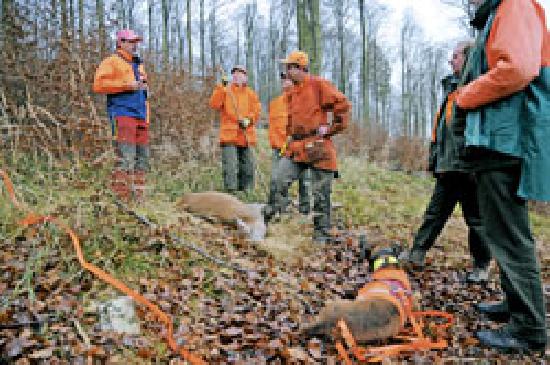
Here is the original article of my pals dog testing day. On 21st March 2012.


Here below I have translated the German text as best as I could.
He is BTW located near Saarlouis on the German French border and was my best jagdschein teacher in 1998-9 and we became very good pals.

Looking for– wounded game!
They have their own dog cemetery, state-owned dogs and the abolition of territorial hunting boundaries: tracking work with the Hanoverian bloodhound is a supreme discipline. DJZ hunting magazine accompanied one of the "tracking detectives" on his main test in the Soonwald forest.

The meeting point is a parking lot in the middle of the Hunsrück region. The driven hunt is over in 15 minutes. A report should be made for wounded game. That’s how long there’s coffee and cake left. The mood is a bit tense. Everyone knows: It is important to assess the shot area and the severity of the injury in the shortest possible time in order to then distribute the work for the test dog aspirants.

Enigmatic
In theory, everything is very clear. But in the practice it looks very different:
Case 1: A sow was shot in the neighboring district that had already been previously shot. The shooter of the first round cannot be determined.
Case 2: A calf was shot at, but has died. Later it turns out that two shooters had already spoken of it as having been wounded, but they couldn't shoot because there was no backstop. A special kind of puzzle.

Main exam
The difficulty of this day: Finding a search that is sufficient for an exam assessment. You have to search for at least 400 meters. If there is a hunt afterwards, the dog can also be judged with regard to the sound and location of the game.
The search for the calf (case 2) was successfully completed by René Wiese (44) (now he is over 50) with his male dog “Delf vom Ibengarten”, but lasted only 100 meters. Good for the piece, bad for the team. Too short for an exam assessment. Mr Wiese has been available on call for a main test since 2009. However, a team of auditors would also have to arrive. To this day, it has failed to meet both points.

Herr Wiese has now made around 300 searches with his dog. In his opinion, 25 to 35 difficult tracking jobs are necessary before a main test should be performed. That is why he registered for the main exam of the Hirschmann club in the Soonwald club on November 12th. But, it actually went differently: He should act as support for the examinees in case control searches or simple death searches are pending. But then it became his own test.

The Hirschmann Association has guaranteed enough dogs with guides for this weekend. If you want a test for a dog, and the handler is convinced that it can be an examination candidate, you swap. The exam candidate takes over. It is therefore not surprising that a total of 11 tracking dog teams are on site on this day. The course of the two simultaneous driven hunts cannot be calculated.

Long search
Delf vom Ibengarten is already in his 7th year. This is actually a very old age for a test, but the dog must have the experience to be able to cope with the test conditions. From a breeding point of view, it would make more sense if the dogs came to the test much earlier, for example in their fourth year. However, since the dogs have to be judged in practice during a search, this is very difficult to plan.

The best prerequisites for an exam-relevant search is a high running shot. The wounded game usually flees a few hundred meters before it goes into the wound bed. If the dog finds the piece, pointing and barking is usually necessary. With such a search, the entire range of abilities can be assessed.

René Wiese was already looking with Delf yesterday. A sow was shot at on a driven hunt. Only the group leader was available as a contact person. He could only say what the wild species was, nothing more. The shooter had already left.

During the preliminary search, Delf turned off at once after about 40 meters. The first drop of blood after 50 meters. Plenty of blood over the next 500 meters. But after almost two kilometers, the search leader had to break off because it was getting dark. No wound bed until then. The hit position remains a mystery. Probably a graze shot on the hip.

Odyssey
After the rain during the night, stalking signs are no longer to be expected. Even so, early in the morning the search team is back at the point where it left off yesterday. Before that, she had wandered ten kilometers through forest paths through the bush. There was no local helper there yesterday. Today it is difficult to explain to the locals where this point is.

After 1.5 hours the test group is at the finish and the male Delf is back at the beginning of a difficult search. Like yesterday, he works very calmly and concentrates on the wound track. There are hardly any confirmations for his guide any more, only now and then a stamp which the experts read as a path to wound bed. The layman hardly recognizes this without explanation. There is no more blood. The wound has probably already closed up.

After it went steeply down the mountain, a gate with good cover gives hope. The sow could be stuck here. Suddenly movement. The examiners have problems sinking deeper into the wet ground following the dog and handler. Then cracks and rushes. Delf stays on the track with his nose down. The old animal and the calf have fled.

After 4.5 kilometers of searching over two days, this is the end. No bed of wounds on the entire route. Only once did the piece briefly give way before a path. This sow is not to be found, the dog handler and the examiner agree.

The way back to the car is long. It goes mountain up, mountain down. Thanks to modern GPS technology from those familiar with the area, the entire search is recorded. No wandering around like in the morning. Back in the search bar, there is a stew for refreshment. After the wet bush and the exertion, just the thing. Unfortunately, these efforts were not rewarded: neither an animal found nor an examination award.

Passed
But the search for a red calf turns out to be a suitable test piece. The end is already known because it was the animal already found (case 2). Only the way was longer, as the dog was placed 1.2 kilometers away at the point of the first hit. The two-day search for the sow is of course taken into account by the judges as well as a subsequent search for a sow over a further 2 days.

Working on 3 pieces and 10 kilometers of searching over 4 days were assessed:

René Wiese passed the main test with his male Delf.
Note: You can find his contact on the homepage of the Hirschmann Association

Hirschmann | Home For a list of bloodhound handlers.
Thanks for the information really good post and very informative. When I finally get round to buying one I may drop you a line for some advice.
 
@Keith Edmunds

for KBGS minimum standard in layman’s terms

Vorprüfung with score of 6 on the track and above and 3rd prize Hauptprufung plus hips of B1 and above plus minimum of good on the Formbewertung (conformity test)

score of 5 On the track means 2nd place Hauptprufung required plus hips etc.

my Heidi scored 5 on her VP track, 2nd prize on her HP, Good/very good on her Formbewertung and A1 on her hips.

there is a lot more in to it than that but that is in bog basic terms.


with the Formbewertung dog too tall no breeding, too short no breeding, 1 tooth out of place no breeding, wrong colour no breeding also poor hip scores no breeding.


Very strict.

nothing like the cock up here in the U.K.

also to add-

no matter how well the dog scores on its tests, when it comes to the conformity if it falls out side of the guidelines it will not be bred.

Lee,you’re a bit wrong with the requirements for breeding.
Rough but ready that’s you😉
 
Thanks Lee, and what do the preliminary and main tests consist of please?

Keith,please find the Verein Hirschmann video of preliminary test,in English.
We have recognised judges here in the UK of both KBGS Vorprüfung/Hauptprüfung and Verein Hirschmann Vorprüfung/Hauptprüfung.
I will search for the KBGS Vorprüfung as well.
There are slight differences mainly owing to tradition which I will explain later.

 
Back
Top