Kentucky Ballistics gun explosion

That was exactly what we did! We used Bren guns. Perhaps I should have said this was back in the late fifties, I rather expect things are rather different today!
I took part in the early 80s in an SMG-fest. We had 5,000 rounds of 9mm Parabellum to fire off as they were either out of date or just coming up to it. We had 10 SMGs and around 100 magazines (34 round capacity). We loaded up 147 or so magazines worth of 9mm.

Unfortunately we had to use a 30m barrack range that only had 4 firing points, so we rotated the SMGs through the firing cycle, so as not to melt them down unnecessarily.

We started with aimed shots in semi-auto (from 10m), but we had a time limit on the range, so we went to full-auto - short bursts of 3-5 rounds. Occasionally, you understand, my trigger finger would cramp up and one pull would unload the 34 round mag through the barrel.

The Figure 11 targets were, shall we say, a little dishevelled by that end of the session. Like Humpty Dumpty, there was no patching them up again. And fortunately there were no extra holes in the brick wall above the sand backstop for the RCO to explain away.

Although this sounds fun, my main memories were of aching fingers and very sore thumbs - no magazine loaders/stripper clips/mechanical assistance in those days.

But yes, we didn't backload the ammo to Kineton for disposal.
 
Last edited:
Serbu is a controversialist.

Want to make your own pistol at home, well he'll sell you plans for that.


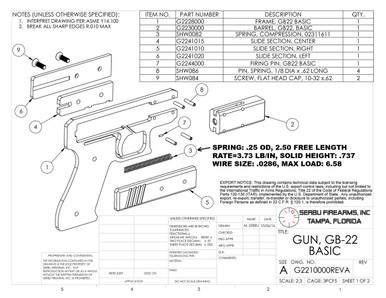
With only a barrel, frame, slide and recoil spring, the GB-22 can be made at home with steel plate and bar stock by use of a hacksaw, file and drill. Attaching the barrel to the frame can be done via welding, roll pins, or screws. The roll pin method is detailed in the plans, though the user can easily adapt them to welding. The concept is to be able to make a simple, working gun for whatever reason you want– though he stresses that you could sell these at gun buybacks for a profit.

Of course his example is a little tricked out with an optic and some custom grips, and he makes the prototype on CAD/CAM-controlled CNC machines because it's easy to do and he has access to them. He stresses you can craft virtually the same with hand tools; it just takes more sweat equity.

If you don’t want to buy a spring he even shows you how to make your own out of music wire!

1619989480645.png


And used to make this charming thing:

1619989620412.webp

What next I wonder, plans to make your own rifle: ? Acquire barrel, preferably pre-chambered. Thread the breech end, or simply use a pre-fit barrel with threaded tenon (wouldn't be such a bad idea, thinking about it). Improvise some sort of cap to screw onto it, drilled for a firing pin, with some sort of thimble to keep it in place. Basic trigger and hammer to whack it. Support the case head as in a proper rifle ? no need, besides it has to stick out so you can pull it out with your fingers, who needs any sort of extractor ?

Sound familiar ? To difficult for you ? Well you can always buy one ready-made. Totally safe, designed by an "engineer", all by himself, and each one gets one round (not proof pressure) shot through it by the man himself, who eschews any sensible precautions such as putting it in a confining box and pulling the trigger with a string from a safe distance. No siree, he just shoulders it and fires it, so confident is he, praise the Lord.
 
One for the armchair nay sayers.


He's on the money I think with regard to failure modes and the lack thereof in this design.

The design doesn't make any provision for venting gas if the case is compromised, even though the case is supported better than most other rifle designs. If pressure did escape from the case somehow (case head separation), there would be something like 4x the normal force on the cap threads (double the area for pressure to act on).

A radial vent hole/holes in the breech cap might have made a big difference. Most bolt action rifles a have vent holes in receiver and bolt body to cope better with case head separations and ruptured primers.
 
even though the case is supported better than most other rifle designs. If pressure did escape from the case somehow (case head separation), there would be something like 4x the normal force on the cap threads (double the area for pressure to act on).
The case head is not fully supported. Not by a long way. Enough of it sticks out to allow the spent case to be plucked out by the fingers, or levered out with e.g. a screwdriver. A "design feature" required because there is no extractor or ejector.

It is far worse than any more conventional design.

Certainly if there is gas leakage into the cap (as will inevitably happen, some day) the forces trying to blow it off will be several times higher than the usual bolt thrust experienced in a traditional rifle design, or normally experienced in this one when all is operating as it should.

Very simple to check, just drill a small hole or two in the exposed case head portion of a full power Nato round, load and fire, see what happens.

I am also curious as to how this rifle headspaces. Is it simply that you screw the cap down until it tightens up against the head of the case, or is it better than that ?

Serbu appears not to have considered including any safety features whatsoever. Or simply disregarded them.
 
Last edited:
@Sharpie the case is supported the full length of the chamber - no worse than any bolt action design (The fact that a bolt action rifle boltface is recessed to accommodate cartridge rim does not mean that it supports the cartridge better).

I'm not sure whether the cap bottoms out against the barrel or on the cartridge.
 
@Sharpie the case is supported the full length of the chamber - no worse than any bolt action design (The fact that a bolt action rifle boltface is recessed to accommodate cartridge rim does not mean that it supports the cartridge better).

I'm not sure whether the cap bottoms out against the barrel or on the cartridge.
I think you have some sort of point. However, to my old fashioned stick in the mud way of thinking, I am more familiar with the idea that the case head should be enclosed all around with steel, with only the minimum of cutaways necessary for e.g. the extractor, and ejector. As in pretty much every bolt gun. And gas venting in controlled directions arranged in that region, as well as consideration to safe venting for when gases get past the firing pin and into the bolt say when primers pierce, primer pockets loosen or even get blown out.

Or even just poor case obturation causing a leak.

I did take a look at the markserbu channel, and found the following couple of vids informative. I'll link to them at points that interest me, but really you need to open them on youtube and watch them all the way through. And maybe read a few of the comments

Firstly the precursor to the BFG and RN-50 designs, and his ideas about bolt lugs and how goes about stress analysis. If that's how he came up with the 85,000 psi yield strength figure for the RN-50 cap threads, well what can I say ?:


In-depth discussion of how the RN-50 came to be, with Royal Nonsuch. You have to watch this from the beginning to get the full flavour. Including a "super funny" account of a negligent discharge.


Finally Demolition Ranch's first use of the thing, demonstrating the operation. I cringed as he loaded it then closed it before cocking the hammer, so as it shut the hammer was in contact with the firing pin, whilst waving it around.


Well, it's entertainment. I suppose.
 
Last edited:
From my armchair, scribbled on the back of an envelope:

Serbu stress analysis. He assumes 25,000 pounds of bolt thrust. Calculated yield strength of thread caps is that they let go when case pressure exceeds 85,000 psi.

Sharpie reverse engineering:

.50 BMG case head diameter is 0.804" Area is 0.508 inches^2 At a pressure of 85,000 psi, bolt thrust is therefore 43,180 pounds. So Serbu is suggesting he has a (catastrophic) safety factor of 1.73. That his cap may be expected to shear off when bolt thrust reaches 43,180 pounds.

Which seems rather low to me.

So let's see where that 25,000 pound bolt thrust assumption might come from. 25,000 pounds applied to 0.508 in^2 = pressure of 49,203 psi. Gulp. That's not even the service pressure of a standard civilian round (53,663 psi CIP). Of course the case should obturate and grip the chamber so 25,000 pounds might be a more real-life expectation. And that gas pressure will not be applied to the full area of the case head, but I don't know what the internal area might be, so can only justify my estimate as worst case (pun). It matters not, because it cancels out in the rest of my analysis.

Lets now use the service pressure for a Nato round, 60,481 psi. 60481/49203 = 1.23 times as much.

Now the Nato proof pressure, 75,608 psi. Now it's 1.54 times as much. And, by the way, one of the proof rounds is oiled to minimise the grip on the chamber, also simulate water or other lubricant in there or on the round.

Thus therefore, waving hands about, the safety margins against a kaboom, particularly using Nato ammo which is highly likely to get into these things, is slim indeed. As for the chances of it passing a Nato proof test, well even if it has been made of top quality steel, without any invisible defects, properly heat treated, and machined to perfection, all thread surfaces mating perfectly, in full contact with zero clearance anywhere, I would be cautious about that.

Would it pass a design review if I was there? No, I can assure you that it would be sent back for a fuller analysis, explanation, and/or redesign.

Feeling tired now, so must get back to my armchair and pencil and paper.
 
Last edited:
More back of fag packet analysis of the threading. Which is completely different than that of simple lugged bolts with square faces.

Assumption, that Serbu has chosen a standard thread profile. ISTR 1" diameter, certainly looks about that.

1620067891423.png

Lets guess that it might be 1" UNF, 8 thread/inch. Leaving three and a little bit threads in engagement (the cap threading is relieved for the first 0.1" to make it easier to fit). Which would be consistent with the picture of Kentucky's stripped threads.

So, to the nuts and bolts:


If using nuts (aka threaded caps) to hold loads, the nut is usually made of lower strength material than the nut. This means the nut can stretch slightly, in an elastic manner, to spread the load. Here is an example looking at five threads engaged, not three. Even so, it is not spread evenly, the first thread taking up say 34% of the load. This is when it has been torqued up, nuts used one time only, not just screwed on finger-tight.

Meaning that the strength of the fastening is actually, in the limit, that of the first thread alone. Exceed that, and it shears, load transfers to second thread, it shears, and so on. This is basic stuff.

Generally the hardness and the actual material strength of a nut is less than the bolt. For example, if you look at the hardness of an SAE J995 Grade 8 nut (HRC 24-32 up to 5/8-in diameter), it is likely to be less than the SAE J429 Grade 8 bolt (HRC 33-39). This is designed to yield the nut threads to ensure the load is not carried solely by the first thread. As the thread yields, the load is further distributed to the next five threads. Even with the load distribution, the first engaged thread still takes the majority of the load. In a typical 7/8-9 Grade 8 nut, the first engaged thread carries 34% of the load. Using internally threaded materials with higher strengths and hardness can often result in fatigue and/or loosening.

1620070672899.png

But what has Serbu done ? He started off with the cap made from stock. But then decided it was barely strong enough in his estimation, so decided to heat treat it. I'm guessing that now it's of similar shear strength to the threads on the barrel.

So very little load sharing. Lets assume none. Valid, because once the first thread shears the force could then propagate to the second, shear, it, and then to the last one.

In reality, in the limit, the cap is, in practice, hanging on by one thread.

Caution: It appears that one could theoretically increase the thread strength by increasing the length
of engagement. However, as illustrated in the Load Distribution chart above, the first thread will be
taking the majority of the applied load. For carbon steel fasteners (including tapped holes) the
length of engagement would be limited to approximately one nominal diameter (approximately 1-
1/2 times the diameter for aluminum). After that, there is no appreciable increase in strength. Once

the applied load has exceeded the first thread’s capacity, it will fail and subsequently cause the
remaining threads to fail in succession.

So, what is the tensile stress area of one thread of a 1" UNF bolt ? Fastener Bolt Thread Stress Tensile Area Table Chart | Bolt Critical Thread Stress Area Chart - Engineers Edge says 0.663 square inches.

Serbu said that his rule of thumb is that a .50 BMG two-lug bolt needs one square inch of high strength heat treated steel lug shear area. Go figure.
 

Attachments

  • 1620067288493.webp
    1620067288493.webp
    23.1 KB · Views: 1
Last edited:
Back
Top