Uberti 1858 New Army tear down and clean - some discoveries

zambezi

Well-Known Member
My newish Uberti 1858 New Army .44 is pretty accurate with round ball as compared to some other similar models used at my shooting club.

But my revolver has suffered more misfires than any other similar model on the range. Switching percussion caps between BP revolvers proved problem was with my Uberti, not the consummables. I then compared how the action felt as compared to another better performing example and discovered that the mainspring tension was much lower on mine. Also, the hammer pivot on mine seemed stiffer and perceptibly "notchy" if released by thumb control.

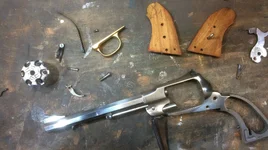
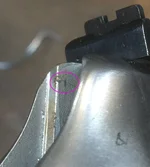
So I did a full tear down IMG_7465.webp and clean today and discovered that quite a few of the internals had friction-inducing light rust IMG_7464.webp IMG_7468.webp These were easy to buff off and lubricate. Next I discovered that the hammer's leading edge was striking the side of the channel into which it passes as the trigger releases it forward IMG_7475.webp . The culprit was a rather obvious machining burr on the hammer's leading face that was snagging the frame as it fell. Lastly, I discovered that the mainspring tension was fully adjustable via the grub screw in the front of the pistol grip Spring_adjuster.webp which allowed for an appropriate improvement in hammer positivity. Need to get back to range to test...
 
Do try to dry fire a few times at home to ensure proper rotation of the cylinder, of course without the hammer smashing the nipples to bits. Found out the hard way after having the cylinder loaded on the range that it didn't spin and was mis-aligned. As it was easy to strip, had to fix it while on the range but was something that could have been avoided. Have fun shooting.
 
The 1858 is a great revolver , you do need to go over the newer replicas however . I've had similiar issues with repros over the years , nothing major , but they do happen . Rust is a constant enemy with any BP firearm , the residue gets into every nook and cranny . It pays to do a regular tear down and lubrication , especially in your environment . I can get away with not doing it as much , but Alberta is drier than the UK .

AB
 
Rust is a constant enemy with any BP firearm , the residue gets into every nook and cranny

One upgrade I would want to do is stainless nipples. The standard blued items rust quicker than any other part of the chassis. I have yet to find a UK stockist. Do you have SS nipple suppliers in Canada?
 
Imagine if guns were made like modern day household appliances. Sealed, not strippable or repairable, and basically throw them away when they go wrong. I hope the gun industry doesn't go that way!
 
I mix beeswax and olive oil for all my muzzleloaders. It goes on the lock parts, in the bore, on the wads and externally too. Never get rust issues.
Mineral oil does not work with black powder or pyrodex. It can not absorb the salts indefnatly and the other deposits will turn it to a tar like substance.
Animal and or vegetable based oils and fats are best. 👍
 
I use "Bore Butter" and Pyrodex. My Navy Model Remington .36 was fired with all three cylinders, three times each on the 4th of July one year. (54 shots) On November 26th I cleaned it. No rust. No pitting.
Animal fats contain salt. They don't get near my BP guns. Bore butter is vegetable based. (and I like the smell!) ~Muir
 
Beeswax, an animal fat does not contain salt. Some store bought fats have added salt. It don't recommend that.
I have rendered beef and deer fat. There is no salt in that.
The point is that animal and vegetable can and does absorb indefinitely salts, unlike mineral oils.
Salts are produced via consuming black powder and pyrodex plus other corrosive elements. But it is easily controlled via animal or vegetable, with no added salt, products or home made concoctions.
Most early black powder bullets used a beeswax or tallow mix for lube etc.
 
It's worth understanding the differences between black powder, and the substitutes that have been developed. Initially Pyrodex, where I think the idea was to make something similar to black powder, but which could be transported and stored without the safety restrictions applying to black powder.

Otherwise it has similar ingredients, (Potassium nitrate, charcoal and sulphur) but the potassium nitrate content has been reduced, potassium perchlorate added as an oxidiser, sodium benzoate and dicyandiamide added as a fuel, supplementing the charcoal and sulphur content.

The sulphur content of black powder is important not just to be burned, but to lower the ignition temperature and make it usable with weak ignition sources, such as flintlocks.

Pyrodex is certainly inferior to black powder in this aspect. When shooting e.g. 45 calibre rifles, patched round ball, No. 11 cap, I found it very erratic, and had to resort to a small duplex charge of black powder, topped with Pyrodex, to get any sort of consistency for target shooting.

Then came 777 which eliminated the sulphur, and so a large part of the smell (hydrogen sulphide gas)

The latest thing is I think Blackthorn 209. Which appears to be quite different, the fuel being "nitrate ester" rather than charcoal, sulphur, sodium benzoate, or dicyandiamide. And contains an organic oxidiser as well as a mineral one.

From a paper discussing gunshot residue analysis: Discriminating Hodgdon Pyrodex(®) and Triple Seven(®) using gas chromatography-mass spectrometry - PubMed

Abstract
Pyrodex(®) and Triple Seven(®) are black powder substitutes that often find use as fillers in improvised explosive devices, such as pipe bombs. These propellants have essentially the same overall appearance and oxidizers, but different fuels. For example, Pyrodex(®) contains sulfur, sodium benzoate, and dicyandiamide (DCDA), whereas Triple Seven(®) lacks sulfur but also contains 3-nitrobenzoic acid. In this method, intact particles and postblast solid residues were reacted with bis(trimethylsilyl)trifluoroacetamide + 1% trimethylchlorosilane in acetonitrile for 30 min at 60°C. The resultant trimethylsilyl derivatives of the organic fuels were then analyzed by gas chromatography-mass spectrometry. Each derivative was clearly resolved from other components, and high-quality mass spectra were obtained. In addition, characteristic fragments resulting from loss of a methyl radical from the molecular ion (m/z 163 for sulfur, m/z 171 for DCDA, m/z 179 for benzoic acid, and m/z 224 for nitrobenzoic acid) were able to be monitored.


© 2010 American Academy of Forensic Sciences.

From the MSDSs:

Pyrodex: (NB, this doesn't mention the other things)

1643368958570.webp
777:

1643368809795.webp

Blackthorn 209:

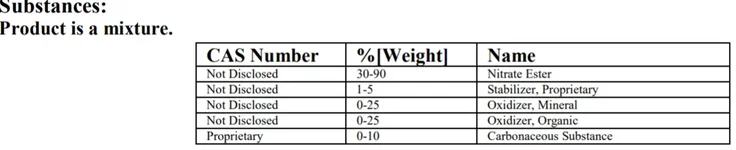
1643369110290.webp


There seems to be a belief that the substitutes are less corrosive than the proper stuff, but I don't think that is necessarily correct. They are different certainly. But corrosive salts are still created during combustion. Certainly Pyrodex can be pretty corrosive, especially as it still contains sulphur. And the potassium perchlorate content of it, and 777 (maybe Blackthorn too ?) adds another twist to the cocktail of solid residues that are formed.

From Wikipeia:

Gunpowder does not burn as a single reaction, so the byproducts are not easily predicted. One study[10] showed that it produced (in order of descending quantities) 55.91% solid products: potassium carbonate, potassium sulfate, potassium sulfide, sulfur, potassium nitrate, potassium thiocyanate, carbon, ammonium carbonate and 42.98% gaseous products: carbon dioxide, nitrogen, carbon monoxide, hydrogen sulfide, hydrogen, methane, 1.11% water.
 
Some interesting thoughts on why BP substitutes that contain potassium perchlorate (Pyrodex, 777 etc.) may become more corrosive than plain black powder if not suitably cleaned. The idea being that potassium chloride residues are left, which are not easily removed or neutralised, except by e.g. hot water. A bit like old corrosive primer residues.

I can certainly confirm that my very experienced muzzle loading friends found that Pyrodex could be much worse than black powder, needing thorough cleaning ASAP using their traditional methods (water and emulsifiable oil.

Perhaps vegetable and animal fats can be more protective than mineral oils and greases. I'm not really sure of the science behind that. They each had their own concoctions for bullet lube and patch lube, one of the best (European champion several times) used to make a patch lube using beeswax and pure neatsfoot oil. Pure, not compounded with mineral oils.

https://www.cascity.com/forumhall/index.php?topic=56362.0

I did take a look at the Blackhorn FAQs, and as I suspected it is completely different. In particular it needs strong ignition, shotgun caps etc. They say that it is not suitable for e.g. no. 11 caps even in revolvers, never mind rifles using larger charges. Claimed to be very un corrosive and aqueous cleaners unsuitable. Doesn't seem to be distributed in the UK either.
 
All I ever use to clean my sidelocks, not revolvers, is boiled water.
All the foul is diluted and the heat dries the gun. Once cooled a little but still warm. On goes the beeswax and olive oil grease/paste. Inside and out.
No problems for 30 years 👍
 
Triple7 with 'water only baby wipes' and a squirt of WD40 does it for me. Once a year I strip it down and just use warm water to clean out all the bits. For the nipples, after a clean, a bit of copper grease helps. I don't know the right or wrong but this seems to work for me the last few years without issues.

Triple7 now needs explosive license to buy/ possess.
 
Triple7 with 'water only baby wipes' and a squirt of WD40 does it for me. Once a year I strip it down and just use warm water to clean out all the bits. For the nipples, after a clean, a bit of copper grease helps. I don't know the right or wrong but this seems to work for me the last few years without issues.

Triple7 now needs explosive license to buy/ possess.

Has done for a while. And so does Pyrodex, in pelletised form (ISTR that these actually have some black powder on the base, to improve the poor ignition properties.)

As Kranks explain:

WHAT LICENSE DO I NEED TO BUY BLACK POWDER?
Quick answer: You require an Explosives Certificate with the UN numbers 0027 and 0028 listed is required in order to acquire and keep black powder. Refer to last section for ordering information.
Comprehensive answer: Black powder is the world's oldest explosive compound and has been in constant use ever since. It is the most popularly consumed powder for muzzle loading, re-enactment and vintage cartridge reloading. Black powder is a mixture of charcoal, potassium nitrate and sulfur, and is a deflagrating low explosive compound. In the UK (along with pretty much everywhere else), black powder is classed as an explosive, and is subject to the most stringent controls.

Black powder is classified as UN0027/UN0028 with hazard type 1.1. This means that in UK law, black powder is considered an explosive (Explosives Regulations 2014 S2(1)(a)), and an Explosives Certificate with the UN numbers 0027 and 0028 listed is required in order to acquire and keep black powder (ER2014 S4(1)(b)).

For more information on how to get an Explosives Certificate to keep black powder, click here.

Full range of Black Powder is available here.


WHAT LICENSE DO I NEED TO BUY HODGDON'S TRIPLE 7 POWDERS?
Quick answer: You require an Explosives Certificate with the UN number UN0499 listed in order to acquire and keep Triple 7. Refer to last section for ordering information.
Comprehensive answer: The Triple 7 range of black powder substitutes from Hodgdon are relatively new on the market, and offer an alternative to black powder, particularly for those shooters seeking less smoke and residue, if shooting indoors for example. Hodgdon's range of Triple 7 covers pretty much every calibre of muzzle loading gun, from FFFG grade for pistols, to FFG for rifles and shotguns. Triple 7 is chemically very different to both black powder and Pyrodex, interestingly using a glucose compound rather than charcoal as a fuel, and therefore behaves differently when used in a gun. It is primarily this difference that means Triple 7 powders are classified differently than any other propellant.

Triple 7 (any type) is classified as UN0499, with a hazard type 1.3c. As this UN number falls outside the exemption under Schedule 2 of the Explosives Regulations 2014, it is not specifically exempt, and therefore an Explosives Certificate with UN number UN0499 is required to acquire and keep Triple 7.

For more information on how to get an Explosives Certificate to keep Triple 7, click here.
Full range of Triple 7 is available here.

WHAT LICENSE DO I NEED TO BUY HODGDON'S PYRODEX POWDERS?
Quick answer: You require a Firearm or Shotgun Certificate to purchase Pyrodex Powders or be a Registered Firearms Dealer. Refer to last section for ordering information.
Comprehensive answer: Pyrodex by Hodgdon is the old favourite black powder substitute, and has been on the market for a number of years. In terms of chemical composition, Pyrodex is classed as a smokeless powder the same as other modern propellants for reloading. Pyrodex is the traditional muzzle loading alternative, and is an excellent, modern and consistent powder, though is less dense than true black powder, and therefore must be measured differently when loading.

Hodgdon's Pyrodex powders are classified as UN0161, with hazard type 1.3c. This UN number is mentioned as specifically exempt from requiring an explosives certificate to own (Explosives Regulations 2014, Schedule 2 S15(a). Whilst this range of powders is exempt from an Explosives Certificate, this does not mean they can be bought over the counter with no license requirements. In order to purchase Pyrodex, you must be either; a Registered Firearms Dealer, or hold a current Firearms or Shotgun Certificate (ER 2014 Schedule 2 S15 (b)(i-iiii). The requirement for the purchaser to be either an RFD, or have a shotgun/firearms certificate is unique to smokeless powders (including Pyrodex), and this is not sufficient to buy either black powder or Triple 7.

Note, this exemption does not apply to Pyrodex pellets, which are classified as UN0499, therefore are treated the same as Triple 7 powders. We are only stockists of Pyrodex powder.
 
Point of information. The co-inventor of Pyrodex (Dan Pawlack) was killed about 18 months after he had filed his patent application. When his powder plant blew up.

Goex had a go at making a fructose based thing, again the plant blew up, somebody died. End of.

Then there was BlackMag. A sorry tale. Explosion, some died, key witness murdered before he could give evidence. Owner banged up for 10-20 years.

Compounding mixtures of strong oxidisers and fuels is not for the faint hearted, or inexperienced. Though I daresay if they can be patented (unlike black powder), maybe just possibly make a better mousetrap, there might be some point.

Making nitro powders seems altogether better understood. Or seek some consultancy from e.g. Switzerland.

Frankly, no accuracy shooter uses Pyrodex. Triple 7 is semi-usable. But hereabouts, why bother to use anything but black ? The entry cost of making or buying the wooden storage box is low, and if you want it, a POMSTER (or whatever the proper name is nowadays) is just a tick box exercise after that.
 
why bother to use anything but black
Convenience and easy to clean. I am pretty sure the invention of bp wasn't a walk in the park either. At my local there's almost next to none who still use bp as many have converted to either Pyrodex or Triple7 and still shooting great scores. I tried bp a couple of times and the mess it creates and the time it takes to clean up was better spent with Tiple7. Everyone has their preference and at least the ones I shoot with, black powder is much lower on the list compared to Pyrodex or Triple7. I have never felt either of these powders unsafe to handle and use much less volume of Triple7 to achieve what I want compared to my trial of bp.
 
Point of information. The co-inventor of Pyrodex (Dan Pawlack) was killed about 18 months after he had filed his patent application. When his powder plant blew up.

Goex had a go at making a fructose based thing, again the plant blew up, somebody died. End of.

Then there was BlackMag. A sorry tale. Explosion, some died, key witness murdered before he could give evidence. Owner banged up for 10-20 years.

Compounding mixtures of strong oxidisers and fuels is not for the faint hearted, or inexperienced. Though I daresay if they can be patented (unlike black powder), maybe just possibly make a better mousetrap, there might be some point.

Making nitro powders seems altogether better understood. Or seek some consultancy from e.g. Switzerland.

Frankly, no accuracy shooter uses Pyrodex. Triple 7 is semi-usable. But hereabouts, why bother to use anything but black ? The entry cost of making or buying the wooden storage box is low, and if you want it, a POMSTER (or whatever the proper name is nowadays) is just a tick box exercise after that.
You beat me to it . I've never been able to get the accuracy out of BP substitutes that I can get with true BP , in either cartridge rifles or muzzleloaders , and I tried ....... a lot . I forgot about BlackMag , that was definitely a freaky sequence of events .
In all honesty , I've been scrubbing out BP residue for over 40 years , it doesn't really bother me anymore . It's like shooting corrosive ball ammo in my milsurps , cleaning them is part of shooting them . That being said , if someone does come up with a viable replacement for BP , I'll buy stocks in the company .

AB
 
On a brighter note , Goex has just been purchased by EMR ( Estes Model Rocket ) . They're going to be producing BP again , no time line unfortunately .

AB
 
Back
Top