
You are using an out of date browser. It may not display this or other websites correctly.
You should upgrade or use an alternative browser.
You should upgrade or use an alternative browser.
best case trimmers?
- Thread starter Utectok
- Start date


Black & Decker
K
K

I really rate my LE Wilson. It’s not especially quick (although the drill bit attachment is a lifesaver!) but it’s very repeatable. Once setup I don’t expect to get a case more than 0.001 out from my desired length, and it’s rare to get any that are out of spec.
The one cutter I have been truly impressed with is the Giraud. I had a LE Wilson stainless ultimate trimmer, not worth the money. I saw a fair thou variance between cases. The Giraud is within 0.0005” - 0.001” typically and adjustable in 0.001” increments use whidden click adjust rings.
Whichever way you go, a trimmer that indexes off the shoulder is more accurate than one that indexs off the base of the case.
I think I was looking at a Lyman orange box thing before getting the Giraud

 www.1967spud.com
Whichever way you go, a trimmer that indexes off the shoulder is more accurate than one that indexs off the base of the case.
I think I was looking at a Lyman orange box thing before getting the Giraud
LYMAN BRASS SMITH CASE TRIM XPRESS - 1967spud Reloading Supplies Ltd
Fast and accurate trims – approximately 15 cases per minute Variable speed motor and ultra-sharp, long lasting carbide cutter Utilizes case shoulders to center & trim(Not for use on straight wall cases) Comes with 10 bushings fitting most popular bottleneck rifle cartridges Smooth...
www.1967spud.com
Last edited:

Utectok
Well-Known Member
Yeah I was looking at that one. Out of interest why is shoulder measuring more accurate than off the base. I would of thought any inaccurate shoulder bumps would affect case length?The one cutter I have been truly impressed with is the Giraud. I had a LE Wilson stainless ultimate trimmer, not worth the money. I saw a fair thou variance between cases. The Giraud is within 0.0005” - 0.001” typically and adjustable in 0.001” increments use whidden click adjust rings.
Whichever way you go, a trimmer that indexes off the shoulder is more accurate than one that indexs off the base of the case.
I think I was looking at a Lyman orange box thing before getting the Giraud
LYMAN BRASS SMITH CASE TRIM XPRESS - 1967spud Reloading Supplies Ltd
Fast and accurate trims – approximately 15 cases per minute Variable speed motor and ultra-sharp, long lasting carbide cutter Utilizes case shoulders to center & trim(Not for use on straight wall cases) Comes with 10 bushings fitting most popular bottleneck rifle cartridges Smooth...

The Lee one is pretty foolproof. And not expensive. It indexes off the case holder/case head face with a pin through the flash hole giving a dead length. I welded a nut onto the case holder ring to make it a one handed job to put a case or take I one out…internal and external chamfering and a wipe with Autosol can be done at the same time.
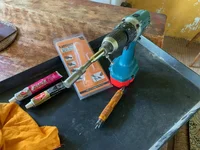
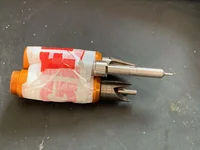
My new improved one pass trim and chamfer tool elegantly taped together!
Uh?
If you are trimming to achieve COAL then it can't be more accurate to index of the shoulder...you must be trimming for some other requirement where shoulder to case mouth is important?
Alan
My new improved one pass trim and chamfer tool elegantly taped together!
Whichever way you go, a trimmer that indexes off the shoulder is more accurate than one that indexs off the base of the case.
Uh?
If you are trimming to achieve COAL then it can't be more accurate to index of the shoulder...you must be trimming for some other requirement where shoulder to case mouth is important?
Alan

This one is pretty good -

 www.thestalkingdirectory.co.uk
Regards
www.thestalkingdirectory.co.uk
Regards
JCS
Sold: - Henderson Gen 3 trimmer + 308 and 6.5 cutters
I have for sale a Henderson Gen 3 trimmer + one 308 cutter and one 6.5 cutter. Included is a US to UK plug adaptor. Photos Mounting board and brass catcher are not included. £895 posted & insured to UK mainland only. Thanks JCS
www.thestalkingdirectory.co.uk
JCS
Just going by experience comparing the LE Wilson to the Giraud.Yeah I was looking at that one. Out of interest why is shoulder measuring more accurate than off the base. I would of thought any inaccurate shoulder bumps would affect case length?
I’d mess about with brass in the Wilson and turn the case around so I was trimming the base just out of curiosity. It was surprising how non-uniform bases were.
Common sense would also lead me to think there is less opportunity for variation in length between the case mouth to the shoulder than the case mouth to the base of the case.
I have an LE Wilson which works nicely but the reality is I hardly need it for most of my cartridges. I shoot and reload .222, .243, 7x57 and .308 and have only ever used it for 7x57 which I run pretty hot. All the other cartridges I haven't bothered trimming yet, even after eight or nine reloading cycles. So depending on which cartridges you run and how hot you load them, you may not need a case trimmer.
Utectok
Well-Known Member
I do currently trim in my old metal lathe which is slow but accurate. About 2/3 of my cases need trimmedI have an LE Wilson which works nicely but the reality is I hardly need it for most of my cartridges. I shoot and reload .222, .243, 7x57 and .308 and have only ever used it for 7x57 which I run pretty hot. All the other cartridges I haven't bothered trimming yet, even after eight or nine reloading cycles. So depending on which cartridges you run and how hot you load them, you may not need a case trimmer.
I’d mess about with brass in the Wilson and turn the case around so I was trimming the base just out of curiosity. It was surprising how non-uniform bases were.
But doesn't that equally affect whatever system you use to set the shoulder length from the head face, prior to setting your case mouth dimension from the shoulder?
Common sense would also lead me to think there is less opportunity for variation in length between the case mouth to the shoulder than the case mouth to the base of the case.
It is a smaller distance. But if trying to achieve cartridge overall length, there is more potential for error if using two dimensions...head face to shoulder then adding shoulder to case mouth, than just the single one from case head face to case mouth.
Alan
Utectok
Well-Known Member
Yeah I use the lee trimmer (in the lathe) for that reason it measures from a pin through the flash hole to the case mouth. My theory is that what matters a shoulders can be bumped back depending on taste and I’ve never got my shoulder bumps super accurate well within a couple of thou so okBut doesn't that equally affect whatever system you use to set the shoulder length from the head face, prior to setting your case mouth dimension from the shoulder?
It is a smaller distance. But if trying to achieve cartridge overall length, there is more potential for error if using two dimensions...head face to shoulder then adding shoulder to case mouth, than just the single one from case head face to case mouth.
Alan
The current chairman of my rifle range club was saying he reverses the system. He holds the Lee mandrel cutter in a pillar drill chuck and has a hard plate on the drill table for the flash hole pin to stop on. He just hand holds the cases down onto the plate which eliminates the fiddle of getting then in the case holder...Yeah I use the lee trimmer (in the lathe) for that reason it measures from a pin through the flash hole to the case mouth. My theory is that what matters a shoulders can be bumped back depending on taste and I’ve never got my shoulder bumps super accurate well within a couple of thou so ok
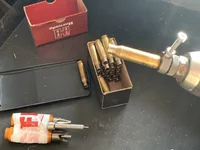
How do you use it in your lathe? Like the photos above of my drill with the case holder rotated by the chuck or the with cutter rotating?
Alan
Utectok
Well-Known Member
So I put the cutter in the headstock and a collet Chuck in the tailstock. The collet Chuck has a bottom stop in it that I made. Then I put the cartridge in the collet Chuck bottomed out and twist tight by hand. Then I feed the tailstock onto the mandrill… but the tailstock is not bolted down so it slides up the bed when the pin hits the bottomThe current chairman of my rifle range club was saying he reverses the system. He holds the Lee mandrel cutter in a pillar drill chuck and has a hard plate on the drill table for the flash hole pin to stop on. He just hand holds the cases down onto the plate which eliminates the fiddle of getting then in the case holder...
How do you use it in your lathe? Like the photos above of my drill with the case holder rotated by the chuck or the with cutter rotating?
Alan


Ttocs
Well-Known Member
I’ve a few case trimmers including a Wilson which is very good but I keep it set up for my Fireball. I’ve found the Lee deluxe very easy to use (it uses a die in the press to hold the case and trimmer) and it trims and also chamfers the inside and out side of the neck all in one quick operation - trim length accuracy/consistency is very good too.
N
N

Jura
Well-Known Member
That looks very good think I might order one and keep it set up in a spare pressI’ve a few case trimmers including a Wilson which is very good but I keep it set up for my Fireball. I’ve found the Lee deluxe very easy to use (it uses a die in the press to hold the case and trimmer) and it trims and also chamfers the inside and out side of the neck all in one quick operation - trim length accuracy/consistency is very good too.
N

One of the few Lee tools I choose to use. The little ziptrim bolted to my mini table that houses the thrower and press as well.
Quick to install a case, trimmer indexes off the base of the shell holder, so trims to length from case head. At the same time you can debur and chamf and also give a couple of spins in wire wool if you like shiny stuff. I must admit to being a little jealous of @Alantoo and his advanced three way tool wrapped in police incident tape . I might have to steal that idea.
Ziptrims are good but you should factor in replacement costs as like some of the Lee stuff, they work well but are crap from a longevity point of view. I reckon mine does somewhere in the region of 2000 cases before it begins its demise and the little metal coil thing inside shears and logs it. For around £20 or whatever they are, I accept that cost. I am on about my 4th one now and they all break in the same place. They are just quicker than manually winding a Forster or other trimmer, although I am sure they would last a lifetime. If I reloaded 100 rounds a year, I would definitely use a lathe style manual winder but for higher volume, I like the Lee cheapo thingy.
Quick to install a case, trimmer indexes off the base of the shell holder, so trims to length from case head. At the same time you can debur and chamf and also give a couple of spins in wire wool if you like shiny stuff. I must admit to being a little jealous of @Alantoo and his advanced three way tool wrapped in police incident tape
. I might have to steal that idea.Ziptrims are good but you should factor in replacement costs as like some of the Lee stuff, they work well but are crap from a longevity point of view. I reckon mine does somewhere in the region of 2000 cases before it begins its demise and the little metal coil thing inside shears and logs it. For around £20 or whatever they are, I accept that cost. I am on about my 4th one now and they all break in the same place. They are just quicker than manually winding a Forster or other trimmer, although I am sure they would last a lifetime. If I reloaded 100 rounds a year, I would definitely use a lathe style manual winder but for higher volume, I like the Lee cheapo thingy.
Similar threads
- Replies
- 11
- Views
- 756


- Replies
- 20
- Views
- 642

- Replies
- 15
- Views
- 1K

- Replies
- 2
- Views
- 155

