
Split Case?

Spikelet

Well-Known Member
I've just started to try reloading and as I went to examine a used case I spotted this split case.
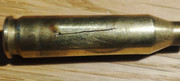
I have to admit I'm not sure if this was a once used factory Hornady case a case or one that I've already reloaded, if so the load was 42gr of Ramshot Hunter and a 75gr Vmax. Loaded using a Lee classic loader.
I've been very cautious and double checked my loads, which at 42gr is slightly under Western Powders suggested weight.
Is this likely to be just a badly formed case or am I missing something, any advise would be much appreciated
 
To start with, do not put 100% faith in what the books say in terms of over or under limits. Your load could be well under what your rifle will tolerate pressure wise or could be the other way. All chambers/bores can be different. Most fall within the standard remit of book/maker advice but for example, I have a rifle that starts showing pressure signs a good 4 whole grains of powder under book max. Adequate velocities and performance can be found just south of where most books say to start from. Yes that rifle is clearly an outlier but it can and does happen both ways. I know people with rifles that tolerate charge weights well in excess of book limits.

Secondly, do keep a tag on how many times cases have been fired. Or should I say, keep all cases that have been fired the same amount of times together. That way, when you get a failure like you have here, you can make a decision to bin the lot if that is what you feel is required. It is a bad idea to mix them up. Use the same brand and batch of brass for a particular load. That, for me anyway, is good practice.

Hard to tell from here but clearly if you look above the web of the case, you are very very close to head separation there. I would personally be binning the brass associated with the batch that the failed case comes from but you might well be able to test the internals of the others (look up paperclip inside case method) to see if any further failures appear imminent. If you do not find any concerns and the no cases show signs of over pressue, then it might just be a random outlier.

Lastly, do you know what sort of velocities you are getting from your loads, how they compare to book data and if you are seeing any other signs of over pressure? Mostly a sticky/hard lift to the bolt post firing and ejector marks on the head of your fired cases. It is worth properly familiarising yourself with signs of over pressue if you are not already. It can save you getting to this point but it could also be some random case failure.
 
I've just started to try reloading and as I went to examine a used case I spotted this split case.

I have to admit I'm not sure if this was a once used factory Hornady case a case or one that I've already reloaded, if so the load was 42gr of Ramshot Hunter and a 75gr Vmax. Loaded using a Lee classic loader.
I've been very cautious and double checked my loads, which at 42gr is slightly under Western Powders suggested weight.
Is this likely to be just a badly formed case or am I missing something, any advise would be much appreciated
did you work up slowly from minimum charge or just jump in at 42 ?
 
I have had one like that from a .223 Tikka T3. It was factory ammunition. I never trusted the rifle after and sold it.

I experienced shrapnel blown back down the side of the bolt.

This was my first centre fire rifle and I was incredibly inexperienced. I didn’t look into the cause and wish I had never sold the rifle. At a significant loss I may add.

I have however just purchased another .223 Tikka T3. I just hope it doesn’t happen again.

For me it’s got to be an object causing damage to the brass to allow that kind of failure. Not a loading issue.
 
Only a guess, but if it were mine I would vote poorly formed case, the lowest part of the fissure shows a flame flowed crater as if that was the initial point of burst.
I would be having the chamber checked for any erosion from that.
 
I've just started to try reloading and as I went to examine a used case I spotted this split case.

I have to admit I'm not sure if this was a once used factory Hornady case a case or one that I've already reloaded, if so the load was 42gr of Ramshot Hunter and a 75gr Vmax. Loaded using a Lee classic loader.
I've been very cautious and double checked my loads, which at 42gr is slightly under Western Powders suggested weight.
Is this likely to be just a badly formed case or am I missing something, any advise would be much appreciated

Could be a bad case.

Had a load of Winchester cases in 243 which split at the neck/shoulder junction, binned the lot.
 
Is this likely to be just a badly formed case or am I missing something, any advise would be much appreciated
The case has split open from the hole near the head, until it stopped eventually.

From the looks of your photo you seem to have scrubbed off most of the sooty evidence to give a clearer picture of the crack. Leaving scratch marks from whatever you used.

The case also seems to be displaying classic signs of incipient case-head separation.

If you have lost track of how many times you reloaded this already, sharpen up your act. Brass wears out, and this piece looks as if it was well past that stage.

The Lee Classic loader is a very poor tool, in some ways. It only sizes the neck, the body and shoulder are untouched, so it is anybody's guess as to what the main portion of that case has gone through, with repeated unrecorded firings, in your rifle's chamber, or maybe even another rifle's, if e.g. you use "once fired, honest guv" or somebody else's cast-offs.

Best to start using a press, with a full length sizer, to actually take control of what you are doing. Batch your reloads and scrap the brass as soon as any of the batch seem wrong.

If I have got any of this wrong, apologies, but that's what I took from your photo. Always best to ask if unsure.
 
The case has split open from the hole near the head, until it stopped eventually.

From the looks of your photo you seem to have scrubbed off most of the sooty evidence to give a clearer picture of the crack. Leaving scratch marks from whatever you used.

The case also seems to be displaying classic signs of incipient case-head separation.

If you have lost track of how many times you reloaded this already, sharpen up your act. Brass wears out, and this piece looks as if it was well past that stage.

The Lee Classic loader is a very poor tool, in some ways. It only sizes the neck, the body and shoulder are untouched, so it is anybody's guess as to what the main portion of that case has gone through, with repeated unrecorded firings, in your rifle's chamber, or maybe even another rifle's, if e.g. you use "once fired, honest guv" or somebody else's cast-offs.

Best to start using a press, with a full length sizer, to actually take control of what you are doing. Batch your reloads and scrap the brass as soon as any of the batch seem wrong.

If I have got any of this wrong, apologies, but that's what I took from your photo. Always best to ask if unsure.
Can‘t really follow you on the Lee Loader issue. Especially a F/L resize would make this damage much more likely than a simple nick sizing.
 
Is it possible there was a bit of grit in the die that weakened the case at the position of what looks like a hole at the end of the split nearest the case head?
 
The Lee Classic loader is a very poor tool, in some ways. It only sizes the neck, the body and shoulder are untouched, so it is anybody's guess as to what the main portion of that case has gone through, with repeated unrecorded firings, in your rifle's chamber, or maybe even another rifle's, if e.g. you use "once fired, honest guv" or somebody else's cast-offs.

Pure drivel.
 
  • Like
Reactions: JTO
I've obviously realised my error in not recording the case history (now suitability addressed) what I can say is that it was either factory loaded ammunition that I had purchased and shot from a retailer or possibly the same but reloaded once by me.
When I examined the cases I spotted the failure and used some fine wire wool to get a clearer view of the crack, hence the scratches (this was a macro image and it certainly has enhanced the marks)
To the best of my knowledge the die was grit free, having been cleaned during use
 
it sounds like you are using assorted batches of case's,I would bin them all and start again with a new batch " all the same".
case's can vary so much and it will take one possible cause from the equation.
consistently is the key.
 
Back
Top