

Yes, its now an established part of my reloading process:Do you anneal after every firing?
- Deprime/neck-size
- Trim if necessary
- Chamfer
- Wet tumble
- Dry
- Anneal
- Neck-size
- Reload as required

Yes, its now an established part of my reloading process:Do you anneal after every firing?
What method did you use to determine optimal anneal time? I think this would be an issue with any potential induction annealing machine too.Yes, its now an established part of my reloading process:
- Deprime/neck-size
- Trim if necessary
- Chamfer
- Wet tumble
- Dry
- Anneal
- Neck-size
- Reload as required
Sacrifical cases and colour changeWhat method did you use to determine optimal anneal time? I think this would be an issue with any potential induction annealing machine too.
I think technically - yes. No different if you paid by bank transfer.I just did pay for the Reloader Brass Annealer.
Please, pay using the option "Send money to someone you trust" so that I don't get charged. Hm?????
No protection to me if the shipment gets lost or?
I will live in hope.I think technically - yes. No different if you paid by bank transfer.
All I can say is that he has many happy customer’s over several years.I will live in hope.
Good to hear that, Bulgaria is for me a bit far on the eastern border of the EU, but at least they are in it.All I can say is that he has many happy customer’s over several years.
Like most/all other shooters answering this most interesting post from ‘HandB’, YES I would be most interested in a good quality UK Made, Induction Annealing Machine, ESPECIALLY if the costs to join the Club are inviting!!?One of my shooting buddies happens to be an electronic engineer and is making me a relatively simple and robust induction annealing machine so I can get even neck tension on my reloads. If any of you might also be interested in such a gadget comment below and I will keep you posted about how the machine develops in case he is willing to make some for other people at some point in the future.
The one from reloader in Bulgaria arrived in good time with all the extra wheels. I have been too busy to set it up as the workshop here gets too cold in the winter.Good to hear that, Bulgaria is for me a bit far on the eastern border of the EU, but at least they are in it.
Thanks Steve, yes I am pleased to report that my engineering pal is progressing well with his development work on the induction annealing machine. At the moment he is testing out different induction coil geometries and has decided to make the machine with a top mounted auto feed carousel big enough automatically to process a batch of 30 cartridge cases in one go. The holes in the carousel will be sized to accommodate cases up to and including .308 and similar sized diameter case heads (such as .243, 6.5 Creedmoor and so on). He is also thinking about making a carousel with magnum sized holes available to buy as an optional extra if anyone wants to anneal large cases like .338 Lapua Magnum. So if anyone interested in annealing magnum cases in the machine please do let me know in this thread and I will do my best to encourage him to offer this large sized carousel.Like most/all other shooters answering this most interesting post from ‘HandB’, YES I would be most interested in a good quality UK Made, Induction Annealing Machine, ESPECIALLY if the costs to join the Club are inviting!!?
Any further information along these lines please my friend?? We are ALL waiting to see what can be offered here I know….
ATVB,
Steve.
Great - I am meeting him tomorrow so I will mention your requirement to him.Hi I would definitely order an additional magnum size carousel

Thanks Alex, nice work - the anneal lines look good to me. As long as the case head is not softened I think they will be fine if some annealed are a bit lower than others. And I think your anneal time of 15 seconds per case is decent as the longer the anneal time the more precise the depth of anneal. I wouldn't want to go much faster than 7 seconds that my pal's machine currently works at.I made one a month ago, cost £300 all in, including a 150x150x400mm aluminium extrusion to put it in, a programmable timer, 120mm diameter fan, and the gubbins inside.
Mine takes 15 second to anneal a 0.270 case, getting the top to bright red hot. Getting it to dull red takes 10s. A tighter coil would reduce that, and keeping the temperature down to 550C rather than almost the melting point would cut to under 5s: I have a cheap IR thermometer so this is simple to set up. I see people on Youtube doing it with the same setup in 2 seconds though.
The key thing to get right, is use a solid copper block to screw the coils into. Using an aluminium block erodes the wire.
Coils are a consumable, to replace every 400 or so annealings. One does not need insulator between the coils, so long as they are spaced apart.
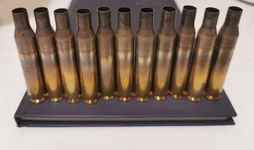
The heat bands are fairly uniform, but take a lot of tumbling to get back to smooth brass. Photo below. To make things more consistent I am now using a glass cup for TIG welding to hold the bullet and the coil is wrapped around it.
On the safety side, I take all powder out of the reloading area before using the annealer, just in case and keep phones etc away though in theory the field is very localised.
I looked at an auto-loading carousel for it, but that would take a day or two of my time plus £100 of materials, and still take a couple of seconds per round to load and unload, so it is more economical in time to just hand load the annealer.
View attachment 344391

Why do the anneal after tumbling? Annealed brass is not pretty. Annealing makes it look beautiful again.Yes, its now an established part of my reloading process:
- Deprime/neck-size
- Trim if necessary
- Chamfer
- Wet tumble
- Dry
- Anneal
- Neck-size
- Reload as required
As it happens my pal's induction annealer will look like a coffee machine as it will stand on legs made of aluminium extrusion in order to allow space underneath for a receptacle into which the annealed cases will drop. That receptacle could be a coffee mug if you so chose...My 25-year old Gaggia coffee making machine threw in the towel yesterday which has meplottingthinking.
Can this development stage annealing machine be made to look like an inclusive (Part B) component of a funky 21st century replacement of the aforementioned?? Asking for the Wife!
Thanks
K





