I have listed a couple of knives for sale over the last couple of days and both of the listings got a passing reference to the fixings - stainless steel Corby type bolts and adhesive secure all together.
Please forgive me if I am trying to teach anyone to suck eggs here but I am not sure we all know what that means though, what it means for me as the maker and you as the owner, user.
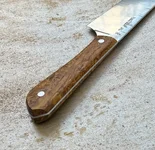
Historically, and by far and away most of the Pat Mitchell ware you will see around, is pinned together, generally 1/8" brass rod (not wire, wire is different) that is rivetted into place, this works and all the Pat Mitchell knives that you still see doing the rounds proves it, I do tend not to use this method today though.
Another fixings used probably by the million on Sheffield was the cutlers rivet, now this was/is a very blunt instrument, there is a counterbore for the heads and then the female half sits through your first scale, the tang and then aligns your second scale, the male then placed into the female and you hit it with a hammer, we never adopted these as they rely purely on friction and one day they will come loose. I guarantee it.
These.
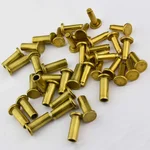
These days things have moved on, thanks I dare say to the 'mericans those rivets have evolved, they evolved into these.
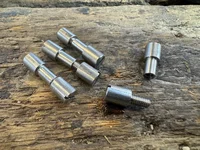
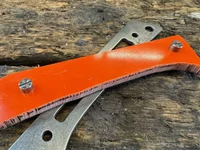
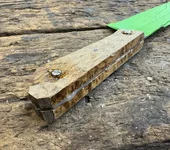
Those are Corby, or Hidden type bolts, hidden I assume as when you shape the handle you grind away the gates of the screws and they then just look like a parallel sided pin, other bolts are available as knife handle fixings but I tend to stick with the type shown above.
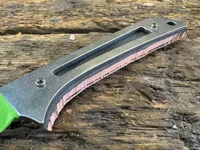
These replace the hammer you'd use with the cutlers rivet with a screwdriver, they are very precise, very secure, the heads are well sunk into your scale material, again the female half sits through your first scale, the tang, and aligns your second scale and when you screw everything together you know it is fixed, it feels fixed, it is not coming apart, you combine that with a G10 scale and it is not coming apart ever, you won't get it apart, you would literally need to drill it out or smash the thing to smithereens to get it apart.
There are various cutters around and available to counterbore the heads, I get these made locally though.
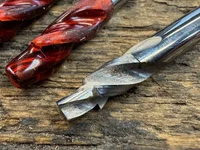
This is why, you can just imagine how securely the bolt head fits into there.
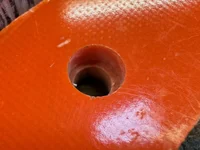
You combine that superb mechanical fixing with adhesive, a thin wipe between the scale and the tang, a touch inside those counterbores, and the fact that those female portions align all.
You know it is fixed.
Forever.
Please forgive me if I am trying to teach anyone to suck eggs here but I am not sure we all know what that means though, what it means for me as the maker and you as the owner, user.
Historically, and by far and away most of the Pat Mitchell ware you will see around, is pinned together, generally 1/8" brass rod (not wire, wire is different) that is rivetted into place, this works and all the Pat Mitchell knives that you still see doing the rounds proves it, I do tend not to use this method today though.
Another fixings used probably by the million on Sheffield was the cutlers rivet, now this was/is a very blunt instrument, there is a counterbore for the heads and then the female half sits through your first scale, the tang and then aligns your second scale, the male then placed into the female and you hit it with a hammer, we never adopted these as they rely purely on friction and one day they will come loose. I guarantee it.
These.
These days things have moved on, thanks I dare say to the 'mericans those rivets have evolved, they evolved into these.
Those are Corby, or Hidden type bolts, hidden I assume as when you shape the handle you grind away the gates of the screws and they then just look like a parallel sided pin, other bolts are available as knife handle fixings but I tend to stick with the type shown above.
These replace the hammer you'd use with the cutlers rivet with a screwdriver, they are very precise, very secure, the heads are well sunk into your scale material, again the female half sits through your first scale, the tang, and aligns your second scale and when you screw everything together you know it is fixed, it feels fixed, it is not coming apart, you combine that with a G10 scale and it is not coming apart ever, you won't get it apart, you would literally need to drill it out or smash the thing to smithereens to get it apart.
There are various cutters around and available to counterbore the heads, I get these made locally though.
This is why, you can just imagine how securely the bolt head fits into there.
You combine that superb mechanical fixing with adhesive, a thin wipe between the scale and the tang, a touch inside those counterbores, and the fact that those female portions align all.
You know it is fixed.
Forever.