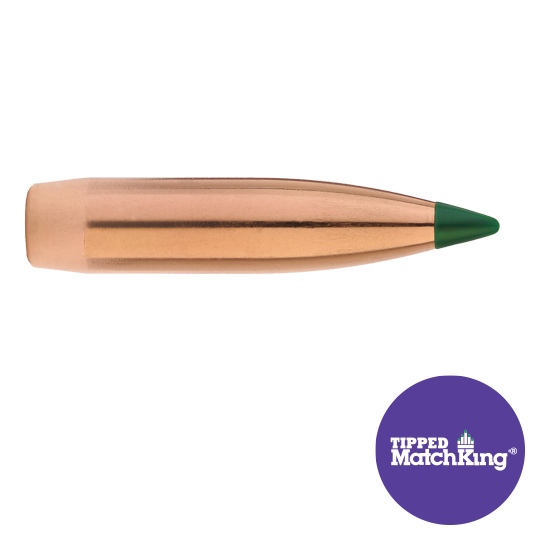
This is one of those topics that attracts lots of “knowledgeable” comments - references to law, bullet manufacturer comments, or just stuff that the poster thinks they know but probably read on a forum somewhere. Pretty soon the thread dissolves into argument and gnashing of teeth.
As always, there is no substitute for real hands-on experience.
Tipped MatchKing is routinely used for deer hunting here, along with other “match” bullets such as Hornady ELD-M and the legendary A-Max. The application tends to be longer range hunting and therein lies the key to their use - lower velocity impacts.
The TMK has a significant cavity behind the tip. Crucially the tip and cavity deliver a far more uniform expansion performance than the non-tipped regular MatchKing. The original MatchKing is a dreadfully inconsistent bullet on game, ranging from complete over-penetration and zero expansion, to hopeless under-penetration and blow-up on the surface. The reason for this is the hollow point on the original MatchKing is very small, and it is a lottery as to whether sufficient pressure is forced into the cavity behind the hollow point to cause the jacket to peel back. It is also notable how variable the position of the top of the lead core is in relation to the hollow point; sometimes the cavity on original MatchKings is huge, other batches it is very small. You can test this with a thin pin. For a long time this was the reason that Berger bullets had a bad reputation.
So, from experience... In .223, .264 and .308, the various weight TMKs have been absolutely lethal on fallow and red deer at the kind of ranges we routinely hunt. Put into the front of the chest cavity targeting the front lungs / aeorta / top of heart (“hilar” zone), the TMK will partially fragment and deliver pole-axing pulverisation of the important bits. In the typical 150-250m range, exit wounds can be quite brutal. In .264 (130gr) and .308 (168gr), there’s more than enough grunt to smash a leg bone and kill the animal DRT.
With a bullet like TMK or ELD-M, on light framed medium deer you are
far more likely to get bang flop kills than you ever will with a hard bonded bullet like Nosler Accubond.
The downside to this type of bullet is of course the fragmentary expansion results in a lot of bloodshot meat. Simply put, if carcass quality is of importance then do not use this bullet.
Another thing to remember is that there is actually very little difference between a TMK jacket and a Sierra GameKing jacket. Again you only find these things out performance wise when you actually have the experience of using them both in the field, but for illustrative purposes a section is a handy reference point.

This is a 130gr TMK recovered from a fallow deer - raking shot - at about 200m with a fast 6.5x47:


Nathan Foster did extensive testing of the TMK when it was released. I don’t have the book to hand now, but I’m pretty sure he described the TMK as “simply outstanding” for use on medium game.