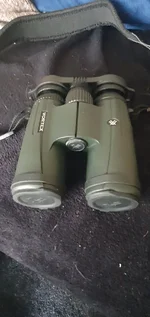
8x42 vs 10x50 Vortex Diamondback HD Binoculars

RoyalRedStag

Well-Known Member
I'm trying to decide between the either the 8x42 or the 10x50 Vortex Diamondback HD Binoculars. Exit pupil is 5.25mm for 8x42 and 5mm for 10x50 so roughly the same light gathering abilities. 8x42 are 620g and 10x50 are 850g. Weight isn't a issue if the 10 magnification will be better.

I will be stalking in farmland, woodland and open hill. I hear 8 magnification is best for woodland and 10 is best for open hill. I'm new to stalking so trying to understand the main uses of binoculars.

I know it's important it comes to Roes. Seeing the tuff is important so can see why 10 magnification might be better in that instance but when else would 10 be better than 8? Maybe for counting the points on a buck or stag? I understand field of view is important in woodlands. Would there be any disadvantages to using 8 magnification on the open hill?

I would really appreciate any advice.
 
I have had the 8x42 and currently have the 10x50.

I think for me personally I prefer the 8x42s and the only time I think the 10x would be better is open hill but even then iam not sure your gaining much other than weight.

I have the 10x50s sat here on a shelf if you would like to give them ago. Iam also in Hampshire.
 
8×42 will give you a much better depth of field, which is essential for woodland and farmland stalking.
The only time the 10× really comes into its own is on open hill.

Faced with a choice, I would always opt for 8×42
 
From Better View Desired, “the independent internet journal of birding optics reviews and the pursuit of the better view.”

“Magnification: We have already noted, in the discussion above, two ways in which higher magnifications can adversely affect binocular handling performance. Higher magnifications generally limit both the field of view and the depth of field of binoculars. Worse, however, is magnification�s affect on image steadiness. As you increase the magnification, you are also magnifying every motion of the binoculars. It is next to impossible to extract information from an image that is bouncing around.

With practice, and given exceptionally well-balanced binoculars, the average birder can learn to extract detail from a 10 power image. Extracting detail from an 8 power image is even easier, and, in objective tests conducted by Zeiss, birders consistently extracted the most detail (at least on eye charts) from a 7 power image. As noted above, my experience has been that there is no practical difference in the amount of detail you can see in hand-held binoculars of equal quality between 7 and 10 power. There is, however, a real difference in the amount of fatigue generated over a day�s use.

The extra effort and concentration needed to hold 10x binoculars steady and extract detail will tire many birders after a fairly short time in the field, especially if the depth of field is shallow enough to require constant refocusing. A tired birder will, in the long run, see less. There are exceptions, of course, but my general recommendation, after years of testing and using binoculars, is that 8x is just about the ideal power for birding . . . enough power to give a satisfyingly large image of the bird, but not enough to cause undue fatigue.”


maximus otter
 
  • Like
Reactions: VSS
Back
Top