Here it is...
I made a blank fairly recently as a 'sample' of sorts for a client to see. I sent it to him (as a blank, not a blade, it wasn't ground) along with another (which was from thinner steel and not heat treated) for him to have a hold of as it were, to modify and refine to his own tastes on paper, then send all back to me with a cardboard template.
That is all now done and I am on with the knife that was designed as a result of the process.
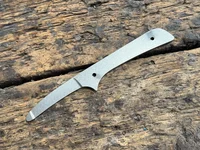
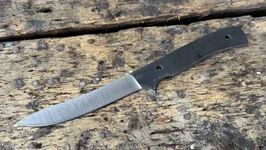
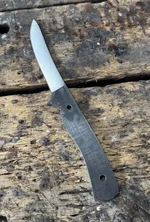
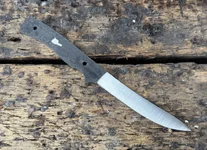
That, of course, leaves me with what you see above though, cut from 3mm stock SF100, heat treated to Rc.60/61.
Blade length is 120mm, Trizact belt finished to around 320g, the flats of the tang retain the fresh from HT patina/scale*
250mm overall and an absolute beauty of a blade, just a proper, fit for duty, sharp as a sharp thing, beautiful object.
I don't really have much time to make this into a finished knife, which is why you see it here. That said, if it doesn't sell I will not lose any sleep at all. I'll find some time and make it. That is how nice a thing it is.
This is £140 delivered tonight. It might be here tomorrow, it might not? I might be very keen to see how a beautifully finished set of green Micarta scales sit over that tang with the HT finish of the ricasso breaking up their marriage to the Trizact finished blade. We will see..?!
* Apologies if I am teaching my grandmother to suck eggs etc, etc, but, post-HT scale on a blade is a killer. It wears abrasives for fun. As a lad, I always recall it being referred to as 'glass hard', which is what it is, it is like trying to grind glass.
I was thinking recently that many of today's 'knifemakers' might not be aware of this. They predominantly use the same supplier of the HT process and their blanks will be returning to them with the surface scaled. If they take them straight to abrasive belts, well, it'll be costing a fortune in abrasives and even the process isn't any fun.
The small portion of the tang of this blade that you can see ground away. That is where the scale has been removed for the hardness test. You can't test hardness through scale either.
Scale is a killer, an abrasive belt destroyer.
I made a blank fairly recently as a 'sample' of sorts for a client to see. I sent it to him (as a blank, not a blade, it wasn't ground) along with another (which was from thinner steel and not heat treated) for him to have a hold of as it were, to modify and refine to his own tastes on paper, then send all back to me with a cardboard template.
That is all now done and I am on with the knife that was designed as a result of the process.
That, of course, leaves me with what you see above though, cut from 3mm stock SF100, heat treated to Rc.60/61.
Blade length is 120mm, Trizact belt finished to around 320g, the flats of the tang retain the fresh from HT patina/scale*
250mm overall and an absolute beauty of a blade, just a proper, fit for duty, sharp as a sharp thing, beautiful object.
I don't really have much time to make this into a finished knife, which is why you see it here. That said, if it doesn't sell I will not lose any sleep at all. I'll find some time and make it. That is how nice a thing it is.
This is £140 delivered tonight. It might be here tomorrow, it might not? I might be very keen to see how a beautifully finished set of green Micarta scales sit over that tang with the HT finish of the ricasso breaking up their marriage to the Trizact finished blade. We will see..?!
* Apologies if I am teaching my grandmother to suck eggs etc, etc, but, post-HT scale on a blade is a killer. It wears abrasives for fun. As a lad, I always recall it being referred to as 'glass hard', which is what it is, it is like trying to grind glass.
I was thinking recently that many of today's 'knifemakers' might not be aware of this. They predominantly use the same supplier of the HT process and their blanks will be returning to them with the surface scaled. If they take them straight to abrasive belts, well, it'll be costing a fortune in abrasives and even the process isn't any fun.
The small portion of the tang of this blade that you can see ground away. That is where the scale has been removed for the hardness test. You can't test hardness through scale either.
Scale is a killer, an abrasive belt destroyer.
Last edited: