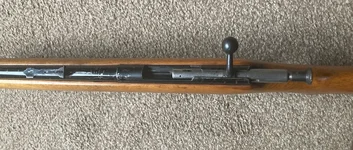
BSA CF2 6.5x55

Thanks, the rifle itself is in good condition in terms of bluing (albeit the trigger guard) and the stock can be made to look really nice. I'm just curious as to why so much gunk and grease. I suppose I asked already, but any ideas to take the bolt down?

How can you tell it's 1982?

The bore looks really good actually. The trigger guard is puzzling as the metal underneath the chipped of anodizing (?) is perfectly fine, so I'm not sure why that is the only area of the rifle that is like that.
 
The Private View mark shown in your photos tells us it's 1982. HB=1982.

I had for a very short time P-H Model 1000 that was covered in grease. I think the owner thought ti would protect it...................... wrong.. It grabbed every bit of rubbish there was about. It did hide the nasty secet though until I cleaned it off then it went back. Your CF2 is nowhere as bad as tat was with grease. but to my mind it needs removing and then just a light wipe with an oily cloth as one does.
 
What does 'Private View' mean and what does HB stand for besides 1982?

Also, what does BNP on the bolt handle mean?

I'm thinking of getting the bottom metal anodized. It is a aluminum alloy right?
 
Last edited:
Yes the bottom metal is aluminium.

BNP= Birmingham Nitro Proof.

Birmingham have this Private View mark the letters and how they are stamped are a date code the single digit below them is the inspector who did the viewing. It's very handy for us as we can date when the rifle was proofed and as both BSA & Parker-Hale submitted the rifles in the white before final finishing it's a good way of dating them. London proof marks are not so helpful.
 
Ok I disassembled her completely. Lots of grease and gunk. Mineral spirits to cut all that grease off? It's packed in the trigger housing but I don't feel comfortable taking that apart. I used WD-40 (contains mineral spirits) when taking off the cosmoline on the Mosin-Nagant, I assume it would work, but this isn't as greasy and most of it has dried up.

I can't find the SILE mark in the barrel channel, but it doesn't look sanded either. The stock is walnut?
 
Last edited:
WD40 is not good for guns. Carb or Brake cleaner is good for cleaning trigger mechs but be careful with it need wood finishes. White spirits or turps or Mineral spirits will desolve the old hard grease yes.. An old tooth bush works wonders too.

When I lightly oil my guns I still use the old Parker-Hale Express oil. 3 in 1 oil is OK but of course I do not know if you can get those or not.

The SILE stamp might be under the butt pad. For some reason I have found it stamped in different places on different stocks.

And yes BSA used walnut on their centre fire rifles. It's probably Italian or Turkish. BSA tended to order for straight grain rather than fancy wood as it's stronger.

Once you get the old grease off and a light coating or proper oil on the metal work I expect that the rifle will also look heaps better. The couple of little rust spots if soaked with a light oil like the Express oil will usually lift off. You will probably need to scratch the surface of the rust spot to allow the oil the penetrate fully. Depending on where it is and how bad will determine what I use but the edge of copper coin does work to gently scrape the oxide off.
 
Hi,

I actually went the non-toxic route and used simple green. It smells so good. It's an alkaline water-based solution. It worked well, but you got to be careful on the aluminum parts, so rinse and oil it quickly. I did the small parts like the screws, rear sight, magazine well, weaver bases just to do some testing on how greasy it was. The grease seems to have caked on to become just brittle amber globs that I can just scratch off with my nail.

I will attempt the receiver and barrel tomorrow for cleaning. Hopefully the trigger assembly won't be too bad.

Regarding the stock, were they stained before applying BLO? I'm thinking of stripping it, ironing out the dents, and then just applying coats of BLO. I was wondering if I will get the wood dark like it is now. Or do I need to stain it (prefer not to).

And the other option is to just clean off the grime off the stock, and then add BLO to the stock. I did that with my Husqvarna and it blended a lot of the dings and dents.
 
Last edited:
Hi,

I actually went the non-toxic route and used simple green. It smells so good. It's an alkaline water-based solution. It worked well, but you got to be careful on the aluminum parts, so rinse and oil it quickly. I did the small parts like the screws, rear sight, magazine well, weaver bases just to do some testing on how greasy it was. The grease seems to have caked on to become just brittle amber globs that I can just scratch off with my nail.

I will attempt the receiver and barrel tomorrow for cleaning. Hopefully the trigger assembly won't be too bad.

Regarding the stock, were they stained before applying BLO? I'm thinking of stripping it, ironing out the dents, and then just applying coats of BLO. I was wondering if I will get the wood dark like it is now. Or do I need to stain it (prefer not to).

No stain was used that I am aware of. For an oiled finish I would use Red oil (Alkanet Root oil) first as it brings out the grain and does darken slightly. It's applied like BLO rubbed in sparingly and allowed to dry until the desired effect is achieved then the BLO or oiled finish is applied over the top I used Red Oil as the base of this oiled finish:-

10226408.jpg

That was just after the new finish was applied

29769676.jpg

That is some years later and from a different angle of course.

29769652.jpg

The way the light catches the ribbons effect how much is shown of the contrasting grain.

29769617.jpg


The factory finish on this P-H 1100 Lwt was worn through in a couple of places to it was stripped and re-finished and Alkanet Oil was used first to highlight the grain and figure of the wood:-

339209413.jpg

Before

339207252.jpg


339207110.jpg


339207056.jpg


After.
 
How did you get that sheen on the Brno?

For the Alkanet Root Oil, what ratio do you mix it and with what? BLO?

How thick or thin do you put it on and do you 400 grit sand it to fill the pores and then hand rub it in? How many coats of the root oil do you put on before you move onto BLO or oil?
 
Last edited:
Sorry it was late and I ha to get to bed.

Hmmm doing a little bit of web surfing and searching it seems although it's known over the pond it's not so easy to get.

The high gloss on the Brno came from using a stock finish kit and following the instructions. THat was my first full strip and re-finish as I did not like the poly type factory finish is came with. Sadly that kit is no longer available ....................................... it was done using a Warthog Purdy's Stock finishing kit which was used on several stocks over a period of time.

The closet I could find in the past few years is:-

CCL Traditional English Gun Stock Finish Kit

Who do supply the bottle separately as well.

Napier Gunstock Finish kit

Off flea bay:-

Item number [FONT=Arial, Helvetica, sans-serif]:- [/FONT]320890008344

Was searching the Canadian site for you and found that one. Did find some US forums where others were buying the powdered root and making up their own.

Ahhh found this which might be of some use to you:-

http://uk.merchantcircle.com/blogs/C.C.L.Traditional.English.Gun.Products.Ltd.0121-559-1071[TABLE="class: sp1, width: 238"]
[TR]
[TD="class: inf_lab, align: right"][/TD]
[TD] [/TD]
[/TR]
[/TABLE]


The company itself has a blog so you could ask them direct via the web.
 
I found the Alkanet for 100g (3.6 oz) for $7 CDN. Is that enough to do the stock? 225g (8 oz) is $11.
 
The CF2 actions were all made the same no matter what cartridge it was finally fitted up in so the same action you have will happily digest magnum pressures. Most hand loading data for the 6.5x55 Swedish is kept down in pressure as the companies printing it are worried about folks blowing up antique Mauser 94's. 95's and 96's.

Speer in their #14 manual cautiously list some loads which are a bit warmer than the the norm but they still fall well short of the 3000 fps which is achievable with careful load development. Speer only took the 120's up to 2850 fps.

I have a buddy in the US that loaded Nosler 125 grain partitions to 3000fps in his Ruger M77 using Reloader 22 if I recall correctly with no excessive pressure signs however once you leave the realm of published data your on your own.

In my old Hodgons #26 it gives a load of :-

start = Reloader 22 48.0 Grns = 2898 Fps

max = Reloader 22 51.0 grns = 3025 fps with the 120 grain bullet

That's at std SAAMI industry pressures for the 6.5x55 Swedish.


Hope that helps answer you question.

Isnt that a very hot load for Reloader 22?

The data i have got shows (for a 140gn bullet, they dont list RL22 for a 120gn) a start load of 43.9gn and a max of 48.1gn. Do you need more for a lighter bullet? Or is my data very consertivite?

I have used a CF2 in .270 and it was a nice rifle, accurate and smooth to use; However it was a .270, a loud bark and a kick like a mule.
 
I have just started reloading for a 6.5x55.

I made up 6 batches of 5 rounds.. With charge weights of 44.5g, 45g, 45.5g, 46g, 46.5g, 47g. I am using Reloader 22 with a 140g Bullet. I have found that the 47gn loads produced the best group and now i am in the process of loading up a batch.

I have just gone with published data.

Thar when you say "yes" is that yes to both questions, or what?


Cheers?
 
Isnt that a very hot load for Reloader 22?

The data i have got shows (for a 140gn bullet, they dont list RL22 for a 120gn) a start load of 43.9gn and a max of 48.1gn. Do you need more for a lighter bullet? Or is my data very consertivite?

I have used a CF2 in .270 and it was a nice rifle, accurate and smooth to use; However it was a .270, a loud bark and a kick like a mule.

May I suggest you contact Hodgdons and ask them after all they developed the data and printed it in the book. Me I just opened the book and looked it up and passed on the data. As I said and you have quoted this was from their #26 book on page 232..
 
Thar when you say "yes" is that yes to both questions, or what?


Cheers?

Hi Beretta

Well no and yes.

Don’t take this as having a go, just advice.

Your question to whether lighter bullets could use more powder showed that you don’t have an understanding of the basic fundamentals of reloading ammunition. While you are obviously using a manual to keep you right it is good to have a under pinning of knowledge about the theory. Don’t rely on manual max’ to be the actual max’ in your rifle, it can be less and if you cannot pick up on the signs of high pressure you could run into problems, do you have a “mentor” for reloading?

There is plenty of information on here, but if you can get your hands on a Copy of Richard Lee modern reloading the first few chapters will give you all the theory in an easy to understand format.

For example I wanted to reload some bullets the other day, the powder I had plenty of is a bit obscure and I could find no load data for that weight bullet; 110gn only 130gn so I used the 130gn data as a base and worked up going over the max’ powder measure for 130gn’s until I got an accurate load without any pressure signs with the 110gn’s.

ATB

Tahr
 
FYI for those that own a BSA CF2. I was at my local gunsmith and he showed me how to take the bolt down. It's not too difficult.

1) Turn the bolt shroud clockwise so it sits on the top of the bolt body, not in the notches. This will align the holes in the bolt shroud to the holes in the cocking piece of the firing pin assembly.

2) Insert a thin punch through both holes and pull up and unscrew the assembly from the bolt body. Remove punch and bolt shroud will separate from firing pin assembly.

3) Cocking indicator can be taken out of bolt shroud, careful as it is spring loaded.

4) To remove firing pin from from spring/assembly, compress the firing pin spring, and slide the firing pin off. It is secured by a notch that allows it to slide into a mating surface on the spring guide. If you are familiar with the Swiss K31 rifles, it is the same concept.

5) Completely disassembled bolt. Reverse these steps to reassemble.

Hope that helps!
 
Sorry ChrisF,

I learned today that the CF2 bottom metal is NOT aluminum. Rather it is Zinc or commonly known as 'white metal'.

Hi Guys ,

Can some one tell me what the trigger guard is made out of , steel or aluminium ?

Cheers CHris
 
Back
Top