I think most would struggle trying to imagine something travelling at 200 miles per second having to slow to two miles per hour to land. Whilst not accurate it's probably more illustrative as I think most folks would grasp that a bullet goes really really fast.
That said, my 22-250 really did motor lol
I do marvel at the complexity of the mathematics and engineering required to make this possible.
Hmmm. I wonder if Sophie should be told that a 50gns vmax travels at c.2,050mph then frequently comes to a very sudden and often extremely messy stop in a really short distance too! Just saying!
So I make it that 12,000 miles per hour equals 17,600 feet per second. So if you imagine a reasonably nimble bullet with a muzzle velocity of 3,520 feet per second, the BBC were only incorrect by a factor of 5.
Good enough for government business, or in this case, left-leaning propaganda!
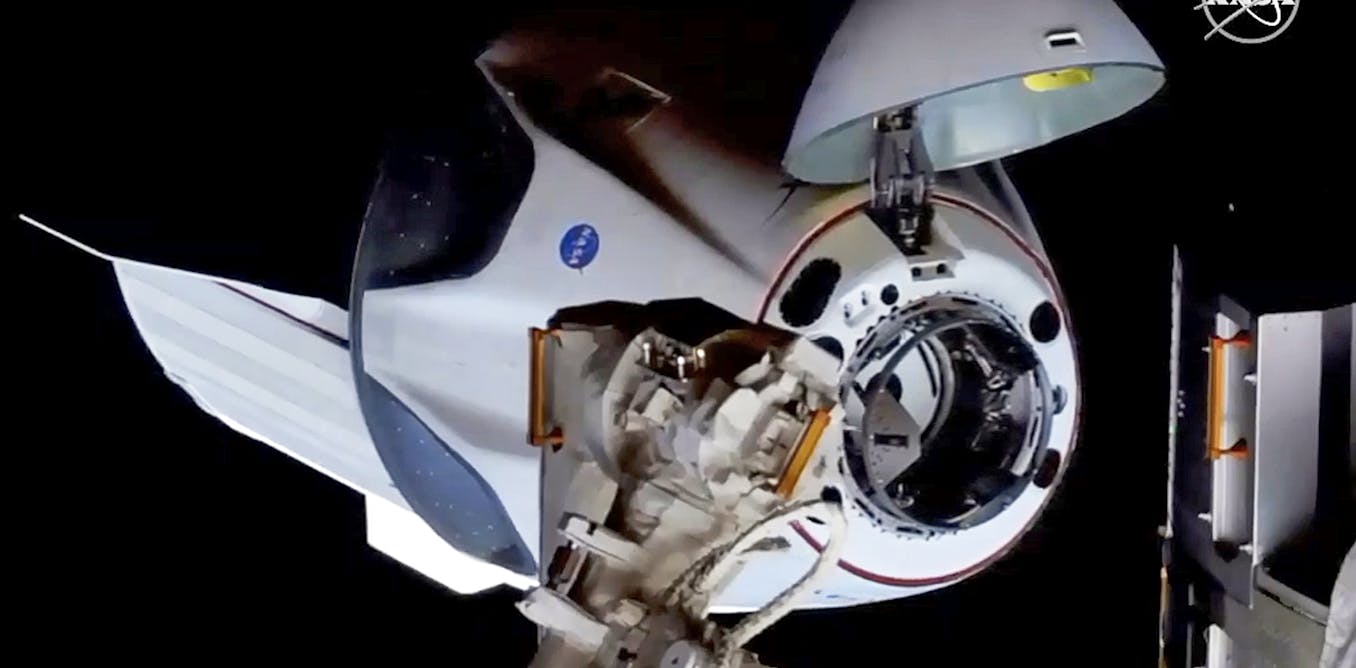
Extreme velocities and temperatures makes the return flight to Earth the most perilous part of a space mission.
theconversation.com
Reentry danger points
The extreme velocities and temperatures the vehicle must endure present a major challenge to engineers and makes reentry the most perilous part of a mission.
The danger starts with finding the right angle of the trajectory as the spacecraft enters the upper atmosphere. If it is too steep, the astronauts will experience potentially fatal g-forces, and the friction of the air drag could cause the spacecraft to explode. If it is too shallow, the capsule will instead catastrophically skip off the atmosphere and back into Earth orbit.
The spacecraft will enter the upper atmosphere at 27,000km/hour. That is 7.5km/second, or more than 20 times the speed of sound. In whichever units you prefer – this is fast. At these velocities, a very strong shock wave forms around the front of the vehicle, compressing and superheating the air. Managing the immense thermal load is a huge reentry engineering challenge.
At the most extreme stage, the temperature of the air in the shock layer exceeds 7,000°C. By comparison, the temperature at the surface of the Sun is around 5,500°C. This makes the vehicle’s heat shield so hot that it starts to glow — a process called incandescence. SpaceX’s new and advanced PICA-X material heat shield has managed to protect the capsule in test flights, later being recovered in a very charred state.
The air molecules around the vehicle also break down into positively charged atoms and free electrons – a so-called plasma. When some of the molecules recombine, excess energy is released as photons (light particles) – giving the air around the vehicle an amber glow.
Extreme velocities and temperatures makes the return flight to Earth the most perilous part of a space mission.
theconversation.com
Reentry danger points
The extreme velocities and temperatures the vehicle must endure present a major challenge to engineers and makes reentry the most perilous part of a mission.
The danger starts with finding the right angle of the trajectory as the spacecraft enters the upper atmosphere. If it is too steep, the astronauts will experience potentially fatal g-forces, and the friction of the air drag could cause the spacecraft to explode. If it is too shallow, the capsule will instead catastrophically skip off the atmosphere and back into Earth orbit.
The spacecraft will enter the upper atmosphere at 27,000km/hour. That is 7.5km/second, or more than 20 times the speed of sound. In whichever units you prefer – this is fast. At these velocities, a very strong shock wave forms around the front of the vehicle, compressing and superheating the air. Managing the immense thermal load is a huge reentry engineering challenge.
At the most extreme stage, the temperature of the air in the shock layer exceeds 7,000°C. By comparison, the temperature at the surface of the Sun is around 5,500°C. This makes the vehicle’s heat shield so hot that it starts to glow — a process called incandescence. SpaceX’s new and advanced PICA-X material heat shield has managed to protect the capsule in test flights, later being recovered in a very charred state.
The air molecules around the vehicle also break down into positively charged atoms and free electrons – a so-called plasma. When some of the molecules recombine, excess energy is released as photons (light particles) – giving the air around the vehicle an amber glow.
Jeez!
“If it is too shallow, the capsule will instead catastrophically skip off the atmosphere and back into Earth orbit”!
And I thought a 22 LR ricochet was bad!
This site uses cookies to help personalise content, tailor your experience and to keep you logged in if you register.
By continuing to use this site, you are consenting to our use of cookies.