Carbon fibre stock project

Great work Tak, the bit that frightens me about making something like this is the bonding together of the two halves and filling the stock, how do you do that, cheers mate

Ian.

Hi Ian

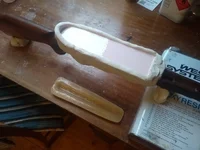
I trim the excess carbon fibre neatly while it's still slightly flexible before it's completely cured. I apply plenty of thickened epoxy on and adjacent to the edges to be joined before bolting the mould halves together. The moulds have registers on them so they align perfectly. Then I apply 2 layers of wetted out 2" carbon fibre tape to all joins on the inside of the stock - easier said than done! The barrel channel/action area and also the butt end is open for this.

Doing this work while the carbon fibre is still partially cured/ green means that a very strong chemical bond is achieved.

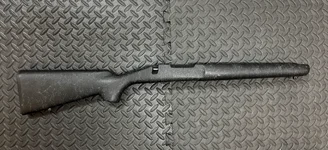
When the stock shell comes out of the mould it is trimmed with a die grinder and Dremel cutting disc then a small sanding wheel. The shell weighs roughly 300g at this point.

I then dam up the pistol grip just behind the action area with plasticine, then fill the butt with 2 part polyurethane foam that aids stiffness of the stock a bit and helps the stock to not sound hollow.

After this the plasticine is removed and the top and bottom RTV Silicone inletting moulds are put in the stock and secured tightly to it. The stock is upended and epoxy resin is poured to create the inletting. Small quantities are poured at a time with long waiting periods inbetween. Pour in 2 much at once and the exothermic heat from the epoxy gets too much and big cracks can form, and also distort the stock (been there, done that).

Then the separate barrel channel is glued in and the foreend filled with PU foam.

The swivel studs can be glued in now or right at the start depending on how one wants to do it.

The butt is then cut to suit required LOP, 2 holes drilled for buttpad screws and filled with epoxy and a few layers of carbon fibre laid up. Buttpad then installed with screws and or glued on. Then use sanding wheel on Dremel to grind buttpad to fit.

Plenty sanding steps etc inbetween all this.
 
Hi Ian

I trim the excess carbon fibre neatly while it's still slightly flexible before it's completely cured. I apply plenty of thickened epoxy on and adjacent to the edges to be joined before bolting the mould halves together. The moulds have registers on them so they align perfectly. Then I apply 2 layers of wetted out 2" carbon fibre tape to all joins on the inside of the stock - easier said than done! The barrel channel/action area and also the butt end is open for this.

Doing this work while the carbon fibre is still partially cured/ green means that a very strong chemical bond is achieved.

When the stock shell comes out of the mould it is trimmed with a die grinder and Dremel cutting disc then a small sanding wheel. The shell weighs roughly 300g at this point.

I then dam up the pistol grip just behind the action area with plasticine, then fill the butt with 2 part polyurethane foam that aids stiffness of the stock a bit and helps the stock to not sound hollow.

After this the plasticine is removed and the top and bottom RTV Silicone inletting moulds are put in the stock and secured tightly to it. The stock is upended and epoxy resin is poured to create the inletting. Small quantities are poured at a time with long waiting periods inbetween. Pour in 2 much at once and the exothermic heat from the epoxy gets too much and big cracks can form, and also distort the stock (been there, done that).

Then the separate barrel channel is glued in and the foreend filled with PU foam.

The swivel studs can be glued in now or right at the start depending on how one wants to do it.

The butt is then cut to suit required LOP, 2 holes drilled for buttpad screws and filled with epoxy and a few layers of carbon fibre laid up. Buttpad then installed with screws and or glued on. Then use sanding wheel on Dremel to grind buttpad to fit.

Plenty sanding steps etc inbetween all this.

And breathe....!
 
Hi Ian

I trim the excess carbon fibre neatly while it's still slightly flexible before it's completely cured. I apply plenty of thickened epoxy on and adjacent to the edges to be joined before bolting the mould halves together. The moulds have registers on them so they align perfectly. Then I apply 2 layers of wetted out 2" carbon fibre tape to all joins on the inside of the stock - easier said than done! The barrel channel/action area and also the butt end is open for this.

Doing this work while the carbon fibre is still partially cured/ green means that a very strong chemical bond is achieved.

When the stock shell comes out of the mould it is trimmed with a die grinder and Dremel cutting disc then a small sanding wheel. The shell weighs roughly 300g at this point.

I then dam up the pistol grip just behind the action area with plasticine, then fill the butt with 2 part polyurethane foam that aids stiffness of the stock a bit and helps the stock to not sound hollow.

After this the plasticine is removed and the top and bottom RTV Silicone inletting moulds are put in the stock and secured tightly to it. The stock is upended and epoxy resin is poured to create the inletting. Small quantities are poured at a time with long waiting periods inbetween. Pour in 2 much at once and the exothermic heat from the epoxy gets too much and big cracks can form, and also distort the stock (been there, done that).

Then the separate barrel channel is glued in and the foreend filled with PU foam.

The swivel studs can be glued in now or right at the start depending on how one wants to do it.

The butt is then cut to suit required LOP, 2 holes drilled for buttpad screws and filled with epoxy and a few layers of carbon fibre laid up. Buttpad then installed with screws and or glued on. Then use sanding wheel on Dremel to grind buttpad to fit.

Plenty sanding steps etc inbetween all this.

Cheers Tak, thats answered a few questions,
 
I found on laminating you can get an accurate trim line by cutting with a stanley knife while it is still green but that depends on the geometry.
As a byline I was doing laminating of 8x4 ply second grade sheets with white polyester on large steel flat tables 1971 in Ontario Canada. We put on half the resin to the twisted ply sheet then rolled out the chopped mat over it then pour on the second half of resin, sort of all over the surface then roll a sheet of mylar (Lucozade bottle wrapper material, kind of) over the 8x4 area with 3 inch overlap. Then used 2 inch masking tape all around the ply onto the mylar to pull the mylar tight. Then I used a window squeege to wipe just like cleaning big windows to work all the air out from the laminate which created a vacuum and sucked the ply sheet flat onto the table. It was amazing how good the final finish was. We sold them for lining hygenic food transporting trucks. Also we could lay a printed sign onto the layup before mylar and they were weatheproof signages but the type of ink used was a company secret that I never learnt. We trimmed these sheets with the knives when still green.
 
Excellent pics, story and workmanship.
Would also be good to get an update when you get it out in the field, it gets a few scrapes and bumps to see how it holds up.

As other have said, i'm sure you will have a few request.

Brief update:

Had rifle out twice. First time there was a lot of rain and no deer seen. Gave it a good shakedown shoot and it performed perfectly.

Second time out and I got this sturdy buck (16.5kg lardered). I bumped a doe and follower on some rather open ground and there he was bringing up the rear. A quick draw and 50m shot had him down on the spot.

I haven't managed to scratch the stock yet so that bodes well for the paint durability but time will tell.

IMG_20200527_191308974_HDR~2.webp
 
Fully impressed looking at the mould.
Coming from an aerospace engineering background you could probably half the weight should you wish and place the weight where needed using a rohacell type foam t bulk the Carbon out. All in all though super impressed with the build. I'll definitely be doing something similar when it comes time replace the stock.
 
Fully impressed looking at the mould.
Coming from an aerospace engineering background you could probably half the weight should you wish and place the weight where needed using a rohacell type foam t bulk the Carbon out. All in all though super impressed with the build. I'll definitely be doing something similar when it comes time replace the stock.
Thanks very much! At the moment the weight distribution is roughly as follows: 350g shell, 200g epoxy inletting, 100g buttpad, 100g PU foam core.

I've thought about other methods and will continue to do so and take your suggestions on board. Just so many things to do and always bills to pay!
 
Thanks very much! At the moment the weight distribution is roughly as follows: 350g shell, 200g epoxy inletting, 100g buttpad, 100g PU foam core.

I've thought about other methods and will continue to do so and take your suggestions on board. Just so many things to do and always bills to pay!
I completely understand, I am very lucky to be able to scavenge raw materials from work that would other wise go in the bin,
The prepreg we throw away is amazing.

My freezer is some what full of CFRP and pigeons all wrapped separately mind you.

I guess the weight of a rifled action needs to be balanced and that requires x amount in the butt. It can't really be less than that.
I am no gunsmith or stock manufacturer but I know composites so holla if you need ought!!
 
I completely understand, I am very lucky to be able to scavenge raw materials from work that would other wise go in the bin,
The prepreg we throw away is amazing.

My freezer is some what full of CFRP and pigeons all wrapped separately mind you.

I guess the weight of a rifled action needs to be balanced and that requires x amount in the butt. It can't really be less than that.
I am no gunsmith or stock manufacturer but I know composites so holla if you need ought!!
Free pre preg sounds great! I will shout if I need help!

I find that lighter is better - no need for any extra weight anywhere IMO.
 
Does making the stocks lighter and lighter make it give more jump, or thump on firing? (Thinking .270, 30-06).

Never had the chance to shoot a Carbon Fibre stock.
 
Does making the stocks lighter and lighter make it give more jump, or thump on firing? (Thinking .270, 30-06).

Never had the chance to shoot a Carbon Fibre stock.

Although weight/mass helps to tame recoil, design is much more effective in doing so.

A badly designed stock with a large drop at the shoulder and no cast on/off will mean the rifle has a tendency to kick upwards and push the shoulder off.

The biggest benefit of using a composite next to weight reduction is the added strength/rigidity.

When you fire the rifle, the stock will always flex slightly.

The average grown man should be able to snap a factory wood or plastic stock in two if it was supported at either end and he stood on the middle.

Whilst a correctly made composite stock will bend if subjected to this treatment, it will bend back once the pressure is removed.

Have not handled one of takbok's stocks yet but having seen his projects I am convinced they are just as strong.
 
Another fine stock on the horizon mty , Very well done . just a pity you did't do a Browning A bolt in 270 stock as a test run :norty::tiphat:
 
Back
Top