
You are using an out of date browser. It may not display this or other websites correctly.
You should upgrade or use an alternative browser.
You should upgrade or use an alternative browser.
Cheese Making
- Thread starter Morkai
- Start date


Something very high up on my list to do given the Mrs got me a cheese making kit for Christmas that Ive yet to use, watching this thread intently!

Morkai
Well-Known Member
Something very high up on my list to do given the Mrs got me a cheese making kit for Christmas that Ive yet to use, watching this thread intently!
I think my GF has a kit from someone, again as a Christmas gift. Its been temporarily lost in the house move but it's something I'm keen to try.
There must be a few distinguished gentlemen on here that have made some.
I used to make a fair bit of a Camembert style cheese using raw milk from our Jersey house cow, until she went the way of all things.
I adapted the recipe from Camembert Recipe . I tended to work with about 6 pints at a time, that would end up with 2 cheeses or a bit more, depending on a huge number of variables. I only have kitchen scales (not reloading or dealing) so being consistent with the quantities of inoculant moulds for such a small quantity of milk is a challenge.
I bought the plastic ring moulds, mesh and inoculants etc from Moorlands Cheesemakers Ltd | Cheese Making Equipment . For maturing the cheese, I used a Tupperware style container at the top of the fridge. Not ideal but the best I have available. Wiping out the condensation on the container each day was essential.
Despite the variability in the milk, the quantities and temperature/humidity, I managed to get fairly consistent results after a bit of trial and error.
For a home setup, I found that it is a bit of a race between the desirable moulds that you need to grow faster than undesirable moulds. I tried a cheddar style but never quite achieved the right outcome of that race. The Camembert style (plus many others), in which you add the desirable moulds at the beginning, tends not to lose the race. Plus maturation is a matter weeks not months.
I adapted the recipe from Camembert Recipe . I tended to work with about 6 pints at a time, that would end up with 2 cheeses or a bit more, depending on a huge number of variables. I only have kitchen scales (not reloading or dealing) so being consistent with the quantities of inoculant moulds for such a small quantity of milk is a challenge.
I bought the plastic ring moulds, mesh and inoculants etc from Moorlands Cheesemakers Ltd | Cheese Making Equipment . For maturing the cheese, I used a Tupperware style container at the top of the fridge. Not ideal but the best I have available. Wiping out the condensation on the container each day was essential.
Despite the variability in the milk, the quantities and temperature/humidity, I managed to get fairly consistent results after a bit of trial and error.
For a home setup, I found that it is a bit of a race between the desirable moulds that you need to grow faster than undesirable moulds. I tried a cheddar style but never quite achieved the right outcome of that race. The Camembert style (plus many others), in which you add the desirable moulds at the beginning, tends not to lose the race. Plus maturation is a matter weeks not months.
Super interesting thank you for sharingI used to make a fair bit of a Camembert style cheese using raw milk from our Jersey house cow, until she went the way of all things.
I adapted the recipe from Camembert Recipe . I tended to work with about 6 pints at a time, that would end up with 2 cheeses or a bit more, depending on a huge number of variables. I only have kitchen scales (not reloading or dealing) so being consistent with the quantities of inoculant moulds for such a small quantity of milk is a challenge.
I bought the plastic ring moulds, mesh and inoculants etc from Moorlands Cheesemakers Ltd | Cheese Making Equipment . For maturing the cheese, I used a Tupperware style container at the top of the fridge. Not ideal but the best I have available. Wiping out the condensation on the container each day was essential.
Despite the variability in the milk, the quantities and temperature/humidity, I managed to get fairly consistent results after a bit of trial and error.
For a home setup, I found that it is a bit of a race between the desirable moulds that you need to grow faster than undesirable moulds. I tried a cheddar style but never quite achieved the right outcome of that race. The Camembert style (plus many others), in which you add the desirable moulds at the beginning, tends not to lose the race. Plus maturation is a matter weeks not months.



Morkai
Well-Known Member
I used to make a fair bit of a Camembert style cheese using raw milk from our Jersey house cow, until she went the way of all things.
I adapted the recipe from Camembert Recipe . I tended to work with about 6 pints at a time, that would end up with 2 cheeses or a bit more, depending on a huge number of variables. I only have kitchen scales (not reloading or dealing) so being consistent with the quantities of inoculant moulds for such a small quantity of milk is a challenge.
I bought the plastic ring moulds, mesh and inoculants etc from Moorlands Cheesemakers Ltd | Cheese Making Equipment . For maturing the cheese, I used a Tupperware style container at the top of the fridge. Not ideal but the best I have available. Wiping out the condensation on the container each day was essential.
Despite the variability in the milk, the quantities and temperature/humidity, I managed to get fairly consistent results after a bit of trial and error.
For a home setup, I found that it is a bit of a race between the desirable moulds that you need to grow faster than undesirable moulds. I tried a cheddar style but never quite achieved the right outcome of that race. The Camembert style (plus many others), in which you add the desirable moulds at the beginning, tends not to lose the race. Plus maturation is a matter weeks not months.
Thank you for the tips.
Morkai
Well-Known Member
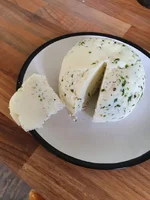
I've made cheese a fair few times with milk from our goats. Really easy, and very satisfying. I tend to stick to soft cheeses, but I also make mozzarella and ricotta.
View attachment 384321View attachment 384322View attachment 384323View attachment 384324
A crusted cheese is always appealing.
The domed one looks like it could be a Sage Derby before aging.

Yes, done quite a bit of cheesemaking off and on over the years.I've never tried making it, love eating it.
Done my fair share of butchering, curing and cooking but never made cheese.
Do any of you make your own cheese?
Any favourites?
I did have a quick look in the forum and I don't think this has come up recently.
Been producing our own milk for as long as I can remember, initially from goats, but changed over to cows about 30 years ago, so cheesemaking kind of goes hand-in-hand with that, along with making butter, ice-cream, yoghurt, etc.
Soft cheese (like cottage cheese) is very simple and is eaten fresh. Just make a fresh batch on a weekly basis.
The trouble with making hard cheeses is having the right environment to store them to mature. This has always been the biggest problem we've had, so making hard cheese has never been a regular thing with us.
That's a nice one, as it happens. It's a semi-hard cheese, but as @VSS says finding somewhere that's just right for them to mature is the hard bit. I tend to just press them for a few days, then leave them for a week or so before eating.A crusted cheese is always appealing.
The domed one looks like it could be a Sage Derby before aging.
Morkai
Well-Known Member
Yes, done quite a bit of cheesemaking off and on over the years.
Been producing our own milk for as long as I can remember, initially from goats, but changed over to cows about 30 years ago, so cheesemaking kind of goes hand-in-hand with that, along with making butter, ice-cream, yoghurt, etc.
Soft cheese (like cottage cheese) is very simple and is eaten fresh. Just make a fresh batch on a weekly basis.
The trouble with making hard cheeses is having the right environment to store them to mature. This has always been the biggest problem we've had, so making hard cheese has never been a regular thing with us.
I think I had that butter with the bread and soup!
Morkai
Well-Known Member
That's a nice one, as it happens. It's a semi-hard cheese, but as @VSS says finding somewhere that's just right for them to mature is the hard bit. I tend to just press them for a few days, then leave them for a week or so before eating.
Yeah, my garage isnt temp stable. Maybe another good excuse to have a shipping container under the lawn as a pantry.
Did you ever have any milking sheep?Been producing our own milk for as long as I can remember, initially from goats, but changed over to cows about 30 years ago
I have worked with dairy sheep in the past.Did you ever have any milking sheep?
Sheep's milk makes the best ice-cream.
The experience didn't tempt you to have your own...! Any views on breed for handmilking?I have worked with dairy sheep in the past.
Sheep's milk makes the best ice-cream.
Yes, often thought about it. In fact, at one time we considered turning the whole farm over to sheep dairying. Except, had we done that, it would have had to have been "all or nothing", with processing facilities etc to produce cheese or ice-cream for sale into the higher end of the market, and no room for any other enterprises on the farm. It would have been very specialist. And the fact is, I don't want to be a dairy farmer, or work in a cheese factory!The experience didn't tempt you to have your own...! Any views on breed for handmilking?
The only reason I produce milk is for our own domestic consumption, and I expect it to be free. So, in the case of a cow, she produces enough milk to supply our needs and rear her calf, and rear an additional bought-in calf. So, when I sell those calves, one covers the cost of all our dairy produce and the other is the profit from keeping the cow.
Sheep wouldn't produce enough milk for that system to work. You'd end up having to buy in powdered milk to rear the lambs. OK if you're selling your dairy products at the high end of the market, but not ok for subsistence production. Exactly the same reason why I stopped keeping goats for domestic milk about 30 years ago.
Having said all that, I milked my own sheep, on a small scale, from time to time, but more for the novelty than anything else. I've also provided guidance to other people setting up sheep dairy units.
There are specialist dairy breeds of sheep, but you can upgrade from pretty much any type of sheep by selecting any individual ewes in the flock that have in the past successfully reared triplets and crossing them with a dairy breed ram. You then keep the daughters to establish your new flock.
Incidentally, there are more dairy sheep in the world than there are dairy cows!
Similar threads

- Replies
- 31
- Views
- 2K

- Replies
- 15
- Views
- 1K


