Compensating for temperature dependence

Kimmeridgien

Active Member
Hi,

I am trying to understand (powder?) temperature dependence and how to compensate for it.

One of my rifles is a Sako 85 Hunter in 6,5x55SE with a new 62 cm Krieger 1:8" 5R barrel and muzzle break. I have been working up a load for Norma Bondstrike Extreme 143 grains with VV N550 powder, Norma brass and Federal 215 LR GM primers.

A few weeks ago I tried loads in 0.1 grain increments and had very nice and consistent (change of) group sizes. I had previously tested heavier loads and thought I was close to a node at a weight that produced just about the desired MV, so I shot these increments from higher to lower.

At 41.7 grains I had a 3-shot group size of 7.2 mm at 100 m, but I hadn't prepared 41.6 so I returned a few days later with 41.7 and 41.6 in the intention of seeing whether the group size would open up again at 41.6. To my surprise, 41.7 now performed like 41.9 had and 41.6 like the average of the previous 41.7 and 41.8 loads (about 12 mm).

On the day of the first load test I believe it was about 20 degrees C. The second time it was about 27 degrees C. The location is a 100 m above-ground tunnel, so there is no wind effect. The rifle and the cartridges are assumed to be of ambient temperature.

Assuming this is due to the difference in temperature, the question is how to proceed. Most of my hunting will be done at lower temperatures, perhaps 0 to 10 degrees C. Presumably this would require slightly heavier loads. I think that the larger group sizes and different PIO would still be acceptable for 50-150 m aim-at-the-lungs hunting, but not being on a node means a random effect on the individual bullet's PIO (plus the difference in bullet drop). It would make it unwise to attempt a head shot, even though the rifle itself can produce excellent groups and assuming the shooter is sufficiently good.

I have thought of the following options:

* Change to VV N555, which is believed to be less temperature-dependent and probably a better choice for a 143 grain bullet for my calibre than N550.

* Change to VV N150 or N160, as I have got the impression that single-base powders are often more temperature stable.

* Replace the muzzle break with a heavy suppressor, in the assumption that the added weight at the muzzle would make the rifle behave more like a varmint barrel. (My Tikka M65 Continental in the same calibre has wider nodes than the thin barrel of the Sako 85 Hunter, perhaps 0.2 - 0.3 grains wide.)

* Replace the muzzle break with a barrel tuner and adjust onto the node.

* Load up a few cartridges of each increment from 41.6 to perhaps 42.0 and select the most fitting based on the expected temperature of the individual hunt.

* Use the varmint-barreled rifle instead when hunting from a tower. It's 1 kg heavier and equipped with a long-range 5-25 target scope, so it's not a drop-in replacement for my light hunting rifle with a Zeiss Victory HT scope, particularly not at dawn and dusk.

First of all, am I on the right track and pondering appropriate alternatives?

What are your thoughts and experience on this topic?

Thank in advance,

Nic
 
My advice - Stop worrying, unless you can demonstrate your ‘nodes’ with repeatable consistency on numerous occasions I’d be inclined to say that what you’ve witnessed is purely random.
 
Thanks Andy,

It's quite possible that you are right, but this would mean that finding an accuracy node is not very relevant for hand-loaded hunting cartridges. And perhaps that reloading for target shooting should always be done on site. I was hoping for some evidence that all the hard work is wroth wihle.
 
Any of your loads are fine, its great then they dont show overpressure signs in 28c hunting are mostly done in colder weather so you have to see how they perform in low temp. Your loads already shows they work great with small variations of powder charge and temperature.
 
Kimmeridgien,

Are you expecting that (in say identical conditions) a certain load will shoot the same group size each time you test it?

If assessing groups by extreme spread - statistically if you can expect that 3 shot groups will vary in size by up to plus or minus 75% (approx) either side of the true (mean) average group size - even with identical loads in consistent conditions. Most of the groups will be somewhat closer to the average but especially with 3 shot groups you can expect a lot of variation either side of that average.

It’s not clear that you’ve got enough samples (i.e. groups fired of the same load) to establish an average group size with any reasonable confidence for even a single load.

The group measurements you’ve mentioned are well within the normal group to group variation you could expect to see with just one load so you’ve not yet established that there’s any difference in (long run) average group size of any of the various loads - they could be performing all the same.
 
In terms of powder temperature all I would say is if you have a screaming hot load thats showing pressure signs when you try it in December, you're going to be having a lively time of it come the summer.

I honestly havent noticed 5-10c make any real difference, but I have noticed the difference between winter and summer. All my home loads are generally in the region of a grain under book maximum so I know I'm good temperature wise all year round.

You've also got to bear in mind that your Sako is a sporting rifle, not a heavy barrelled varmint or long distance TR rifle so it is going to be more fickle. The lower quantity of steel in the barrel (which makes it lighter to carry) means the barrel is going to resonate more with each shot, heat up faster etc. and thats going to make much more difference to your group size than a sub 10c change in the ambient temperature.

I'd say if you're repeatably able to get a MOA or sub-MOA group at a consistent POI, and you maintain the MOA accuracy as the range increases, with your home loads then you're onto a winner - stop there and don't worry about it any further. That's all I've ever done and I have competed and held my own with proper TR shooters with my sporting rifles and my home loads on more than one occasion.
 
Thank you both.

It's perfectly possible that the main reason for not getting the same spread and POI with the two sessions shooting 41.7 is that in the first session I had already fired nine or twelve rounds and in the second session I started from a "cold" (27 deg C) barrel. (And I might be having unreasonable expectations of my two Sako 85 Hunter rifles.)

In the first session the consistency in the change of group size was near perfect, but as webley701 points out it could be that what I experienced was just random results that appeared to be systematic and that adding samples would have showed me otherwise.

It would still be interesting to get an understanding of how these alternatives weigh in. E.g. in Sweden it seems that just about every hunting rifle bought in the last decade is equipped with a suppressor. One suppressor manufacturer claims that the added weight will tighten up the groups by making the barrel resonate less. This might explain why factory ammunition in mass-manufactured rifles (at least quality rifles by e.g. Sako and Tikka) are said to generally perform well. A Sako 85 with a properly fitted Krieger barrel should at least be on a par with a standard rifle.
 
Well, as I pointed out in my original posting, this is not a question of what is "good enough for hunting". It's a matter of understanding what level of consistent accuracy can be achieved and maintained, with hunting-class rifles in particular.

The boar I shot last weekend was at a feeding site (I don't know the correct English word or even if this is common practice in the UK) less than 50 m away. It was so close that I thought the 2.5 x minimum magnification of my scope was too strong.

In my humble experience I have come to believe that in Sweden there is often a 100 m limit imposed by the group of people holding the hunting rights on the grounds in question. Nobody is keen on having to track down a wounded animal.

However, If I could get my hunting rifle to behave in a consistent and predictable manner so that I could take hunting shots at say 300 m, if might at some point be of practical value. Even knowing that I would have to use my varmint-barreled rifle for such a shot is useful knowledge.
 
Well, as I pointed out in my original posting, this is not a question of what is "good enough for hunting". It's a matter of understanding what level of consistent accuracy can be achieved and maintained, with hunting-class rifles in particular.

The boar I shot last weekend was at a feeding site (I don't know the correct English word or even if this is common practice in the UK) less than 50 m away. It was so close that I thought the 2.5 x minimum magnification of my scope was too strong.

In my humble experience I have come to believe that in Sweden there is often a 100 m limit imposed by the group of people holding the hunting rights on the grounds in question. Nobody is keen on having to track down a wounded animal.

However, If I could get my hunting rifle to behave in a consistent and predictable manner so that I could take hunting shots at say 300 m, if might at some point be of practical value. Even knowing that I would have to use my varmint-barreled rifle for such a shot is useful knowledge.
Ok.
In extreme weather changes checking zero and adjusting for on a daily basis if required is the only way. Other than that....get closer.
I don't know of any rifle I owned that did not need some adjustment between summer and winter.
 
On hot days the air is less dense and therefore provides less resistance for the bullet and so generates flatter trajectories and faster velocities. For example with my .308 AI shooting NATO ball ammo I dial 12.8 Mrad normally to hit the target at 1100yds but on a hot day I only need to dial 11.7 Mrad. So I have normal DOPE and hot weather DOPE.
 
Thank you Smellydog for the question about weighing. I am using an Ohaus precision scale with 0.02 grain resolution, tested with class E1 check weights. And as I am an over-ambitious newbie I have been weight-sorting the bullets and the once-fired Norma brass. Not the primers, though. I figured that it would be better to adjust my ambitions after I figured out which ones actually matter.

Thank you also HandB. This is the kind of input I was hoping for. Do you notice any significant change in group size between the two scenarios you are describing, or is it mainly a question of different trajectories?

Does anybody have any input on the sub-topic of whether the added weight of a suppressor results in a tighter group?
 
Thank you Smellydog for the question about weighing. I am using an Ohaus precision scale with 0.02 grain resolution, tested with class E1 check weights. And as I am an over-ambitious newbie I have been weight-sorting the bullets and the once-fired Norma brass. Not the primers, though. I figured that it would be better to adjust my ambitions after I figured out which ones actually matter.

Thank you also HandB. This is the kind of input I was hoping for. Do you notice any significant change in group size between the two scenarios you are describing, or is it mainly a question of different trajectories?

Does anybody have any input on the sub-topic of whether the added weight of a suppressor results in a tighter group?
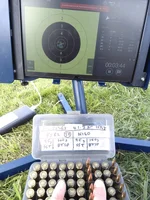
You're welcome. There's no significant difference in accuracy when I shoot on hot or cold days. It is just a matter of dialing a bit less elevation when it is a hot day. By hot I mean really hot, such as 30 degrees centigrade. Don't worry about finicky things like trickling powder etc as the effect on accuracy is dwarfed by technique errors (especially trigger technique and wind effects). I don't even bother cleaning my brass as I found it makes no difference on target. All you need to do is shoot, wipe off any blood,/mud/soot from the case, deprime/resize, wipe off lube, reprime, drop powder into case using an RCBS Uniflow or similar. Seat bullet. Shoot. That crude reloading routine generates groups like this: ten consecutive v bulls at 300yds with my Tikka M55 in .243.
 

Attachments

  • 300yds .243 100gr Speer BTSP 15th jump with 41.3gr RS62 and N160.webp
    300yds .243 100gr Speer BTSP 15th jump with 41.3gr RS62 and N160.webp
    135.5 KB · Views: 14
Back
Top