

So I’m on a different farm in a different area, south of Wanganui National Park, rather than to the east of it. I met this farmer on one of my backblock road trips a couple of years ago. At the time, he was developing this farm from a rundown condition. I’ve been here twice now, great things have been done.
The first visit was full on goat mayhem. Went through 300 rounds between four rifles; .223 Rem, .243 Win, 6.5 Creedmoor and .308 Win. I saw fallow deer but was so accustomed to not shooting them (fallow are currency on our place), that I just shot the goats.
Despite being only 43km from my normal block, as the crow flies, there are no red deer here at all. Red deer stop at the Wanganui River, give or take, any further west and it’s a swimmer.
(To give you a clue about the regional topography, it might only be 43km as the crow flies, but the most direct route by road is over four hours drive.)
The owner has now put up a high (electric) wire around his new lambing paddocks, and issued the order to remove fallow. A lot has changed - better access, a massive internal and boundary fencing program, new implement sheds, tractors, fertiliser bin at the airstrip, the works. It’s now the best fenced farm you’ll ever visit with a perfect metalled access race. So I can drive the Hilux up onto the plateau at the top of the hill. If you could see the hill, you would instantly recognise why this is such a good thing.
Lambing has just started properly, and everything is set up perfectly with the best pasture for the triplets and twins ewes. The singles are a ways out but they’ve got plenty of tucker. Grass is in short supply this year due to the earlier drought this past summer. Hence the pressure on pests. This paddock has just been finished by ewes about to drop their lambs. Note the Paradise Ducks (more on them in a bit).
To this second visit then. It’s a frosty start in the morning, a real finger biter. All the cold weather gear came out – it’s the little things that count, like decent gloves, a pair of googles for riding the bike, a small scarf. Nothing worse than being cold and not being able to use your fingers.
There’s hardly a goat to be seen compared to last time, such is the huge eradication effort that’s gone into this block. The emphasis this trip was on the fallow, which have expanded greatly in numbers. All varieties of coloration are present, even a couple of white ones. It was reported that there was a mob of mostly young animals, all melanistic variety, that were coming out in the same place every day, so that was the place to go look.
I shot just three measly goats during the first morning on the way into the block. One was however a solid longer range effort for a 6mm, and my personal 6mm record to date. On the first morning of the my first trip, in the exact same location, I would have shot upwards of 30 I expect. The rest of the morning was spent in reconnaissance mode and watching fallow as they retreated to the bush to bed down and ruminate. It was time very well spent, as I could see pretty much straightaway where the fallow were entering the bush.
Now it was all about getting in position a good hour before deer o’clock. After a minor track mishap that involved me needing the winch rope, I made it around to the back of the farm hard up against the bush, where I thought I had a good chance of accessing the hunting grounds without being winded. From the end of the race at the high wire, to the fantastic shooting positions in between rocky knobs overlooking the last rough paddock, it’s about 1,600m of up and down undulating pasture. It’s an impossible bush edge to fence, as the papa rock outcrops in high rubbly faces with large blocks falling regularly, which roll down and destroy fencing (as it has in the recent past on the other side of the river). So the last paddock isn’t fenced on the perimeter now, but rather some 200-300m in and beyond rolling boulders. This large and very long unfenced perimeter paddock of quite rough feed is mostly used for older Angus cows that know their way around. So all up, conditions are perfect for a daily invasion by pest ungulates.
Everything in the surrounding bush is geared around this pasture access. The tracks in the native bush, leading to this corner from three points of the compass, are worn like a network of dairy races. There’s bugger all feed under the canopy and it’s easy to move around in there. Very noisy walking though, as there’s so much dry sticks and leaves. The point at which the tracks all converge and exit into the pasture on the edge of the bluffs is like the entrance to a supermarket - the deer and goats have to come out because there’s no food left in the forest. This point is about 500m from the first and highest rocky knobs.
This kind of shooting is pest control. Whilst the country is dramatic and steep, it’s not “proper” hunting. It is all about the numbers, and to get permission you need to demonstrate you aren’t in the business of making pests gun shy. There are two aspects the farmer granting permission has taken time to come and check, by turning up unexpectedly and observing me shooting goats. Firstly can I shoot at all, secondly can I shoot the way this kind of country demands, and thirdly do I know my way round a farm.
This guy has put a lot of money into this farm, and he cannot allow the game / pests to eat out the rougher pasture that the seasons non-productive sheep and cattle can keep in good order, thus leaving the lambing ewes to the best of the fertilised pasture. If he is to control it well and have sufficient feed to carry unproductive stock for that season, he needs pest animals to be killed in numbers. The focus is on the pest does & nannies and their young, so that herd memory is diminished as far as possible. This means controlling your urges - leaving the nice buck off on his own, and instead going for the group of juveniles and does. And you must put the deer down. Runners are not encouraged. Minimising the number of mature does that escape is the goal, so shoot them first, then the youngsters will 99% of the time run a short way, then stop to look back.
Perhaps the best defence mechanism for the deer at this time of year, and the winter / spring hunter’s nemesis, is the Paradise Duck. Paired off for life, these large ducks pick a good spot from which to survey their territory, and their nest site, and observe proceedings sentinel like. They hate men with guns, and at the first sight of one will take to the air and circle, honking their uniquely different his-and-hers alarm calls in perfect synchronicity. Loud, persistent and incredibly annoying, the ducks’ alarms alert every deer within earshot “here comes man, with gun”. You can’t avoid them, the trick is to give yourself enough time to upset them, get to your position, and then wait for everything to settle down again. Rarely, if you are unfortunately close to a nest, you’ll get no mercy and be forced to move. Sometimes it’s so bad the only option is to pack a sad and go home.
Range is the big decider on this land. There is no access other than on foot across the stretch of pasture below the scarp that is hidden from the hunting ground by the aforementioned rocky knobs. You have to get out early else there will likely be deer on the scarp bush line above you, and they’ll look right down at you and raise the alarm. The wind is a killer, because you are looking east with the dominant westerly at your back. No other way round it. The way the deer select an area to habitually return to day in, day out, is simple but effective. Sun, grass, clear and wide field of view, wind almost always blowing from the direction that danger usually arrives. Once the deer have made it to the flatter pasture, there is no way to stalk in close to them. By close I mean anything less than 300m. It would be like trying to stalk a deer standing on a golf green by walking down the middle of the fairway, with the wind behind you. Waving a big flag. Coo-eee!
So that’s the kind of range you need to work with. You can’t get much closer than 250m max in light winds else you’ll be winded. I decided to cut down the range slightly as I had the 6mm and not the 6.5mm, so 108gr vs 143gr. I made it unobserved to a slightly lower outcrop and set up on a tiny grassed point with tussock around me for a degree of cover. It really helps to have a bright, low sun at your back, as the deer will have a hard time looking into the sun. The deer popped out of the bush bang on time, no more than 5 minutes after I setup, which was a lucky break and all part of the learning of a particular area. Need to get their earlier next time. It was also obvious how the older animals stood and winded hard in all directions, right at the crest of the clear cut on the edge of the native. The younger ones were far less cautious. I watched one buck winding and looking nervous, before turning and bolting back into cover, and I thought oh here we go, they've winded me and now they're off. But no, the rest were too hungry. Range was 295 - 315m across the mob, so 1.1 - 1.2 MRAD up and we’re good to go. As mentioned, largest doe first, then whatever I can get.

I shot the largest doe, but the others scattered too fast for a second shot. After waiting a couple of minutes, I decided to move closer to the far bush edge and take a chance on the deer coming back out again as the sun hit the horizon. So I quickly scrambled down to GPS mark the position of the doe in case it was dark by the time I returned, and took off over to the next shooting position.
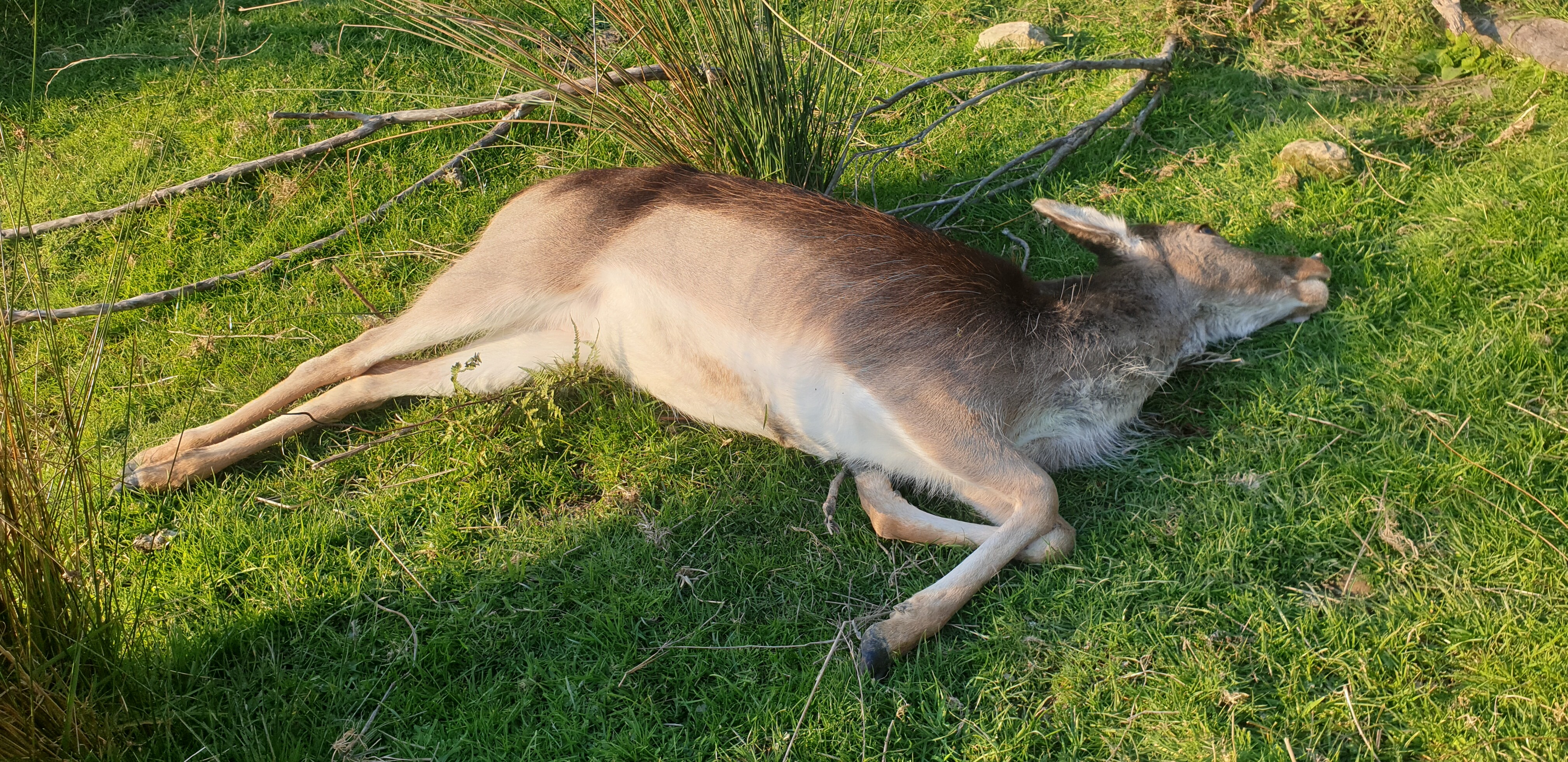

Rewards came about half an hour later, as out stepped a group of four fallow deer, a prickett, one doe and two yearlings, all of whom dropped to the shot at between 270-300m.

An unfortunate goat was too slow retreating to the bush edge, as he didn’t seem that sure where the shots were coming from due to the sharp reflection and echo of the report. He changed direction twice and dithered. Bonus goat.
All the evening’s action was setup by the recce earlier in the day. There’s no substitute for a bit of observation before setting foot in the hunting area.
This kind of shooting is why I always favour a Varmint rifle. Shot strings of 5, 6, 7 or more shots is not unusual. My .308 sporter contour rifle is well hot after a string like that, and wanders slightly high and left. But my Varmint rifles just stay nice and cool and steady as. I use a Harris bipod with spikes and podlock, and jam the feet into the tuft for a dead steady rest. Sometimes for the long stuff I use a rear bag, but it wasn’t necessary today. The hold on the deer with this setup is rock solid.
Now I had just enough light to deal to five beautiful eating deer. Inspection of the carcasses showed perfect bullet performance. Aiming for hilar shots, the bullets all exited bar one, which I recovered*. Exit holes were a good size and blood flowed freely, not that any tracking was necessary as they all fell over there and then. These being small fallow, the smallest of which would be slightly larger than a typical female roe deer, I was glad I hadn’t brought the 6.5mm and kind of annoyed I hadn’t brought the .223 Rem. At 300m, a 55gr Speer Gold Dot would be the mustard on these small deer. Why anyone in their right mind would even think to suggest that a 6mm is not enough gun for a deer this size is beyond me, if anything it’s almost too much!
I took the backstraps and rumps off the deer as it got dark, and resolved to do a second run. I trudged off back to the truck with a heavy pack and my ridiculous but deadly 13lb rifle. It was quite a mission in the dark, nothing quite like the sound of a spooked herd of Angus charging around in the dark, and you can’t see them. Back at the truck I had a refreshing motivational beer, packed the meat into the Engel and took off back to the carcasses. I whipped out the guts, took the hearts, loin fillets and kidneys, and hacked off the remaining rear leg meat for dog tucker. I managed to avoid cutting myself, and the pack was a lot lighter for the second return to the truck. An easy drive out and I was done for the night. Happy to get cleaned up, get the meat into the fridge and drink some more brown ale.
It’s now dawn on the following morning, with a hard frost and fog. There are more magpies in this valley than the whole of the Waikato in total, so I am going to rest my legs and lure unsuspecting noisy annoying Australian birds to their fate, I’ll take it very easy and then head of again to the same spot this afternoon!

* A while back, a new member – a self-proclaimed esteemed French scholar of ballistics – scoffed at my claim that some bullets will expand to 3x calibre. Well it’s fair to say that got up my nose a little bit, but being a bit “Cold War” about life I just bided my time until I next got some evidence. I won’t clean this 108gr ELD-M because it might fall apart, but bottom line is that this spinning, expanding, weight shedding cutting machine expanded to well over 3x calibre.
0.836” across, divided by 0.243” = 3.44

This bullet turned the hilar area and upper part of the front lungs into gelatinous mincemeat. Tut tut tut, oh how we disapprove of the unethical, barely legal, women and youth 6mm rifle! It’s a varmint rifle, not a deer rifle! And he’s shooting a light MATCH bullet, good lord it’s too much to contemplate. From 300m! Quick, help me sit down!
Anyway, minor point proving aside, these small, soft bullets carve big holes.
The first visit was full on goat mayhem. Went through 300 rounds between four rifles; .223 Rem, .243 Win, 6.5 Creedmoor and .308 Win. I saw fallow deer but was so accustomed to not shooting them (fallow are currency on our place), that I just shot the goats.
Despite being only 43km from my normal block, as the crow flies, there are no red deer here at all. Red deer stop at the Wanganui River, give or take, any further west and it’s a swimmer.
(To give you a clue about the regional topography, it might only be 43km as the crow flies, but the most direct route by road is over four hours drive.)
The owner has now put up a high (electric) wire around his new lambing paddocks, and issued the order to remove fallow. A lot has changed - better access, a massive internal and boundary fencing program, new implement sheds, tractors, fertiliser bin at the airstrip, the works. It’s now the best fenced farm you’ll ever visit with a perfect metalled access race. So I can drive the Hilux up onto the plateau at the top of the hill. If you could see the hill, you would instantly recognise why this is such a good thing.
Lambing has just started properly, and everything is set up perfectly with the best pasture for the triplets and twins ewes. The singles are a ways out but they’ve got plenty of tucker. Grass is in short supply this year due to the earlier drought this past summer. Hence the pressure on pests. This paddock has just been finished by ewes about to drop their lambs. Note the Paradise Ducks (more on them in a bit).
To this second visit then. It’s a frosty start in the morning, a real finger biter. All the cold weather gear came out – it’s the little things that count, like decent gloves, a pair of googles for riding the bike, a small scarf. Nothing worse than being cold and not being able to use your fingers.
There’s hardly a goat to be seen compared to last time, such is the huge eradication effort that’s gone into this block. The emphasis this trip was on the fallow, which have expanded greatly in numbers. All varieties of coloration are present, even a couple of white ones. It was reported that there was a mob of mostly young animals, all melanistic variety, that were coming out in the same place every day, so that was the place to go look.
I shot just three measly goats during the first morning on the way into the block. One was however a solid longer range effort for a 6mm, and my personal 6mm record to date. On the first morning of the my first trip, in the exact same location, I would have shot upwards of 30 I expect. The rest of the morning was spent in reconnaissance mode and watching fallow as they retreated to the bush to bed down and ruminate. It was time very well spent, as I could see pretty much straightaway where the fallow were entering the bush.
Now it was all about getting in position a good hour before deer o’clock. After a minor track mishap that involved me needing the winch rope, I made it around to the back of the farm hard up against the bush, where I thought I had a good chance of accessing the hunting grounds without being winded. From the end of the race at the high wire, to the fantastic shooting positions in between rocky knobs overlooking the last rough paddock, it’s about 1,600m of up and down undulating pasture. It’s an impossible bush edge to fence, as the papa rock outcrops in high rubbly faces with large blocks falling regularly, which roll down and destroy fencing (as it has in the recent past on the other side of the river). So the last paddock isn’t fenced on the perimeter now, but rather some 200-300m in and beyond rolling boulders. This large and very long unfenced perimeter paddock of quite rough feed is mostly used for older Angus cows that know their way around. So all up, conditions are perfect for a daily invasion by pest ungulates.
Everything in the surrounding bush is geared around this pasture access. The tracks in the native bush, leading to this corner from three points of the compass, are worn like a network of dairy races. There’s bugger all feed under the canopy and it’s easy to move around in there. Very noisy walking though, as there’s so much dry sticks and leaves. The point at which the tracks all converge and exit into the pasture on the edge of the bluffs is like the entrance to a supermarket - the deer and goats have to come out because there’s no food left in the forest. This point is about 500m from the first and highest rocky knobs.
This kind of shooting is pest control. Whilst the country is dramatic and steep, it’s not “proper” hunting. It is all about the numbers, and to get permission you need to demonstrate you aren’t in the business of making pests gun shy. There are two aspects the farmer granting permission has taken time to come and check, by turning up unexpectedly and observing me shooting goats. Firstly can I shoot at all, secondly can I shoot the way this kind of country demands, and thirdly do I know my way round a farm.
This guy has put a lot of money into this farm, and he cannot allow the game / pests to eat out the rougher pasture that the seasons non-productive sheep and cattle can keep in good order, thus leaving the lambing ewes to the best of the fertilised pasture. If he is to control it well and have sufficient feed to carry unproductive stock for that season, he needs pest animals to be killed in numbers. The focus is on the pest does & nannies and their young, so that herd memory is diminished as far as possible. This means controlling your urges - leaving the nice buck off on his own, and instead going for the group of juveniles and does. And you must put the deer down. Runners are not encouraged. Minimising the number of mature does that escape is the goal, so shoot them first, then the youngsters will 99% of the time run a short way, then stop to look back.
Perhaps the best defence mechanism for the deer at this time of year, and the winter / spring hunter’s nemesis, is the Paradise Duck. Paired off for life, these large ducks pick a good spot from which to survey their territory, and their nest site, and observe proceedings sentinel like. They hate men with guns, and at the first sight of one will take to the air and circle, honking their uniquely different his-and-hers alarm calls in perfect synchronicity. Loud, persistent and incredibly annoying, the ducks’ alarms alert every deer within earshot “here comes man, with gun”. You can’t avoid them, the trick is to give yourself enough time to upset them, get to your position, and then wait for everything to settle down again. Rarely, if you are unfortunately close to a nest, you’ll get no mercy and be forced to move. Sometimes it’s so bad the only option is to pack a sad and go home.
Range is the big decider on this land. There is no access other than on foot across the stretch of pasture below the scarp that is hidden from the hunting ground by the aforementioned rocky knobs. You have to get out early else there will likely be deer on the scarp bush line above you, and they’ll look right down at you and raise the alarm. The wind is a killer, because you are looking east with the dominant westerly at your back. No other way round it. The way the deer select an area to habitually return to day in, day out, is simple but effective. Sun, grass, clear and wide field of view, wind almost always blowing from the direction that danger usually arrives. Once the deer have made it to the flatter pasture, there is no way to stalk in close to them. By close I mean anything less than 300m. It would be like trying to stalk a deer standing on a golf green by walking down the middle of the fairway, with the wind behind you. Waving a big flag. Coo-eee!
So that’s the kind of range you need to work with. You can’t get much closer than 250m max in light winds else you’ll be winded. I decided to cut down the range slightly as I had the 6mm and not the 6.5mm, so 108gr vs 143gr. I made it unobserved to a slightly lower outcrop and set up on a tiny grassed point with tussock around me for a degree of cover. It really helps to have a bright, low sun at your back, as the deer will have a hard time looking into the sun. The deer popped out of the bush bang on time, no more than 5 minutes after I setup, which was a lucky break and all part of the learning of a particular area. Need to get their earlier next time. It was also obvious how the older animals stood and winded hard in all directions, right at the crest of the clear cut on the edge of the native. The younger ones were far less cautious. I watched one buck winding and looking nervous, before turning and bolting back into cover, and I thought oh here we go, they've winded me and now they're off. But no, the rest were too hungry. Range was 295 - 315m across the mob, so 1.1 - 1.2 MRAD up and we’re good to go. As mentioned, largest doe first, then whatever I can get.
I shot the largest doe, but the others scattered too fast for a second shot. After waiting a couple of minutes, I decided to move closer to the far bush edge and take a chance on the deer coming back out again as the sun hit the horizon. So I quickly scrambled down to GPS mark the position of the doe in case it was dark by the time I returned, and took off over to the next shooting position.
Rewards came about half an hour later, as out stepped a group of four fallow deer, a prickett, one doe and two yearlings, all of whom dropped to the shot at between 270-300m.
An unfortunate goat was too slow retreating to the bush edge, as he didn’t seem that sure where the shots were coming from due to the sharp reflection and echo of the report. He changed direction twice and dithered. Bonus goat.
All the evening’s action was setup by the recce earlier in the day. There’s no substitute for a bit of observation before setting foot in the hunting area.
This kind of shooting is why I always favour a Varmint rifle. Shot strings of 5, 6, 7 or more shots is not unusual. My .308 sporter contour rifle is well hot after a string like that, and wanders slightly high and left. But my Varmint rifles just stay nice and cool and steady as. I use a Harris bipod with spikes and podlock, and jam the feet into the tuft for a dead steady rest. Sometimes for the long stuff I use a rear bag, but it wasn’t necessary today. The hold on the deer with this setup is rock solid.
Now I had just enough light to deal to five beautiful eating deer. Inspection of the carcasses showed perfect bullet performance. Aiming for hilar shots, the bullets all exited bar one, which I recovered*. Exit holes were a good size and blood flowed freely, not that any tracking was necessary as they all fell over there and then. These being small fallow, the smallest of which would be slightly larger than a typical female roe deer, I was glad I hadn’t brought the 6.5mm and kind of annoyed I hadn’t brought the .223 Rem. At 300m, a 55gr Speer Gold Dot would be the mustard on these small deer. Why anyone in their right mind would even think to suggest that a 6mm is not enough gun for a deer this size is beyond me, if anything it’s almost too much!
I took the backstraps and rumps off the deer as it got dark, and resolved to do a second run. I trudged off back to the truck with a heavy pack and my ridiculous but deadly 13lb rifle. It was quite a mission in the dark, nothing quite like the sound of a spooked herd of Angus charging around in the dark, and you can’t see them. Back at the truck I had a refreshing motivational beer, packed the meat into the Engel and took off back to the carcasses. I whipped out the guts, took the hearts, loin fillets and kidneys, and hacked off the remaining rear leg meat for dog tucker. I managed to avoid cutting myself, and the pack was a lot lighter for the second return to the truck. An easy drive out and I was done for the night. Happy to get cleaned up, get the meat into the fridge and drink some more brown ale.
It’s now dawn on the following morning, with a hard frost and fog. There are more magpies in this valley than the whole of the Waikato in total, so I am going to rest my legs and lure unsuspecting noisy annoying Australian birds to their fate, I’ll take it very easy and then head of again to the same spot this afternoon!
* A while back, a new member – a self-proclaimed esteemed French scholar of ballistics – scoffed at my claim that some bullets will expand to 3x calibre. Well it’s fair to say that got up my nose a little bit, but being a bit “Cold War” about life I just bided my time until I next got some evidence. I won’t clean this 108gr ELD-M because it might fall apart, but bottom line is that this spinning, expanding, weight shedding cutting machine expanded to well over 3x calibre.
0.836” across, divided by 0.243” = 3.44
This bullet turned the hilar area and upper part of the front lungs into gelatinous mincemeat. Tut tut tut, oh how we disapprove of the unethical, barely legal, women and youth 6mm rifle! It’s a varmint rifle, not a deer rifle! And he’s shooting a light MATCH bullet, good lord it’s too much to contemplate. From 300m! Quick, help me sit down!
Anyway, minor point proving aside, these small, soft bullets carve big holes.
Last edited by a moderator:


