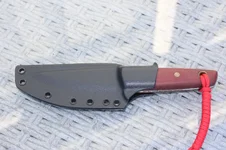
Knife handles.

Dave31

Well-Known Member
Gents, I'm looking for some advice.

I need to make an accurate cut which needs to be plumb at 90 degrees through some knife scales. This will let me get two knives out of one set of large scales. This is important as I have limited stock of the wood and I have future projects in mind.

If it isn't 90 degrees then the scale on the other side will likely not be the right size.

I have considered using a coping saw but I don't think I have the ability to ensure a perfectly straight cut. Plus the cuts I've made so far have by hand have been a slog.

I think the answer is scroll saw or band saw.

Am I right or is there some other method in haven't thought of. I'd rather avoid going to buy more power tools as I am limited on space and the budget would be thrown out of the window.

(both sides of the scales are stuck together in this image)IMG-20240122-WA0001.webp
 
Gents, I'm looking for some advice.

I need to make an accurate cut which needs to be plumb at 90 degrees through some knife scales. This will let me get two knives out of one set of large scales. This is important as I have limited stock of the wood and I have future projects in mind.

If it isn't 90 degrees then the scale on the other side will likely not be the right size.

I have considered using a coping saw but I don't think I have the ability to ensure a perfectly straight cut. Plus the cuts I've made so far have by hand have been a slog.

I think the answer is scroll saw or band saw.

Am I right or is there some other method in haven't thought of. I'd rather avoid going to buy more power tools as I am limited on space and the budget would be thrown out of the window.

(both sides of the scales are stuck together in this image)View attachment 347304
How thick is it?
A side on photo showing the line you want to cut down might help.
 
I would get it on a band saw, at least you would get a straight direct cut and be able to steer it

Good luck with that, my mate has just done one on a skeleton type blade and and it’s come out very nice 👍
 
Great gesture Stuart! 😃😃😃

Can I derail this thread and ask whether it is nescessary to stabilise wood handle scales? Specifically walnut, London plane and olive wood…obviously they need to be dried correctly…
 
Great gesture Stuart! 😃😃😃

Can I derail this thread and ask whether it is nescessary to stabilise wood handle scales? Specifically walnut, London plane and olive wood…obviously they need to be dried correctly…
I think the short answer is no, it isn’t necessary, it can be an advantage though.

We have used timber, and still use, for knife handles and a plethora of other things for donkeys years without it being stabilised, many of those knives and other things are still out and about, working fine and doing their stuff.

That said though I do tend to stick with the stabilised these days because it does have a few advantages, first off of course it is more stable, not fully stable but more, it is easier to finish and it is less absorbent, again only less, not fully.

It is also worth remembering that not all things are created equal, there is stabilised and stabilised.

I have a couple of mates here in Sheffield, one makes violins and the other guitars, they passionately dislike the stabilised wood that I use because once stabilised the timber loses all its resonance, they don't like that 😂

I make knives for two or three gunmakers, one of those won't have stabilised timber as they like to give the knives to their stock finishers and have the scales oil finished in house, that won't work on a stabilised handle.

So in short, no, non stabilised can be fine.
 
I think the short answer is no, it isn’t necessary, it can be an advantage though.

We have used timber, and still use, for knife handles and a plethora of other things for donkeys years without it being stabilised, many of those knives and other things are still out and about, working fine and doing their stuff.

That said though I do tend to stick with the stabilised these days because it does have a few advantages, first off of course it is more stable, not fully stable but more, it is easier to finish and it is less absorbent, again only less, not fully.

It is also worth remembering that not all things are created equal, there is stabilised and stabilised.

I have a couple of mates here in Sheffield, one makes violins and the other guitars, they passionately dislike the stabilised wood that I use because once stabilised the timber loses all its resonance, they don't like that 😂

I make knives for two or three gunmakers, one of those won't have stabilised timber as they like to give the knives to their stock finishers and have the scales oil finished in house, that won't work on a stabilised handle.

So in short, no, non stabilised can be fine.
Thanks Stuart, massively helpful and I appreciate it.

Completely understand we’ve used wood for handles for 100s of years…I think I’ll make sure it’s properly dry and just finish it well!
 
Back
Top