Namibia 2018 hunt - Intro

I've not written a hunting report in a while so thought I was overdue. I know some of you guys have hunted there many times, but the info might be of use to those thinking of visiting Namibia. I arrived back yesterday and will add info as I get chance.

During my first ever hunting trip to South Africa I was invited to a dinner party held at the home of our PH after our hunting had finished. That trip was an eye opening experience and an interesting and informative introduction to hunting Africa. I mentioned that I'd really like to hunt a Gemsbok and was told they were available there before a friend of our PH stepped in and said "You don't want to hunt them here (Eastern Cape) you want to hunt them up north, where they belong, in the sand, in the Kalahari". Right at that moment a seed had been sown.

Since then I've visited South Africa several times but always resisted the opportunity to hunt Gemsbok after that conversation. Fortunately my friend Gordon invited me to hunt in Namibia with him, in the Kalahari.

In 2015 Gordon made the acquaintance of Outpost Safaris. A Namibian based outfit operating on a huge 40,000 acre (15,000 hectare) area of Kalahari bordering the Botswana border. Look at a map where South Africa, Botswana and Namibia meet and there you are. He hunted with them the following year and chose to return in 2018 after his previous tales of hunting there I jumped at the chance to go with him.

We booked flights with South African airways to Windhoek via Johannesburg. We've found them to be a good airline and they have no additional fees for flying firearms. Our bags and guns were checked all the way through from Heathrow to Windhoek so didn't have to run the gauntlet of dealing with the South African police in Jo'burg an experience I don't relish. Currently at the time of writing there is no need to apply for a firearms export permit like there is in South Africa.

After clearing immigration in Namibia and collecting our hold luggage we reported to the local police office where we picked up our rifles and ammunition. The whole process took just a few minutes. There we met a couple from the US, they had the largest and heaviest gun case I've ever seen in my life. Apparently it contained amongst others a 9.3 x 62 as the lady was there to hunt an elephant. We obtained our Namibian gun import licenses and were on our way to meet our PH, Frank, We jumped into his truck and our Namibian adventure began.

During the trip we were told about the various species in our hunting area as well as those also burrowing under and climbing over an 8 kilometer twin high fence line on the Botswana border. It appeared that Franks place was under constant attack from lions, cheetah, hyena, caracal, jackal and on occasion, leopard. On the Botswana side of the fence lies a national park with a high concentration of predators. On the Namibian side a large population of gemsbok, which I'll now refer too using the Namibian name of Oryx, Kalahari springbok, eland, red hartebeest, ostrich, steenbok, duiker as well as sheep and cattle farmed there. Knowing how secretive these predators can be I didn't expect to see any of them, I had no idea of the surprises and experiences we were in for.

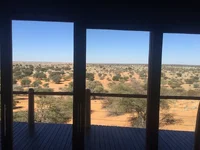
The lodge was surprisingly comfortable. We were initially booked into their 'hunters camp' but due to an administrative error we were upgraded to another lodge on the property which the land owner uses to entertain family and friends. The bedrooms had excellent views of the game hunting area, a comfortable lounge area and it turns out that Franks girlfriend just happened to be a trained chef. The springbok we had for dinner that evening was excellent.

We eventually retired for the evening to get some much needed sleep after a long day of travelling. Annoyingly I awoke early and at around 5.30 am whilst laying in bed I heard a familiar noise outside. I often take my young son to Chester Zoo and Yorkshire Wildlife Park so the deep and low noise coming from outside was unmistakable to me, it was a lion calling, a noise I've heard many many times at these two zoos. I opened the doors to listen and could tell he was some distance away.

At breakfast Frank advised he'd also heard the cat and thought that due to the level of detail he could hear in the call that it was about four kilometers away in Botswana. Some of the staff at the lodge had also heard the calling. The local indigenous people are terrified of lions and a new starter didn't want to walk the 300 meters or so from her house to the lodge knowing a lion was in the area! We had breakfast and headed for the range to zero our rifles.

The view from my bed. A salt lick around two hundred yards from the lodge regularly attracted Kalahari Springbok, Eland, Oryx, Sable and Ostrich.
bedroom_view.webp


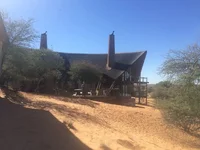
The lodge.

lodge.webp

More to follow when I get chance.
 
Last edited:
It was a short journey to the rifle range. The Land Cruiser sped along under blue, cloudless skies along a well worn track in the red Kalahari sand. Oryx trotted off at the sight of the vehicle, ostrich ran at impressive speeds and herds of Kalahari springok ran and pronked up to an impressive five feet high alongside the truck.

It became apparent almost immediately that there were impressive numbers of springbok here. Mother Nature has been very kind to this part of Namibia in previous years with good rains resulting in large numbers of these antelope. This booming population was very much on Franks mind as poor rains in the future would result in very real problems and the plan was to cull heavily. Frank was also acutely aware that a large percentage of these springbok were female.

Kalahari Springbok are larger than their South African cousins with a distinctive colouration. Their bodyweight being an average of around 25% heavier. The property has produced a number of impressive trophy rams over the years with many over 16". Though to find a trophy ran of this size you'd have to pass by hundreds of regular animals. As a small group of springbok ran we arrived at the rifle range to check our rifles.

Both Gordon and I had packed Tikka T3 Lite rifles in .30--06 calibre with 180 grain ammo. I had chosen to use Sako Super Haammerheads as their performance had been excellent on previous African safaris. It only took a few shots before we were both happy, shooting at both 100 meter and 200 meter targets.

Frank and Gordon on the range.

IMG_0014resize.webp

With the heat of the rising sun on my back and the smell of cordite in the air our hunting trip had begun in earnest. We'd made it very clear that we didn't want to shoot from the back of the truck and that we fully intended to spot and stalk. This was something that seemed to surprise Frank a little as he was used to American clients but he was perfectly ok with this. The truck ambled across the sand driving around the trees as we glassed the countryside looking for our quarry.

We drove past a group of meerkats scrambling for the safety of their burrows, mongoose and brown squirrel were also among the small animals we saw driving around. Before too long we saw a group of springbok. We stopped the truck, jumped off and began our stalk by glassing the large open expanses of ground.

IMG_0123resize.webp

Stalking on sand was a new experience for myself. I thought it would be advantageous as we were moving silently along right up until I stood on a dead and dry branch anyway! Thankfully the springbok didn't notice. They were about four hundred meters away when we set off. Moving slowly towards them we used the vegetation to conceal our presence and soon began to get closer. Crouching down low and moving very slowly we got to within around 180 meters and identified a young ram amongst the group.

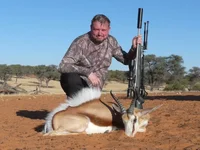
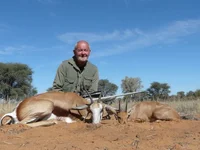
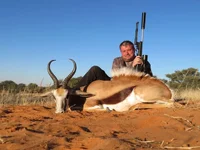
I placed the rifle on the sticks and fired snatching my first shot. I immediately realised what I'd done, reloaded and fired a second time dropping the animal. The first shot was a bit too far back, I chastised myself and vowed not to do that again. Not the perfect start to a safari, but I had taken my first Namibian animal.

P1030237resize.webp

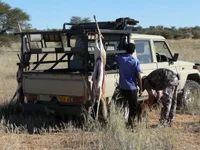
Large bodied Kalahari springbok are loaded onto the hunting vehicle as Franks Bavarian a very talented hunting dog investigates what's going on.

P1030162resize.webp


We stalked for the rest of the day. I was to take a further Kalahari springbok ewe, Gordon would take another springbok and a steenbok These small antelope are found throughout Southern Africa and in good numbers throughout the Kalahari and we regularly bumped them driving along or stalking through the grass. They seem to lie there almost until you're practically on top of them before running.

P1030153resize.webp

Day one had been very successful so we returned to the lodge around 6 pm seeing several more species of antelope along the way.


Last edited:
The following morning I heard a lion roaring at around 6am. This time there was a little more detail in the sound. It seemed closer but still in the distance. The lodge is located 1.5 kilometers from the Botswana fenceline and it was thought to be on the other side.

Lodge staff drive the full length of the eight kilometer border every morning looking for lion, leopard, cheetah, hyena and other predator tracks and then follow the tracks to see if they've returned to Botswana or are on their ground. Porcupine also tunnel under the fences letting all manner of species into Namibia. Later in the week we'd travel down the fenceline with some highly experienced trackers who'd show us exactly what had come over the border, what had returned and what had stayed. Something I personally found fascinating.

We set off in the hunting truck. Today we were after management red hartebeest, oryx and eland. Steenbok were a target of opportunity and if ostrich showed up we'd also try for one of those. They can't be that difficult I thought to myself.

In june it's winter time in Namibia. The nights can be very cold and sub zero temperatures are possible at night. However although we set off wearing hats, jackets and gloves it soon warmed up as the sun rose eventually reaching the mid twenties in the early afternoon. As you'd expect in the Kalahari desert in the dry season, there was no humidity.

Herds of springbok ran as we drove off to an area where we were going to hunt for the day. A herd of oryx in the distance became our first target for the day but they were some way away with a large open area between them and ourselves. This presented a challenge because large herds have many pairs of eyes in all directions. We decided to move closer slowly as it looked like the oryx would eventually move away from us over a dune giving us the opportunity to make up some ground. In time they did so we followed steadily moving up the dune over the next twenty minutes or so.

Sadly our plan hadn't gone to plan. They'd moved on much quicker than we anticipated. The wind was in our face and we were certain that we'd not spooked them they'd just moved on quickly. All was not lost though. As I glanced the oryx in the distance I also saw a small herd of red hartebeest off to our right hand side around 300 meters away.

There are several different species of hartebeest found throughout Africa but only the red or cape hartebeest is endemic to Namibia. They are also found in South Africa and Botswana. These large antelope can weigh over 150 kilos and have an almost primeval looking face. Frank identified a shootable animal and we stalked forward slowly. Eventually I was around 200 meters from the animal. The rifle placed on the sticks and I took aim at the hartebeest now slightly quartered. The sake round broke the animals shoulder and paased through the heart and lungs dropping him on the spot.

A fairly typical cull male from the Kalahari. We did see some quite exceptional trophy animals on another property we visited at the end of the trip but this is what is to be expected on a management hunt.

hartebeestresize.webp

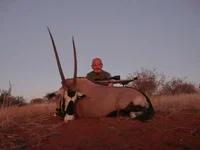
We continued hunting later that day with Gordon taking a nice oryx as the sun started to go down. This is the species that ultimately brought us both to Namibia. Although he's been here before it was my tale of hunting these animals "in the sand, where they belong" that also appealed to him.

oryx_gordon_resize.webp

At this point I was really starting to enjoy being in such a vast and remote wilderness. We were seeing a lot of game from tiny steenbok and small duiker to eland, sable, wildebeest, huge numbers of Kalahari springbok, ostrich and of course oryx. We enjoyed another great meal cooked by Franks girlfriend and I wondered what lay in store for us the following morning.


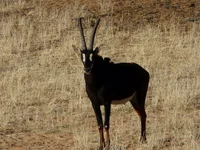
One of a small number of sable on the property. Numbers of these plummeted in recent years but determined efforts to breed them by game ranchers has ensured their numbers have increased dramatically. They have been very expensive to hunt in Africa particularly if they were a good trophy size. Though recently I've seen them offered for as low as $3,000 each. A fraction of what they once cost. However, I've seen them on a game farm in South Africa and when I went to take a picture I could have got close enough to throw a bullet at it. The game ranching operations have resulted in many of these animals becoming used to human activity and thus the captive bred animals don't appear to be the most challenging animals to hunt. What we did notice though if one approached a salt lick or water, other animals noticeably kept their distance! Seen broadside they always remind me of a pantomime horse!

sable_resize.webp
 
This is just making me want to go to Africa TBH...
Don't do it mate. There is strong chance of contracting "Africansafarihunteritis" This is serious affliction and there is no known cure. You don't know if you have contracted it until you return.
Symptoms are irritability, staring out of the window for hours often with a wistful grin. lac of concentration and constant looking up flight costs etc.
Tusker
 
Don't do it mate. There is strong chance of contracting "Africansafarihunteritis" This is serious affliction and there is no known cure. You don't know if you have contracted it until you return.
Symptoms are irritability, staring out of the window for hours often with a wistful grin. lac of concentration and constant looking up flight costs etc.
Tusker

Haha! I already have that with stalking, how much worse can it get?? 😬[emoji56]
 
Haha! I already have that with stalking, how much worse can it get?? 😬[emoji56]

Considerably worse! :D

Africa can be very unpredictable. You never know what random sights you'll see. If you visit, I guarantee it will get under your skin. Like Tusker said, you'll be sat there grinning with your memories and plans to return.
 
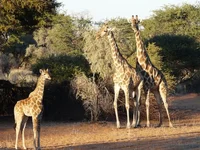
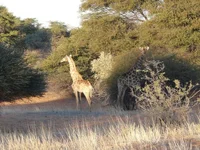
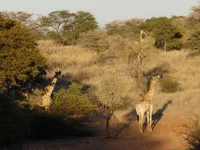
My new lion alarm clock started calling again at 6.00 am. This time it was blatantly obvious that he'd moved further away from the lodge. We headed out at 7.30 am with the temperature a little warmer and set off in search of our target antelope species. On the way we came across a herd of giraffes. Although huntable the reality is that no one has wanted to hunt one in quite some time so their numbers have increased slowly.

The animal to the right is a bull giraffe. The one in the middle a female and it's mating system. It's not coincidence how he's standing there!

giraffe1.webp

giraffe_3.webp

giraffe_2.webp

The truck drove slowly for around 30 minutes before we reached an area where we were to begin hunting. We jumped off the back of the truck and stalked for some time. Again the oryx seemed to travel at a fair pace not staying in any one place for any time. We returned to the lodge for brunch before heading out again later. Whilst out Frank received a call on his radio from an excited member of staff. Apparently a leopard had taken a springbok and dragged it over the fence line onto the property to the south of our hunting area. This was around three miles or so from our current location. We sped off in search of the cat. As Gordon, myself and Frank were all on the back of the hunting vehicle Frank advised how to act in front of the cat. No sudden movements etc.

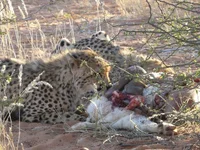
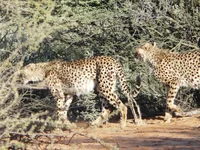
We eventually arrived against the boundary with the next property and slowed right down. We were looking across the boundary for a leopard feeding on a springbok. I've never seen a wild leopard and the excitement started to build. We drove a couple of miles before stopping. Looking through binos at the kill it quickly became apparent that the springbok was in fact a domestic goat! As for the leopard, well, that turned out to be not one but two wild cheetahs!

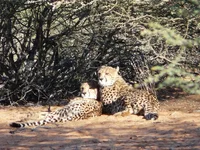
I've read that wild cheetahs don't attack humans and so relaxed a little bit. We stopped the truck, grabbed our cameras leaving the rifles behind and crossed over to the other farm. The two cats were very skinny we were told. It all made sense too because we managed to get very close to the pair of them whilst feeding. Their hunger resulting in them simply not being bothered by our presence.

Cheetahresize.webp

Shortly afterwards the neighbouring farmer and his workers arrived. Word had gotten around very quickly of the two predators killing livestock and Frank and the farmer walked off to have a discussion about the problem. We left shortly afterwards to continue our hunt, but not before I was asked to shoot (not hunt) a springbok from the back of the truck which was used to keep the cheetah in the area.

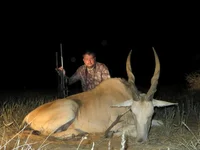
Later that evening we observed a herd of eland and stalked them. The area consisted of undulating dunes and as we approached the top of one a young bull appeared. Getting into position I took aim at the boiler room and fired. Cape eland are the worlds largest antelope and endemic to Namibia, South Africa and Botswana. In some instances they can weigh in excess of 700 kilos. Before leaving for this trip I had been advised by a couple of armchair experts that my .30-06 wasn't up to the job for such a large animal. I had packed some 220 grain ammo but in this instance I had my usual 180 grain sake super hammerheads loaded. I needn't have worried though. The shot sounded good with a large dull thumping noise sounding immediately after I squeezed the trigger. The eland stumbled forward and fell.

eland_resize.webp

Almost immediately afterwards we saw a herd of oryx close by, closer than we'd seen them and so started another stalk through the vegetation. Within minutes we'd finally gotten into position to take a shot. It felt a little surreal as we'd spent a lot of time stalking oryx previosly without getting the chance of a shot and now within minutes of taking my first eland I was on an oryx. The animal we'd travelled to Namibia to hunt.

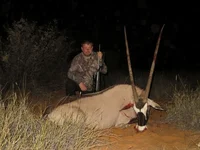
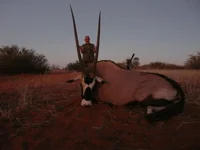
A good looking animal presented the perfect broadside shot and I fired. The shot was a little high but the result was an oryx down. The result was a 39" female. It appeared Frank had somewhat underestimated her size, this wasn't a management animal but a trophy oryx. This really was a case of right place, right time and a little bit of good luck.

oryxresize.webp

The hunting vehicle wasn't big enough to load both animals so our tracker had to drive back and swap it for a larger land cruiser. By the time he returned the sun had gone down and we just about had enough time to take a couple of pics before driving back to the lodge.

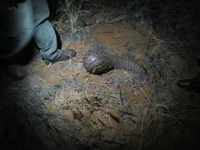
I'd seen my first wild cheetahs, taken my first cape eland and my first oryx and just when I thought the day couldn't get any better, Frank shouts to the driver to stop the truck, jumps off runs 15 yards at a small animal walking along the ground. A pangolin. The most smuggled animal in the world thanks to the Chinese 'medicine' industry. Ironically I'd watched a documentary on TV about their plight just a few months ago. Their numbers are in a steep decline so it was a real privilege to see one in the wild. It rolled into a ball which is a defense mechanism. It was obviously unhappy to see us so we took a couple of quick snaps and left it be. F

pangolinresize.webp

All in all a very good day.
 
And again... 6 am and a lion is calling away. I walked onto the balcony of my bedroom with a coffee and listened intently. It was in the distance but this was the closest I'd heard it.

Today we'd arranged to do a spot of wing shooting. Sand grouse were our quarry. Franks girlfriend and the lodge chef, Marli had agreed to cook them on a braai that evening if we were successful. She joked that there were some in the freezer anyway if we were not anyway. At breakfast Frank advised that he'd like to check to see if the cheetah were still feeding on our way to the wing shooting area. It sounded like an idea too good to pass up and I hoped to get some better photos so all was good.

Marli had never seen wild cheetah despite living in Namibia all her life and so decided to accompany us all to take a look. We drove down the Botswana border fence line on our way there stopping to observe hyena tracks. It became apparent quite quickly that a hyena had entered int the night but had also left too. We arrived at the area where we'd seen cheetah the previous day. The cats had gone as had the kill. Our tracker studied the area carefully. This guys tracking skills really do need to be seen to be believed. He identified lion tracks. Two separate lions to be precise and showed how they'd approached the cheetahs, who's tracks indicated that they had ran off when the larger cats approached.

Where the Botswana, Namibia and South Africa borders meet there is a small concrete post marking the spot. We were just thirty or forty yards from this point on a neighbouring property south of ours. This property bordered South Africa with a low fence, small pieces of flesh, blood and the mane hair from a lion were found on this fence along with the goats stomach. The lions had carried the remains of the goat and the springbok into South Africa robbing the cheetahs of their meal.

I joked with Marli saying that if the lions show up, kick Gordon as hard as possible in the knee cap and run like hell. I then asked Frank how far away he thought they'd be. His reply was a simple "Not far". Our tracker was interested in the cheetah and where they had gone when Frank suddenly says, "there's the lion. Wait, there is both of them". I look across the fence line into South Africa and see the two cats. Gordon had his Leica range finding binoculars with him and clocks them at 140 meters away before one of them disappears into the undergrowth.

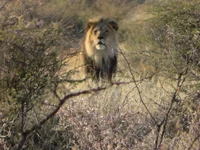
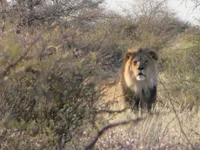
I've seen lions in zoos and safari parks. But right now I'm staring at the real thing. Wild lions, king of the jungle looking right at us. Our vehicle is approximately forty meters to my left. Up an incline and our rifles are on the top of the truck. One of the lions had moved closer. Gordon now clocks him at 113 meters. I'm thinking he can probably cover that distance in seven or eight seconds. How long would it take me to reach the truck uphill wearing hiking boots on sand? I'm thinking to myself don't run, don't turn your back etc. Then it dawns on me. Frank and our tracker seem not bothered by their presence at all. This is reassuring and I pull out my camera to try and take a few snaps.

What started as a management hunt became a hunting trip / photographic safari. Seeing truly wild lions at this distance really was a fantastic experience and something I'll never forget.

lion_3_resize.webp

lion1_resize.webp

The lion on the left was only seen for a few seconds before disappearing adding to the excitement.

lion2_resize.webp

Eventually both lions disappeared and we returned to the truck to look for the cheetahs. Following their tracks in the sand they were located in just a few minutes.

cheetah_5_resize.webp

However today they were less than impressed with our presence and moved off as the vehicle approached. Interestingly there bellies were noticeably fuller than the previous day.

cheetah_6_resize.webp

We headed to an area where the sand grouse come into drink and using Franks semi auto 12 gauge attempted to bag our dinner.

Thankfully Marli wouldn't have to raid the freezer on this day.

sand_grouse_resize.webp


We hunted in the afternoon taking more kalahari springbok and chasing ostrich. In a previous life the owner used to be an ostrich farmer resulting in large numbers of these birds. Their eye sight is very keen and as soon as they saw us they ran and then ran some more. We wondered if the stainless barrels of our Tikka rifles was giving away our presence in the Namibian sun as they were proving to be more of a challenge than we anticipated.

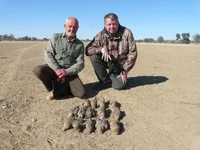
Later tha evening we enjoyed an African braai featuring springbok, oryx and of course the sand grouse we'd shot that morning. Eating the meat you'd hunted is a tremendously satisfying experience and one I could have enjoyed every single evening we were there. It had been another fantastic day in the Kalahari.

braai_resize.webp
 
It sounds like a great trip ! Despite 4 trips to Namibia I haven’t seen a lion in the wild apart from in Etosha.
I note your comment on the stainless barrel on your rifle. I was beginning to think that the shine off my rifle was giving the game away occasionally. So much so that I have decided to get the rifle Duracoated in coyote brown.
On occasion watching someone returning to the Bakkie through the bush it was interesting to note what stood out.
Face,hands and rifle (shiny barrel)were the main giveaways .
 
It sounds like a great trip ! Despite 4 trips to Namibia I haven’t seen a lion in the wild apart from in Etosha.
I note your comment on the stainless barrel on your rifle. I was beginning to think that the shine off my rifle was giving the game away occasionally. So much so that I have decided to get the rifle Duracoated in coyote brown.
On occasion watching someone returning to the Bakkie through the bush it was interesting to note what stood out.
Face,hands and rifle (shiny barrel)were the main giveaways .

I think I'll do something similar. The ostrich picked us up all too easily and a shiny barrel is the only logical explanation.

As for lions it's the hunting areas location which is key. It borders 8 kilometers of the Kgalagadi Transfrontier Park. This is a very large area where no hunting is permitted and it contains a range and large number of predators including a very good population of large African lions. Ironically I didn't see very much game on the Botswana side of the fence. Gordon advised that he'd seen very large numbers of steenbok in that area on his previous trip but we saw very few there on this trip. Lots elsewhere but not near Botswana. I can only assume that the increased number of predators they's started to see there have played a part on the steenbok moving on.

Fencing is an emotive subject often discussed when talking about hunting in Africa, so it's mildly ironic that we were seeing tracks from lion, cheetah, hyena and jackal breaking into the property. We were also shown a part of fence where a lion had chased an oryx into the fencing smashing it's way through onto Franks farm. The guys also kept a shovel on the bakkie and ended up filling in holes dug underneath the fence by hyena, jackal, porcupine and possibly rare (there anyway) warthog on a near daily basis. Apparently a giraffe also crossed both sections of high fence and entered Botswana a couple of years ago.

The double border fence is also occasionally breached by idiotic tourists who want to tick Botswana off their list of countries visited, or to claim they illegally entered a country, even if it is only for 10 seconds or so, but I couldn't possibly comment. :-D

I have three more installments to write when I get chance but I'll post pics of 'no mans land' with another large predator species inbetween them later.
 
We had two days left at the lodge before transferring to another large hunting area close to Windhoek as Gordon wanted to hunt baboon, a species which wasn't to be found here.

At breakfast FArank received another call from his staff checking the Botswana fence lines. It appeared one lion and one cheetah had made it into the property. Ten minutes later a second call confirmed that the lion had left but the cheetah had made it's way into the ground and a freshly killed springbok had already been found. He looked frustrated and deep in thought.

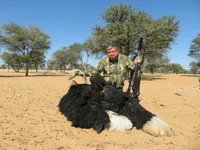
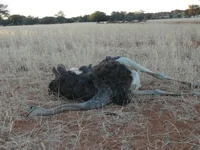
Instead of stalking ostrich we'd decided to find an area and sit. I'd grabbed some water and a radio and waited on my own in an area where I though I might see ostrich and other game and stalk them from there. Gordon did the same It wasn't long before springbok appeared, I briefly caught site of a herd of blesbok too but no ostrich. I stayed put and continued to glass all around me. Maybe thirty minutes passed as I was watching a herd of eland at distance to my left when I turned to see six adult ostrich just fifty yards from me to my right. They hadn't seen me but would do the second I moved. I turned my scope down to it's minimum magnification, moved, took aim and shot the nearest male to me freehand as I had no time to set the sticks up. He dropped there on the spot resulting in my first ostrich and first animal shot freehand ever.

ostrich_resize.webp


I picked up the radio and called Frank, "ostrich down,". He replied, "Well don, I'll be with you in twenty minutes".

Frank asked if I wanted to help track the cheetah, who wouldn't so we drove over to the area where three of his guys were following the cheetahs tracks in the sand. It transpired that when coyote tracks are found on the property they are tracked and shot on sight. However this would be the first time they've employed such tactics with the fastest land animal on earth.

The three guys would jog when they had clear site of the cats tracks going in a clear direction. Pausing and fanning out when they lost the tracks and fanning out until found again. They soon advised that the cheetah knew it was being followed. It's paw marks had now changed signifying it was walking quickly but not yet running. It had also chosen not to lie up which is what would be expected after feeding. After a couple of hours the cat had been moving around in circles. Frank was convinced this animal had been chased before as it knew how to avoid people unlike the two "dumb" cheetahs we'd seen previously. Before long the trackers got excited as they realised the tracks were very fresh and we may have only been one or two minutes behind it, though now it was running and despite me glassing and glassing for it I never once caught site of the cheetah in the long grass.

Eventually, in the heat of the early afternoon it seemed that the cat was finally tiring. A couple of what we'd call couch marks had been found and in time these rests would become more frequent. It was estimated that the cat had given us the slip for around 15 kilometers. I was beginning to doubt if we'd ever see it before finally catching a glimpse of it in long grass around 600 yards away. We gave chase in the truck, pedal to the metal which was a lot of fun doing 70 mph off road avoiding trees whilst I secretly prayed we wouldn't hit one of the large porcupine holes I'd seen many of. Seeing herds of springbok and flocks of ostrich run alongside the truck is one thing but watching the cat in full flight was a sight I'll never forget. It soon ran towards the border and we lost sight of it in thick vegetation.

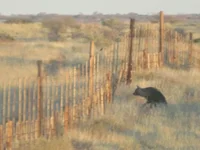
We headed to the track nhext to the fenceline expecting it would return to where it had come from. Up ahead I saw a dark shape in 'no mans land', but it wasn't a cat!

hyena_resize1.webp

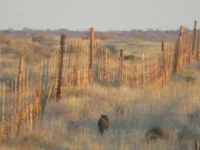
In the bottom right hand corner of this pic you can just about make out a fence post. That was the boundary of our hunting ground. The strip of land where you can see the brown hyena is what's deemed 'no mans land' and signifies the border fence between Namibia and a national parl in Botswana. The source of all of these predators.

hyena_resize_2.webp

Frank grabbed a Foxpro caller and tried to call the hyena in but it didn't really seem interested. It went through the fence back into Botswana and slowly walked off only turning a couple of times. We drove off very slowly with the three guys still searching for the cat which eventually broke cover a few minutes later. The old battle scarred female being dispatched almost immediately. There was a real sense of relief that she'd been taken due to the damage she'd probably do to the sheep farming operations on the property and whilst knowing she was no more genuinely saddened me I understood why this was done.

Gordon had also had a great day he also got an ostrich and another springbok. I just wanted to try for a steenbok now.
 
It was now our last day at the lodge. We wouldn't see any more cats or hyena during our trip so we hunted the property by spotting and stalk. For the first time we came across a herd of zebra. We also saw wildebeest and waterbuck, the latter jumping low fences for fun.


Gordon's ostrich from the previous day.

g_ostrich_resize.webp


Gordon took a huge oryx, or is he just really very small?

g_oryx_resize.webp

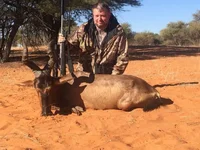
I took another management springbok. Note how the rose (strip of fur along its back) is raised. That guarantees the animal is dead when you see this.


j_springbok_resize.webp

And finally my first steenbok, unsurprisingly shot in the evening when these guys along with he local duiker seem to be a lot more active. I have to add that I'd not choose to use a .30-06 on these guys but not knowing if we'd come across these chaps or a large eland bull I couldn't really have taken a smaller weapon out. However if I do choose to target these and other smaller antelope species I'll pack a .222 or similar as the venison damage was significant on this old chap with a broken horn.

That evening after dinner we jumped on the back of the truck and headed out into the dark African night. We called for lion, hyena and jackal. I hasten to add that we were not lion hunting just calling to see if any were around. Jackal and hyena would be shot on sight along with warthog and porcupine. It was made clear to us that although we were not targeting any of these species the damage they cause means clients are allowed to shoot them for free if spotted. If you don't wish to take a shot on any of these species that's also fine but the PH will do.

We called but no response from anything so we moved on. Namibia is scarred with dry richer beds that have seen no water for decades and we stopped the vehicle in one. A river bed which itself has not seen water since the eighties. We called again and shone a spotlight all around us to reveal just one rabbit. We moved on and tried again with the same result. Frank seemed quite please that there were no hyena and jackal in the area. And with that we headed back to the lodge knowing we'd be moving on tomorrow.
 
Back
Top