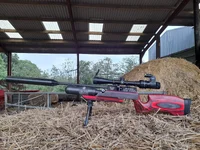
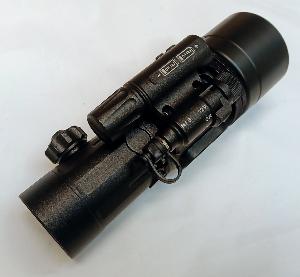
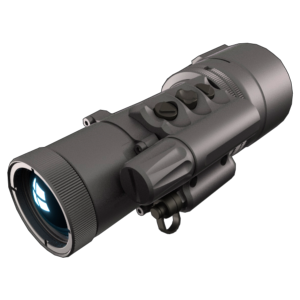
Night vision, add on or straight scope

Hi alled 12.
If you have used a starlight archer or longbow, "performance wise " none of the n/v's being sold now will equal or beat it.
Lots of good advice has already been given above, what i would say is ask on here if some one local enough to you will let you look through their n/v at live quarry, its only when you look and compare at live quarry that you can then make a judgment as to what you think is best for you.
A Pard 007 i consider is a starting n/v with correct scope and a solaris or sirius laser will get you out to 300 yds on a good n/v night, the vulpine mk3 is probably the best add on but it is "no Archer beater".
As a general rule a dedicated digital n/v will out perform a add on when used in the dark and IMO the best one out now is the Pulsar c50.
IMO add on's are great when you want to use of a few rifle's (correct scope still needed), and say for air rifle or rimfire rat's/rabbits they are ideal, still useable for centre fire foxing but i would think a c50 would be better.

Ask on here to look through some.

Dave (warbucks)
Thanks Dave the advice is appreciated. I intend to spend some time looking through as many as i can.
is starlight actually still in business and is the customer service really as abysmal as is made out?
 
Iv'e never bought owt from Starlight but going off the complaints (and there are many) only a fool would risk paying money to them, such a shame as great products (Longbow, Archer, dragonfly) let down by Starlight themselves.
I have two mates that have second hand archers and IMO they equal the Drone Pro 10x, they can work trouble free for 15 years or so but if and when you do need back up ???, not only that they do add a lot of length to the scope and if your shooting and there is street lighting 3 miles away it cause's the tube to flair up.
Lots of the new stuff is good enough for what most people need with warranty and spare's back up

Dave (warbucks)
 
Add-ons come in many shapes and sizes and inevitably if they are rear-fitting you will have to tweak your head positioning to some degree. That said it is no big deal and you will quickly get used to it. I have fitted collars to my .17hmr, .222 and 6,5x55SE for my Pard 007 and they each have different scopes with differing eye relief and thus head positioning, but again I find this no big deal. The one thing I would say is add a good IR - the Pard is great for maybe 130/150 yards but a good IR will transform it. I have a Dragonfly and a Solaris and each are great, the latter wins because of the adjustable light power but rabbits can be clearly seen well beyond even long distances - far further than you will ever shoot.
Good luck.
🦊🦊
 
Iv'e never bought owt from Starlight but going off the complaints (and there are many) only a fool would risk paying money to them, such a shame as great products (Longbow, Archer, dragonfly) let down by Starlight themselves.
I have two mates that have second hand archers and IMO they equal the Drone Pro 10x, they can work trouble free for 15 years or so but if and when you do need back up ???, not only that they do add a lot of length to the scope and if your shooting and there is street lighting 3 miles away it cause's the tube to flair up.
Lots of the new stuff is good enough for what most people need with warranty and spare's back up

Dave (warbucks)
thanks for the info
 
Add-ons come in many shapes and sizes and inevitably if they are rear-fitting you will have to tweak your head positioning to some degree. That said it is no big deal and you will quickly get used to it. I have fitted collars to my .17hmr, .222 and 6,5x55SE for my Pard 007 and they each have different scopes with differing eye relief and thus head positioning, but again I find this no big deal. The one thing I would say is add a good IR - the Pard is great for maybe 130/150 yards but a good IR will transform it. I have a Dragonfly and a Solaris and each are great, the latter wins because of the adjustable light power but rabbits can be clearly seen well beyond even long distances - far further than you will ever shoot.
Good luck.
🦊🦊
Thanks i will take that on board much appreciated
 
If you have used a starlight archer or longbow, "performance wise " none of the n/v's being sold now will equal or beat it.
I cannot agree with that.
Tubed night vision and its ‘everything is green’ image inevitably makes distinguishing quarry from background difficult.
 
The Senopex S10 (12 micron 640x480 sensor and 100mm lens) is as good as it gets at the moment and probably will be for some time to come.
100mm is about as big a lens as is practical on a rifle and although sensor pixels will get smaller - the next step down from the current 12 micron will be 10 micron - that small change won't make a big difference to overall performance - plus the NETD of 10 micron sensors will initially be poor compared to 12 micron sensors and rubbish compared to 17 micron sensors
Thermal pixels will never get smaller than 5 or 6 microns (that's just physics), whereas the sensors in the current 4k day/night digital scopes such as the Wulf 4k, Wraith 4k and ATN 4k are already only 1.5 microns and the pixels in scopes like the PARD and Pulsar C50 are 3 microns (which is why the PARD and the C50 are better NV scopes than the 4k mob)
The bottom line is that a rifle mounted thermal will never produce as detailed an image as even currently available digital scopes.
However, it's not all about detail - where thermal wins over all other NV technologies (tubed and digital) is contrast.
Recognition of details (animals etc) in a scene viewed in daylight is basically down the shape, size, colour, and the contrast between nearby objects of similar shape, size and colour
NV and thermal cannot reproduce colour (again, just physics) so detail recognition is down to shape, size and the contrast between nearby objects of similar shape and size
Tubed and digital NV are inherently low contrast technologies with most spotting of a target dependent on seeing bright eyeshine against a fairly uniformly grey background.
If the target is not oriented such that some IR reflects from it's eyes, it can be very difficult to detect
No such problem exists with thermal - no IR is needed and heat is emitted from all of the animal so orientation is much less important.
What thermal does require is operator experience with species identification - and when that has been achieved, the level of detail provided by a suitably specified thermal riflescope is normally perfectly adequate to take a safe shot at a target that has been identified with 100% certainty.
As has been said before - it's not necessary to see the whiskers on a fox to know it's a fox
Thermal might never be able to see the whiskers, but it already is more than capable of giving an image that gives the shooter 100% certainty that it's a fox

Cheers

Bruce
 
Surprised no one has mentioned the PVS14, amazing unit when paired with the correct scope ! I have used them for years and wouldn’t use any other add on . I am able to use it on 4 of my rifles .
 
The Senopex S10 (12 micron 640x480 sensor and 100mm lens) is as good as it gets at the moment and probably will be for some time to come.
100mm is about as big a lens as is practical on a rifle and although sensor pixels will get smaller - the next step down from the current 12 micron will be 10 micron - that small change won't make a big difference to overall performance - plus the NETD of 10 micron sensors will initially be poor compared to 12 micron sensors and rubbish compared to 17 micron sensors
Thermal pixels will never get smaller than 5 or 6 microns (that's just physics), whereas the sensors in the current 4k day/night digital scopes such as the Wulf 4k, Wraith 4k and ATN 4k are already only 1.5 microns and the pixels in scopes like the PARD and Pulsar C50 are 3 microns (which is why the PARD and the C50 are better NV scopes than the 4k mob)
The bottom line is that a rifle mounted thermal will never produce as detailed an image as even currently available digital scopes.
However, it's not all about detail - where thermal wins over all other NV technologies (tubed and digital) is contrast.
Recognition of details (animals etc) in a scene viewed in daylight is basically down the shape, size, colour, and the contrast between nearby objects of similar shape, size and colour
NV and thermal cannot reproduce colour (again, just physics) so detail recognition is down to shape, size and the contrast between nearby objects of similar shape and size
Tubed and digital NV are inherently low contrast technologies with most spotting of a target dependent on seeing bright eyeshine against a fairly uniformly grey background.
If the target is not oriented such that some IR reflects from it's eyes, it can be very difficult to detect
No such problem exists with thermal - no IR is needed and heat is emitted from all of the animal so orientation is much less important.
What thermal does require is operator experience with species identification - and when that has been achieved, the level of detail provided by a suitably specified thermal riflescope is normally perfectly adequate to take a safe shot at a target that has been identified with 100% certainty.
As has been said before - it's not necessary to see the whiskers on a fox to know it's a fox
Thermal might never be able to see the whiskers, but it already is more than capable of giving an image that gives the shooter 100% certainty that it's a fox

Cheers

Bruce
What thermal rifle scope do you recommend,3-4K ish ,not bothered about built in range finder as I’ve already got accolade pro .thanks
 
If you want something that looks and mounts like a traditional then the Thermion 2 XP50 is a very good thermal scope, although you would need to haggle a discount to get it down to £4k
The HIK Stellar SQ50 is also a good thermal scope that "looks like a scope", but is about £1k less than the Thermion at £3500 list price and a some discount available with some haggling
Best "bang for your buck" thermal scope at the moment is the HIK MicroThunder TQ50 with a list price of £3k but available for around £2600
If you want something with a high base magnification for longer range work, the the Senopex A7 at £2979 takes some beating.

Cheers

Bruce
 
Hi ladies & gents
I a mstarting to look at getting into night vision, what is the best way to go, i have used starlights system which seems to be a really good idea, just from what i can gather poor customer service, i am aware there are others, thats the only one i have played with, what are peoples experiences with this type of setup, any issues wtih zero shift for front mounted systems etc.?
Or do I go for a straight scope and zero every time i swap?
Alternatively another rifle and create a dedicated setup, if thats the case which calibre etc?
The floor is yours on this one, I have no budget in mind I am looking for the practical solutions and not an appendage measuring session, just honest experiences?
I look forward to your thoughts.
I use a vulpine mk3, and use it on my z6i, ok, I cant get a crisp image below 80yds due to the parallax only going down to 50yds, but out past 80yds its great. Can see way further than you need to shoot. On a clear night, probably out to around 450yds. And I get to keep my good optics for daytime use.
 
Thank you to all of the contributors i have plenty to digest. I think we have covered most of the types of night vision out there which will be very handy, i suspect not just for me. Interestingly nobody appears to be using a longbow which says something. Please continue to comment it is all valid.
 
Hi Alled,

If you have a parallax adjustable scope, I would 'dip a toe' with this:


if you have a German scope with an IR eyebell, we can supply suitable bayonets from Rusan for Z6, Z8, V8, etc.

If it's for foxing, I would definitely add one of these:


That will give you a very solid system for not a lot of money that you can use on all your rifles (depending on the day scopes). It also is very short mounted so won't affect your shooting position.

Moving on, if you don't have parallax adjustment on your day scopes, but have a minimum mag of 3-4x then a front add on would be the next step:


With this recommended IR for it:


We also do a thermal version, if you are feeling more extravagant:


Our front mounts are done properly and don't have POI issues.

For a dedicated NV rifle scope there is loads of choice from Pulsar, Pard and Iray, etc.

What I personally use, after 20 odd years of NV shooting is...

Most of the rifles have picatinny rails and I swap this around all of them on a standard mount, but use a torque wrench and repeatable procedure. There is no loss of zero:


For the stalking rifle, and occasionally the .22LR when going from evening to night this time of the year, I use this:


If you can let us know what day scopes you have and what sort of shooting it is for and required ranges...things can be narrowed down.

Hopefully this helps.


Cheers


Clive
HI
Been really interested in this thread - thanks to the original poster as I'm in a similar position. There's a possibility that I might be on boar in the near future but maybe only a handful of occasions per year. I'm reluctant to get say a C50 as I've got a Swaro Z8i on my current rifle (a Mauser M03). The issue with the M03 is that it has bespoke mounts so no picatinny rail. I've looked into buying a rail but these seem to cost around £400 from the EU. I've also seen the adaptor you can get for the Z8 but I'm worried this will push the eye piece too far back along the stock!! Tricky times! Any help would be great...
 
Unfortunately the lens coating on your Swaro mean that it's unlikely to perform well with an NV rear add-on
Swaro lens coatings are designed to optimise transmission of light from the blue end of the spectrum because that's what's dominant at dawn and dusk.
Those lens coating are good at transmitting blue light, but not at transmitting IR so performance with any NV rear add-on is compromised
Also, the minimum parallax on the Z8i is 50m
IR passing through a scope focusses at a different point than visible light.
This means that targets at say 100m need the parallax adjusted down to about 10m to get a focussed image
Since the Z8i won't focus below 50m it will be difficult to get a focussed image when using IR
If you really want an NV capability with your Z8i, then a front add-on might be worth considering.
However front add-ons also have their limitations and are considerably more expensive than a rear add-on (or a C50)
The major limitations are how much scope magnification can be used: x3 - x8 is about as much as you'll be able to use and there's always concern about the add-on retaining zero after it is removed and re-fitted to the scope

Cheers

Bruce
 
Back
Top