Pups first track

JM knives

Well-Known Member
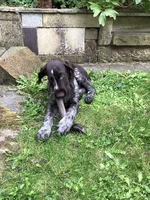
06E556E2-8322-4CC7-9903-9FF73D61158E.webpYoung Eddies first track, it’s the second leg he’s had but the first time I’ve laid a trail for him, it was about 15yds on the garden and out of sight with some biscuits. He got on it and followed bang on, so what would be my next step more on the garden or short ones elsewhere?
Cheers John
 
I would start in a field with short grass with little distraction, just a short drag around 200 meters around 2-4 hours old, have you got scent shoes ?. Have a piece of skin at the end on a rope with a pole you can flick the skin for him so he can chase and grab put up resistance and let him shake it, he will never get tired of this and you can use this as positive reward and feed when you finish on the skin with a big meal, get the prey drive instilled early, only do a short track with a shallow curve no more than once a week, and never go upping times or making it hard unless he’s succeeded a few times, it’s good to video with a go pro so we can see his reaction to help further regards Wayne.
 
I would start in a field with short grass with little distraction, just a short drag around 200 meters around 2-4 hours old, have you got scent shoes ?. Have a piece of skin at the end on a rope with a pole you can flick the skin for him so he can chase and grab put up resistance and let him shake it, he will never get tired of this and you can use this as positive reward and feed when you finish on the skin with a big meal, get the prey drive instilled early, only do a short track with a shallow curve no more than once a week, and never go upping times or making it hard unless he’s succeeded a few times, it’s good to video with a go pro so we can see his reaction to help further regards Wayne.
Thanks, I’m getting some shoes sorted, should all his tracks be with him on a long lead? Or running free to start with.
His drive seems good and he rags everything he has.
Would you say just stick with the cleats as they are or add a little blood?
Cheers John
 
I would start in a field with short grass with little distraction, just a short drag around 200 meters around 2-4 hours old, have you got scent shoes ?. Have a piece of skin at the end on a rope with a pole you can flick the skin for him so he can chase and grab put up resistance and let him shake it, he will never get tired of this and you can use this as positive reward and feed when you finish on the skin with a big meal, get the prey drive instilled early, only do a short track with a shallow curve no more than once a week, and never go upping times or making it hard unless he’s succeeded a few times, it’s good to video with a go pro so we can see his reaction to help further regards Wayne.
Great advice. Without wanting to sound patronising at all, back garden trails of only a few yards can be a bit pointless and sometimes harder for a pups as (a) A cleave in a back garden will be wafting scent all over the place (b) it is such a familiar area with familiar distractions. You need at least 50 metres to settle the young dog in to the trail line and and to see if he is actually following the trail and not air scenting part of it, on that note, down wind trails are better for younger dogs. Personally I would always long lead to start with until you know they are competent and personally a small amount of blood on the shot site and then, if with scent shoes, maybe 50ml per 100 metres max - reducing this as competence increases. I once read of a guy who uses cleaned fairy liquid bottles!! For me this would indicate far too much blood is used. I started off using 200ml bottles but then moved on to 50ml bottles as I could be more accurate and dose just one droplet every couple of steps.

For further advice, there are some very experienced trackers on this site who will guide the way.
 
Thanks, I’m getting some shoes sorted, should all his tracks be with him on a long lead? Or running free to start with.
His drive seems good and he rags everything he has.
Would you say just stick with the cleats as they are or add a little blood?
Cheers John
always on a line under control, there are two ways one with blood the other without, I personally prefer the without method, for a few reasons, firstly not using blood you get the dog to stick to a harder track from the off, this helps further down the line when your dogs actually tracking and the animal has not left any visible sign, when you use blood people always use too much the dog becomes lazy and expects it to be there. you can add into your tracks other excersises like marking a tree or log with only one drop of blood to get the dog to start marking them this then helps on harder tracks as the dog will show these marks, introducing this instead of using blood along the track the dog soon switches off and won't indicate for you so for my choice we always work no blood but will mark a spot just to get the dogs indicating as this is super important, not really for me because I know my dogs on the right track from her mannerisms and body language but for the person calling on me, because they often don't think your correct till the dog indicates something. regards wayne
 
Mereside & keith are spot on.
Everyone has a slighty different approach.
Im no expert but have done a lot of reading and trained my last dog to a reasonable standard. B96C6415-C4A3-4B7D-B92F-4797EBC55E97.webp
Home made lines. Paracord left, 8mm Biothane right.

I’m the camp of using a line from early on.
I use Para cord when the pup is really young as it’s light enough to not interfere with their tracking.
I like to use lump of fresh hide or liver on puppy first 2 tracks, 50m or so and definitely on Unfamiliar ground as opposed to back garden.
I find this is something really easy for them to follow and keeps their focus on the ground much more than a hoof or bit of blood.
Have hoofs or more hide at the end of trail.

From third track on I then start use blood and hoof. I would continue this until dog is Competent at following reasonably old trails with several turns in. Then start to reduce the blood over time until non required.

It’s not too hard to train a dog to follow a warm track. What sets the real dogs apart is following up a 24hr old gut shot.
 
Thanks for all the feedback, it’s definitely a learning curve for me and the dog. I suppose i just wanted to try one on the back garden to see his reactions and he definitely ground scented it so i was happy with that, I’ll get some shoes sorted and get him back on a track.
Many thanks John
 
A technique
Thanks for all the feedback, it’s definitely a learning curve for me and the dog. I suppose i just wanted to try one on the back garden to see his reactions and he definitely ground scented it so i was happy with that, I’ll get some shoes sorted and get him back on a track.
Many thanks John
We all do it John, why wouldn't you? Everyone is going to lay a little trail in the back garden. Having hunted with a number of breeds - terriers, lurchers, labs, followed hounds on foot - previously beagles, then harriers and now foxhounds, learning about scent is amazing. It often defies logic and often defies the books. So many variables come into play. Never underestimate your dog's nose but...at the same time...always remember that he is using his nose more than his eyes. What seems obvious to you as a handler, will be a different story for the dog. He will fail at seemingly easy things and he will amaze you with what seemed impossible. Always think from the dog's perspective. I try to imagine scent as a coloured mist - not really accurate but this helps imagine that close, smelly objects can be harder to pinpoint than a more diluted scent. Also, learn about vegetation 'wounding' or decay left by hoof prints and also how blood or flesh scent can actually improve/strengthen during a certain time frame. As your trails are aged longer, in wild places, contamination from other live game is a challenge that the dog will need to overcome - trail cams are great to show just what has passed your trail, in specific places, overnight.......you will be amazed.

All of the above can become an obsession far greater than what most 'everyday' stalking companion dogs will ever encounter and you will probably find you either become obsessed with trail laying, move on to deer recovery work or just settle for a good stalking companion as the truth is that most stalking dogs rarely need to follow trails that are too complex....unless you are a terrible shot :-)...Enjoy
 
If you use blood then use it sparingly and less and less as training progresses. If dragging a skin just use a small square not half a deer hide. Don't drag round lungs, heart or great lumps of deer or boar. A hoof is sufficient.
There is a very good book that explains scent, Scent and the scenting dog, by, William G Syrotuck .
Tracking is one of the easiest things to train a dog to do. It's no black art
 
Back
Top