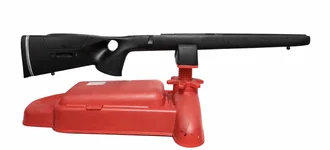
Sako 85 Ejection Problems?

I was intrigued by this thread so did a quick google and found this video on YouTube. About a minute and a half in you see footage of the ejected case hitting the scope and falling back into the chamber.

 
I was intrigued by this thread so did a quick google and found this video on YouTube. About a minute and a half in you see footage of the ejected case hitting the scope and falling back into the chamber.


SNAP!! Slo mo video of my laminate stainless sako 85 30.06 is mirror image of this .375 video. The fix above is fine and dandy if (1) you can machine such a part and (2) you don't reload: that ally bracket is securely mounted and must ding the emerging case necks.

To repeat: my solution was to rotate the scope in the rings. With the windage turret rotated 90 degrees to the 12 o'clock position, there is nothing to foul case ejection. 100% success. And since my scope has a duplex reticle, it makes no difference visually. Now the windage turret controls elevation.
 
Pretty **** poor that Sako didn't nail this before releasing the model. I have also read that some 75's were also prone to the same problem but not experienced it myself on my two. That being said the Optilock mount system is pretty high. On sporter barrelled rifles you can generally mount a 56mm scope with low mounts :cuckoo:
 
As I said earlier, this problem does not appear to affect all rifles and seems to only affect a small number of sako rifles produced AFTER Beretta acquired Sako. Perhaps quality control changed after the Beretta takeover?

The issue seems to occur in some rifles after firing a round and the bolt is moved rearwards. If the extractor has a loose grip on the case rim, then the ejector predominates and rotates the case upwards and into the underside of the scope.

Post the following links into Youtube

youtube]tK1jVTMlneE
youtube]ihURwQQwGlc
youtube]C7_1h1jeKuA
youtube]FkL5TtVezAU

Sako agents deny there is an issue and will blame scopes, low rings etc in an effort to deflect blame (even though the low rings are produced by Sako). They also insist this is not a warranty issue. Many countries have laws governing the sale of goods that are not fit for purpose wherby the seller is required to either replace the faulty item, or refund the sale in full.

Despite Sako's denial of liability, I have emails from Sako senior staff stating they are well aware of the ejection issue and have been working on a fix........even though they still deny there is a problem??.

It is such a shame that poor quality control and even worse customer service has damaged the reputation of what is otherwise a very good rifle. Most sako owners will not experience the ejection issue and have a rifle they are proud to own.
For those sako owners whose rifles have the ejection issue, coupled with a sako agent that both denies there is an issue and refuses to accept liability, its a nightmare. When faced with an angry animal that is rapidly closing the gap between you and it, who wants a rifle that wont cycle the next round because the previous case hasn't ejected properly?

The solution I posted earlier works well and can be done by almost anyone at no cost. But, why should we have to put up with a faulty product in the first place!
 
Last edited:
Waimahana's well-documented solution to his extraction/ejection problem above relates to his Sako 75, not the 85. Elsewhere we hear that this issue started with the 85. I have 85's and have never handled a 75. Is there a difference in the extractor and ejector between the 75 and the 85? Pictures of the two would be great :)

Cheers
I have owned both 75 and 85 Sakos and the extractor and ejector are identical as far as I can tell.
 
The issue seems to occur in some rifles after firing a round and the bolt is moved rearwards. If the extractor has a loose grip on the case rim, then the ejector predominates and rotates the case upwards and into the underside of the scope.

Agreed: my Sako 85 rifle's extractor has a very poor grip of the Sako cartridge rim. If I seat the Sako cartridge flush against the boltface, I estimate that the air gap between the rim and the extractor's claw is at least 50% the width of the rim itself. That married to a low ejection ram on the opposite side means the spent case is always going to be thrown at a higher angle than is likely to work with a scope mounted rifle.

When I protested to Sako they redirected me to their UK agent who declared that my "extractor must be worn" and sold me a new one for £54. The old one and new one perform identically. They both throw cases at the same angle. They both fail to eject with standard scopes fitted. I was stone-walled by Sako. Pretty poor really.

Comparing the machining tolerance between both extractor claws finds zero dimensional differences. New and old are same size. Ergo this is a design issue, not a production issue. My guess is they built a one size fits all claw: to allow for vagaries of brass cases perhaps? Some maker's rims thicker than others? I.e. at the cost of inexact cartridge extraction, Beretta/Sako built a claw that would accommodate any brass?

If anyone gets any satisfaction out of Sako on the matter, please post here. I want my £54 back!
 
I have owned several model 75 and 85 sako rifles made after the Beretta takeover of Sako in 2000. Perhaps I've just been unlucky but All of them have had issues.
Issues include:
- terrible checkering with patches of the small pyramids missing/broken off;
- tooling marks on the action;
- cartridge feed issues;
- cartridge ejection issue.

I see others have had issues with the action not aligning with the barrel to the extent that it was not useable (see following link)
youtube]ihURwQQwGlc

It appears quality control has slipped significantly since the Beretta takeover, or they have adjusted their allowable tolerances so that poor quality is now acceptable.

While most of the newer sako's are fine, based on my experience dealing with Beretta, I certainly would not buy another Sako rifle unless it was manufactured prior to the Beretta takeover.

A rifle I will consider is the Schultz and Larsen:
Schultz & Larsen | Technical
I like the Victory model.
 
My first cf rifle was and is , a Sako 85S .243. Apart from changing the stock for a synthetic factory Sako 85, it's untouched. I've put **** loads of rounds through it, at the range and it has performed perfectly. Zero issues. Brilliant rifles.
 
Read these posts with interest, I have a Sako 85 Classic 6.5x55 and the ejector is certainly not great but lived with it as it’s a beautiful rifle and extremely accurate. It was in fact for sale but just couldn’t get my head around why I was selling it so decided to keep it!
Anyway to the point, yesterday I tried some empty 7x64, 7mm-08 and 308 cases to see if they ejected. Ok they don’t chamber properly but do engage the bolt head and extract across the room! Unlike the 6.5x55 cases, so there is a problem albeit not huge.
What makes me laugh is how people slag off the Remington 700 of which I’ve had quite a few and still do yet they eject, all have ejected better than any Sako or my Tikka for that matter. I think I’ll have to get some extractors and experiment.
 
Read these posts with interest, I have a Sako 85 Classic 6.5x55 and the ejector is certainly not great but lived with it as it’s a beautiful rifle and extremely accurate. It was in fact for sale but just couldn’t get my head around why I was selling it so decided to keep it!
Anyway to the point, yesterday I tried some empty 7x64, 7mm-08 and 308 cases to see if they ejected. Ok they don’t chamber properly but do engage the bolt head and extract across the room! Unlike the 6.5x55 cases, so there is a problem albeit not huge.
What makes me laugh is how people slag off the Remington 700 of which I’ve had quite a few and still do yet they eject, all have ejected better than any Sako or my Tikka for that matter. I think I’ll have to get some extractors and experiment.
I'm certainly no expert, but I'm interested in your problem.
Are you able to determine what is happening with the 6.5x55 case? - I gather is is extracting OK but just not ejecting very well. This could be at the other end of the spectrum compared to the problem I had (see earlier post in this thread).
The CIP specs for the 6.5x55 case show a noticably thicker rim (1.5mm) than the other cases you have tried (1.37 - 1.30mm). I wonder if the extractor is gripping the case rim a little too tightly because of the thicker rim. If this was the case, you could try filing a bit off the top of the round bit on the extractor so that it has a weaker grip on the case. Before you start altering parts of your rifle i.e. the extractor, try filing a bit off the INSIDE of a 6.5x55 case rim to make it a fraction thinner and see how the ejector handles it - better to ruin a case rather than your extractor.
 
I'm certainly no expert, but I'm interested in your problem.
Are you able to determine what is happening with the 6.5x55 case? - I gather is is extracting OK but just not ejecting very well. This could be at the other end of the spectrum compared to the problem I had (see earlier post in this thread).
The CIP specs for the 6.5x55 case show a noticably thicker rim (1.5mm) than the other cases you have tried (1.37 - 1.30mm). I wonder if the extractor is gripping the case rim a little too tightly because of the thicker rim. If this was the case, you could try filing a bit off the top of the round bit on the extractor so that it has a weaker grip on the case. Before you start altering parts of your rifle i.e. the extractor, try filing a bit off the INSIDE of a 6.5x55 case rim to make it a fraction thinner and see how the ejector handles it - better to ruin a case rather than your extractor.

Interesting point, I'll try a case first before the rifle and post the results.
 
It also seems 30-06 and 6.5x55 are at the opposite ends of the spectrum regards the CIP 'R' (rim) measurement and both these cartridges appear to give problems. Off to the workshop. . .
 
I know this is now an old thread, however, I can share how I resolved the Sako ejection issue that seems to plauge a number of 75 and 85 model Sako rifles and hope others may find this useful.

How I fixed my Sako 75 ejection issue:
I resolved this problem in about 1 hour and at no cost.


In my experience, long actions (30-06, 270, etc) seem more commonly affected whereas short actions (.308, .243) appear to be less affected. My Sako 75 .308 has give many years of service without ever failing to eject cases perfectly.

In contrast, my Sako 75 .30-06 used to eject the case vertically upwards into the base of the scope and occasionally it would come to rest in the magazine on top of the next round which was really frustrating. I searched the internet for a solution without success. So I decided to do something about it myself.

I tried .30-06 cases in my Sako 75 .308 rifle and still had the same ejection issues whereas it works perfectly with .308 cases.
I tried 9.3x62 cases in my Sako 75 .30-06 rifle and only occasionally had ejection issues.
I tried .308 cases in my Sako 75 .30-06 rifle and had no ejection issues, so I knew it must be something to do with the cartridge.

The rim thickness of a .308 case is 1.37mm
The rim thickness of a 9.3x62 case is 1.30mm
The rim thickness of a .30-06 case is 1.2mm

There seems to be a relationship between the rim thickness and ejection issues i.e. thinner rims lead to ejection issues. If you seat a case in the bolt face you will see there is more slop for cases with a thinner rim. Seems Sako has gone for the 'one extractor size fits all' approach - presumably to save costs.

So..... I needed to reduce the amount of slop that the extractor held the .30-06 case so the extractor would have a tighter grip on the case (at least as tight as it holds a .308 case). My options were:
1) either build up the under-side lip of the extractor;
2) seat the extractor deeper in the bolt somehow, or,
3) compress the extractor to reduce its overall length.
Options 1 and 2 seemed very difficult, so I chose option 3.

I removed the extractor from the bolt face of my .30-06 and with all the skill of a high-precision swiss watch maker.....I beat it with a hammer! Actually, I placed the extractor vertically with the flat near the round bit on the sharp right-angle edge of an anvil and used a hammer to very carefully slightly compress the extractor so when fitted back into the bolt, the extractor had a tight grip on the cartridge case.

If you do this make sure to closely monitor the amount you compress the extractor with a good set of calipers and repeatedly try the extractor in the bolt. If you overdo it the cartridge will not align straight with the chamber, and.....you will need to buy a new extractor - not cheap. Also make sure the hammer impacts the extractor square on - not on an angle. Hammering may create a very small burr on the top of the claw and you may need to gently file a small amount off the inner top edge of the extractor claw so the case slides easily into the bolt face.

Actually this is a really easy process and can be done by anyone with basic handyman abilities (i.e. anyone who can use a hammer). The extractor does not look any different compared to an unaltered extractor - it's just compressed a by a couple of hundred microns.

My .30-06 now extracts and ejects cases perfectly EVERY time. Cases eject horizontally rather than vertically and NEVER hit the scope anymore.

Essential tools for this task are: a hammer, a vice or anvil with a sharp right angle edge, a set of calipers, and a bandaid for when you hit your thumb.

Caveat: this worked very well for my rifle but may not work for everyone - attempt it at your own risk. Good luck.

I wonder if the variability between rifles comes from the process they use to put the rifles together (I don't know, but food for thought):

If the bolt extractor hole and channel is milled into the bolt head and THEN the barrelled action is correctly head-spaced by milling material out of the bolt face. This would account for the variability in how well the extractor holds the cartridge case, and the variability between rifles.
i.e. good design with incorrect implementation. Some Sako 75 rifles a have this ejection problem, however, the issue is allegedly more prevalent with sako 85 rifles. Beretta acquired Sako in 2000. The Sako model 75 persisted until introduction of the model 85 in 2006, so later model 75's might be affected by the ejection issue.
In my experience the first thing you do after taking over a rival company is look at way to cut costs and improve profitability.

Hence what I believe should be done is adjustment of the extractor to each rifle. This could be achieved by my method (crude but effective - see above), or better still, having a range of extractor sizes and fitting the correct size extractor to each bolt AFTER it is head-spaced, or even better, drill/mill the extractor hole and channel after the barrelled action has been head-spaced.
Hi All,

I know it is an old post. Sorry for resurrecting it but I think it is of relevance to many Sako 85 owners.
I own one in 300 win mag and suffers this problem. Not always the spent case falls back in the action but almost always hits the scope.

I realized when reloading after killing a wild boar with my first shot and trying to down also his pal in a driven hunt. Reloading was as quick as I could action the bolt, the spent case hit the scope (30mm tube rail mounted Swaro 2.5-15) and fell back into the action jamming it. The spent case was badly dented and stuck. It took me quite an effort to take it out. Of course the other boar ran away intact.

Once at home I had my son filming me operating the action several times with the high speed feature of his Iphone. It could be clearly seen in the films that most times the case hit the scope although very few times it dropped back into the action.

To practicalities, due to not being a native English speaker I have trouble understanding how you modified the extractor claw: Did you rest the claw side on the anvil and tapped the back side (where the plunger pushes the extractor) or the other way around ?

Thanks a lot,
Frank
 
I sent mine back to the UK distributor GMK (via my gun shop) who did the work for nothing. An improvement, but empty cases still hit the underside of my windage turret, to the extent that the black paint finish on my S&B is wearing off. I will eventually PX it for another rifle. But it is accurate and reliable.
 
1” tube scopes help reduce the risk of cases striking the windage turret, and also using older style scopes with small turret caps.

The ejection angle on the 75/85 and the older tikka’s such as the m55/m65/LSA are steeper angled because the lock time design amongst other elements such as in the m55/65 where the RH lug rides on the RH ejection side rail to create one of the smoothest bolt throws ever designed.
It does mean it requires a steeper ejection angle as the claw cannot be set at 3 o,clock, but more like 1:30. The tikka actions lock design has two movements, so there is a bit of resting time, which also allows the exceptionally fine trigger.

The Schultz design with a 90 degree straight sideways and exceptional ejection is allowed by the almost reverse lug-rail design,
Also creating an incredibly slick bolt throw, but the bolt design, lock time, etc, means a fine trigger like the older tikka’s would trip/fail as it shuts too hard/quickly, with no resting time. You get incredible bolt cycling and ejecting without risk of striking the scope, however on the flip side, you cannot have a (safe) trigger without a slight creep.

If there was an exceptional aftermarket trigger, I’d say the SL system would be the ideal all rounder - except, they need to integrate a double stack magazine design to avoid rhe 5 round ‘rattle’ and sticking out.
 
Vow, I didn't know the profound implications of the position of the locking lugs. So it sounds like Sako tried to compromise and some units, perhaps the ones on the farthest side of the allowed tolerance run into ejection problems.
 
Back
Top