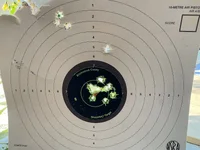
I shoot subsonics in 300 AAC (Blackout), 6.5 Creedmoor and 308 Win all using Viht N310 and pistol primers.
All produce single hole groups at 25yds using cast bullets.
Usual loads are,
300 AAC - 3.8gr and 170gr ShellHouse RN
308 Win - 6gr and a ShellHouse 165gr RNFP
6.5 Creedmoor - 5gr with a 150gr Spire Point cast by a friend.
There's no need to add fillers or enlarge flash holes.
I've posted this before,
Here's the classic standard work for starting shooting military smokeless firearms with cast boolits by E Harris.
CAST BULLET LOADS FOR MILITARY RIFLES
Cast bullets can make shooting that surplus rifle easy and economical.
And basic data works for many different guns.
BY C.E. Harris
Cast bullet loads usually give a more useful zero at practical field ranges with military battle sights than do full power loads. Nothing is more frustrating than a military rifle that shoots a foot high at 100 yards with surplus ammo when the sight is as low as it will go! Do not use inert fillers (Dacron or kapok) to take up excess empty space in the case. This was once common practice, but it raises chamber pressure and under certain conditions contributes to chamber ringing. If a particular load will not work well without a filler, the powder is not suitable for those conditions of loading. Four load classifications from Mattern (1932) cover all uses for the cast bullet military rifle. I worked up equivalent charges to obtain the desired velocity ranges with modern powders, which provide a sound basis for loading cast bullets in any post-1898 military rifle from 7mm to 8mm:
1. 125 grain plain based "small game/gallery" 900-1000 f.p.s., 5 grains of Bullseye or equivalent.
2. 150 grain plain based "100-yard target/small game", 1050-1250 f.p.s., 7 grains of Bullseye or equivalent.
3. 170-180 grain gas checked "200 yard target", 1500-1600 f.p.s., 16 grains of Hercules #2400 or equivalent.
4. 180-200 grain gas-checked "deer/600 yard target", 1750-1850 f.p.s., 26 grains of RL-7 or equivalent.
None of these loads are maximum when used in full-sized rifle cases such as the 30-40 Krag, .303 British, 7.65 Argentine, 7.7 Jap, 7.62x54R Russian , or 30-06. They can be used as basic load data in most modern military rifles of 7mm or larger, with a standard weight cast bullet for the caliber, such as 140-170 grains in the 7x57, 150-180 grains in the .30 calibers, and 150-190 grains in the 8mm. For bores smaller than 7mm, consult published data.
The Small Game or Gallery" Load
The 110-115 grain bullets intended for the .30 carbine and .32-20 Winchester, such as the Lyman #3118, #311008, #311359, or #311316 are not as accurate as heavier ones like the #311291. There isn't a readily available .30 caliber cast small game bullet of the proper 125-130 grain weight. LBT makes a 130 grain flat-nosed gas-check bullet for the .32 H&R Magnum which is ideal for this purpose. I recommend it highly, particularly if you own a .32 revolver.
The "100 Yard Target and Small Game" Load
I use Mattern's plain-based "100 yard target load" to use up my minor visual defect culls for offhand and rapid-fire 100 yard practice. I substitute my usual gas-checked bullets, but without the gas-check. I started doing this in 1963 with the Lyman #311291. Today I use the Lee .312-155-2R, or the similar tumble-lubed design TL.312-160-2R. Most of my rifle shooting is done with these two basic designs.
Bullets I intend for plain based loads are blunted using a flat-nosed top punch in my lubricator, providing a 1/8" flat which makes them more effective on small game and clearly distinguishes them from my heavier gas-checked loads. This makes more sense to me than casting different bullets.
Bullet preparation is easy. I visually inspect each run of bullets and throw those with gross defects into the scrap box for remelting. Bullets with minor visual defects are tumble-lubed in Lee Liquid Alox without sizing, and are used for plain base plinkers. Bullets which are visually perfect are weighed and sorted into groups of +/- 0.5 grain for use in 200 yard matches. Gas checks are pressed onto bullet bases by hand prior to running into the lubricator-sizer. For gas-check bullets loaded without the gas- checks, for cases like the .303 British, 7.62 NATO, 7.62x54R Russian and 30-06, I use 6-7 grains of almost any fast burning powder. These include, but are not limited to Bullseye, WW231, SR-7625, Green Dot, Red Dot or 700-X. I have also had fine results with 8 to 9 grains of medium rate burning pistol or shotgun powders, such as Unique, PB, Herco, or SR-4756 in any case of .303 British or larger.
In the 7.62x39 case, use no more than 4 grains of the fast burning powders mentioned or 5 grains of the shotgun powders. Theses make accurate 50 yard small game loads which let you operate the action manually and save your precious cases. These plinkers are more accurate than you can hold.
Repeated loading of rimless cases with very mild loads results in the primer blast shoving the shoulder back, unless flash holes are enlarged with a No. 39 drill bit to 0.099" diameter. Cases which are so modified must never be used with full powered loads! Always identify cases which are so modified by filing a deep groove across the rim and labeling them clearly to prevent their inadvertent use. For this reason on I prefer to do my plain based practice shooting in rimmed cases like the 30-30, 30-40 Krag, 303 British and 7.62x54R which maintain positive headspace on the rim and are not subject to this limitation.
The Harris "Subsonic Target" Compromise
Mattern liked a velocity of around 1250 f.p.s. for his 100 yard target load because this was common with the lead bullet .32-40 target rifles of his era. I have found grouping is best with non gas- checked bullets in military rifles at lower velocities approaching match grade .22 long rifle ammunition. I use my "Subsonic Target" load at around 1050-1100 f.p.s. to replace both Mattern's "small game" and "100 yard target" loads, though I have lumped it with the latter since it really serves the same purpose. It's report is only a modest "pop" rather than a "crack".
If elongated bullet holes and enlarged groups indicate marginal bullet stability, increase the charge no more than a full grain from the minimum recommended, if needed to get consistent accuracy. If this doesn't work, try a bullet which is more blunt and short for its weight because it will be more easily stabilized. If this doesn't do the trick, you must change to a gas-checked bullet and a heavier load.
The Workhorse Load - Mattern's "200 yard Target"
My favorite load is the most accurate. Mattern's so-called "200 yard target load." I expect 10 shot groups at 200 yards, firing prone rapid with sling to average 4-5". I shoot high Sharpshooter, low Expert scores across the course with an issue 03A3 or M1917, shooting in a cloth coat, using may cast bullet loads. The power of this load approximates the 32-40, inadequate for deer by today's standards. Mattern's "200 yard target load" is easy to assemble. Because it is a mild load, soft scrap alloys usually give better accuracy than harder ones, such as linotype. Local military collector-shooters have standardized on 16 grains of #2400 as the "universal" prescription. It gives around 1500 f.p.s. with a 150-180 grain cast bullet in almost any military caliber. We use 16 grains of #2400 as our reference standard, just as high power competitors use 168 Sierra Match Kings and 4895.
The only common military rifle cartridge in which 16 grains of #2400 provides a maximum load, and which must not be exceeded, is in the tiny 7.63x39mm case. Most SKS rifles will function reliably with charges of #2400 as light as 14 grains with the Lee 312-155-2R at around 1500 f.p.s. I designed this bullet especially for the 7.62x39, but it works very well as a light bullet in any .30 or .303 caliber rifle.
Sixteen Grains of #2400 is the Universal Load
The same 16 grain charge of #2400 is universal for all calibers as a starting load. It is mild and accurate in any larger military case from a 30-40 Krag or .303 British up through a 30-06 or 7.9x57, with standard weight bullets of suitable diameter for the caliber. This is my recommendation for anybody trying cast bullets loads for the first time in a military rifle without prior load development. I say this because #2400 is not "position sensitive", requires no fiber fillers to ensure uniform ignition, and actually groups better when you stripper-clip load the rifle and bang them off, rather than tipping the muzzle up to position the powder charge.
Similar ballistics can be obtained with other powders in any case from 7.62x39 to 30-06 size. If you don't have Hercules #2400, you can freely substitute 17 grains of IMR or H4227, 18 grains of 4198, 21 grains of Reloder 7, 24 grains of IMR 3031, or 25.5 grains of 4895 for comparable results.
However, these other powders may give some vertical stringing in cases larger than the 7.62x39 unless the charge is positioned against the primer by tipping the muzzle up before firing. Hercules #2400 does not require this precaution. Don't ask me why. Hercules #2400 usually gives tight clusters only within a narrow range of charge weights within a grain or so, and the "universal" 16 grain load is almost always the best. Believe me, we have spent a lot of time trying to improve on this, and you can take our word for it.
The beauty of the "200 yard target load" at about 1500 f.p.s. is that it can be assembled from bullets cast from the cheapest, inexpensive scrap alloy, and fired all day without having to clean the bore. It always works. Leading is never a problem. Once a uniform bore condition is established, the rifle behaves like a .22 match rifle, perhaps needing a warming shot or two if it has cooled, but otherwise being remarkably consistent.
The only thing I do after a day's shooting with this load is to swab the bore with a couple of wet patches of GI bore cleaner or Hoppe's, and let it soak until the next match. I then follow with three dry patches prior to firing. It takes only about three foulers to get the 03A3 to settle into tight little clusters again.
"Deer and Long Range Target Load"
Mattern's "deer and 600 yard target load" can be assembled in cases of 30-40 Krag capacity or larger up to 30-06 using 18-21 grains of #2400 or 4227, 22-25 grains of 4198, 25-28 grains of RL-7 or 27-30 grains of 4895, which give from 1700-1800 f.p.s., depending on the case size. These charges must not be used in cases smaller than the 303 British without cross checking against published data! The minimum charge should always be used initially, and the charge adjusted within the specified range only as necessary to get best grouping.
Popular folklore suggests a barrel must be near perfect for good results with cast bullets, but this is mostly bunk, though you may have to be persistent.
I have a rusty-bored Finnish M28/30 which I have shot extensively, in making direct comparisons with the same batches of loads on the same day with a mint M28 and there was no difference. The secret in getting a worn bore to shoot acceptably is to remove all prior fouling and corrosion. Then you must continue to clean the bore "thoroughly and often" until it maintains a consistent bore condition over the long term. You must also keep cast bullet loads under 1800 f.p.s. for hunting and under 1600 f.p.s. for target work.
A cleaned and restored bore will usually give good accuracy with cast bullet loads if the bullet fits the chamber throat properly, is well lubricated and the velocities are kept below 1800 f.p.s.
The distinction between throat diameter and groove diameter in determining proper bullet size is important. If you are unable to determine throat diameter from a chamber cast, a rule of thumb is to size bullets .002" over groove diameter, such as .310" for a 30-06, .312" for a 7.63x54R and .314" for a .303 British.
"Oversized 30's", like the .303 British, 7.7 Jap, 7.65 Argentine, and 7.62x39 Russian frequently give poor accuracy with .30 caliber cast bullets designed for U.S. barrels having .300 bore and .308 groove dimensions. This is because the part of the bullet ahead of the driving bands receives no guidance from the lands in barrel s of larger bore diameter. The quick rule of thumb to checking proper fit of the forepart is to insert the bullet, nose first, into the muzzle. If it enters clear up to the front driving band without being noticeably engraved, accuracy will seldom be satisfactory.
The forepart is not too large if loaded rounds can be chambered with only slight resistance, the bullet does not telescope back into the case, or stick in the throat when extracted without firing. A properly fitting cast bullet should engrave the forepart positively with the lands, and be no more than .001" under chamber throat diameter on the driving bands. Cast bullets with a tapered forepart at least .002" over bore diameter give the best results.
Many pre-WWII Russian rifles of US make, and later Finnish reworks, particularly those with Swiss barrels by the firm SIG, have very snug chamber necks and cannot be used with bullets over .311" diameter unless case necks are reamed or outside turned to .011" wall thickness to provide safe clearance.
Bullets with a large forepart, like the Lee 312-155-2R or Lyman #314299 work best with the 7.62x54R because the forcing cones are large and gradual. Standard .30 caliber gas-checks are correct.
Finnish 7.62x54R, Russian 7.62x39 and 7.65 Argentine barrels are smaller than Russian 7.62x54R, Chinese 7.62x39, Jap 7.7 or .303 British barrels, and usually have standard .300" bore diameter. (Finnish barrels occasionally are as small as .298") and groove diameters of .310 -.3115".
In getting the best grouping with iron sighted military rifles, eyesight is the limiting factor. Anybody over age 40 who shoots iron sights should equip himself with a "Farr-Sight" from Gil Hebard or Brownell's. This adjustable aperture for your eyeglass frame was intended for indoor pistol shooters, but it helps my iron sight rifle shooting, and adds about 5 points to my score!
So now you have enough fundamentals to get started. If you want to have fun, give that old military rifle a try. You'll never know the fun you've been missing until you try it!