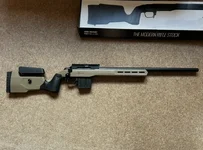
US Military adopts 6.5 Creedmoor

[FONT=&amp][FONT=&amp]No no no, I’m not wanting a battle over calibres and cartridges with you edi... So, just to tidy up a few loose ends... Delayed at the airport so this will likely meander along a fair bit, best way to kill the time... Choose to read on or click ‘back’ now![/FONT][/FONT]

[FONT=&amp][FONT=&amp]Firstly, I didn’t call anyone stupid. Ignorance and stupidity are two totally different problems. And by ignorance, I think it is fair to say that there is a bit out there when it comes to Creedmoor, my own gunsmith is clueless about them simply because he’s never used one. So me encountering an ignorant guide who maybe doesn’t like my 6.5CM and choice of bullet, based on years of woe with other cartridges also beginning with “6.5”... well its unlikely to ever happen but maybe you see my point.

Secondly, I think a couple of elements have been introduced into the discussion that have clouded the issue, which started with my original question to you about the 6.5CM as a deer round, though I admit I didn’t ask the question very well did I, because I left out the CM part which was not what I meant at all! Anyway, these introduced elements are the traditional rather anaemic 6.5 factory loadings, e.g. the Swede, and the introduction of boar shooting, which is a totally different kettle of artiodactyls.[/FONT][/FONT]
[FONT=&amp]
[/FONT]

[FONT=&amp][FONT=&amp]Now I can’t comment on you customer’s lost boars he shot with the Creedmoor, only to say that I’ve shot probably two dozen medium pigs with mine at shortish to relatively long range and not one of them has even hinted at running. Now all these pigs were stationary, which makes a massive difference obviously. By medium, I mean a hook weight of about 60-100lb (gutted, head on). And our pigs are proper razorbacks / boars, thick shield and all, like German ones. But.... If I were to go pig shooting in the woods, anticipating running animals, I would take my .308 and 178gr ELD-X, no question. Why? Shorter barrel, lighter rifle (by far), easier to shoulder, scope designed for the task, extra thump. Simple. So we can agree there.[/FONT][/FONT][FONT=&amp]
[/FONT]

[FONT=&amp][FONT=&amp]I think a lot of guys discuss Creedmoor in loose-ish terms and conclude that there is very little between it and the rest of the 6.5s. You’re right edi that the key is the bullet choice, this makes all the difference. And I’ll add powder choice to the mix too. The gap between the Creedmoor and the rest really opens up at the high end of the weight range, the long chambering allowing increased COAL and the use of the longest, heaviest tapered high BC bullets. A properly full case of powder makes 2750fps+ a doddle. Now that’s about the extent of my interest in the subject of 6.5 ballistics because I don’t really care about the rest! But my own analysis with Quickload and the Hornady app was a real eye opener for me, just how powerful the Creedmoor is with a 143gr or 147gr ELD. My comparisons were primarily against my existing loads in my .308 Win, that’s what I was interested in. [/FONT][/FONT]

[FONT=&amp][FONT=&amp]So yeah, considering the OP was alerting us to continued interest in the Creedmoor by the US military, its probably worth us sticking to the Creedmoor rather than worrying about the other 6.5s. My fault for not being specific in the first place.[/FONT][/FONT]

[FONT=&amp][FONT=&amp]I can say categorically, from 6 months and a little over 300 hunting rounds with the 6.5CM versus about 10yrs of .308Win, that shooting the Creedmoor medium to long at smallish deer and goats is a significantly improved experience over the .308 Winchester. The lower recoil, higher BCs and comparable energy (and higher energy past about 400m) make the 143gr ELD-X an absolute slayer of light framed medium game. My medium range shooting percentages on goats have increased big time with the Creedmoor, a combination of low recoil and exterior ballistics, especially in light variable breezes. The bullet is a fantastic performer at all ranges, and thats from experience not marketing spin. [/FONT][/FONT]

[FONT=&amp][FONT=&amp]I spent a few hours up the hill on Monday last on a nearby property and picked off 22 large mature goats between 280-625m, its just so much more straightforward shooting prone on rough terrain with a light kicking rifle. Happy to be called a poof for preferring light recoiling rifles. 25 odd shots prone with the .308, on awkward rough ground, gets a bit wearing after a while. And you can’t watch the bullet strike, which to me is very important. I would love to conduct a PRS style match in this terrain against 7mm magnums, .30cals etc, would be very interesting. [/FONT][/FONT]

[FONT=&amp][FONT=&amp]So horses for courses then, I doubt I’ll ever take my .308 up the hill again. But I’ll never take my Creedmoor into the woods, its not that kind of rifle.[/FONT][/FONT][FONT=&amp]
[/FONT]

[FONT=&amp][FONT=&amp]Now the last part that I’ll debate with you is the Creedmoor velocity and shorter barrels. ****Spoiler alert**** I’m about to lurch into off-topicness. I don’t know what to expect in terms of velocity drops going to 22” or 20”. And I don’t honestly think it matters. Because I believe (unshakable on this) that it makes next to no difference if you shoot a small to medium deer with a .22 cal or a .30 cal or anything in between within normal stalking ranges, its where you shoot it and with what bullet, that accounts for how far it runs. On small, restricted permissions - which edi I do actually shoot a great deal of at our home block as its lifestyler country with lots of horrible neighbours - I want a fast, accurate, expanding but frangible round that I could place into a high percentage zone to involve CNS and deliver a bankable bang-flop. I would most likely shoot them in the neck or the front of the chest if I was concerned about them jumping the fence. And I would be taking my time, not snap shooting. [/FONT][/FONT]

[FONT=&amp][FONT=&amp]The only time I take my .308 is when I am anticipating close cover off-hand shooting with the possibility of a shot through (very) light brush. I’m still looking for a .338 BLR to take over this specific task. [/FONT][/FONT][FONT=&amp]
[/FONT]

[FONT=&amp][FONT=&amp]99% of the time when I see runners, they are shot with tough bullets too far back. That’s just a fact from 35 yrs of hunting. Too tough, too far back. Could be any caliber, from a tough fast .22 monolithic to a .30-06 Partition. Straight through the animal well behind the shoulder, minimal chance of involving CNS, slowish bleeds. I respect the fact that meatsaver shots and the demands of game dealers creates limitations, but I will never be convinced that the heart and/or rear lungs is a bankable shot for a quick put down. To me, if the shooter is even slightly concerned about the animal jumping the fence, he needs to shoot it for CNS.[/FONT][/FONT][FONT=&amp]
[/FONT]

[FONT=&amp][FONT=&amp]So to that end, the debates we love about “which calibre” for regular light skinned medium game are pretty meaningless really. .22 cals have their place for head and neck shooting, anything between 6 - 7.62mm will do for neck and chest shooting, magnums are great for proper long range, the various medium bores are great in the woods or at very long range, large bores just the ticket for close range brush, grizzlies and the jungle![/FONT][/FONT][FONT=&amp]
[/FONT]

[FONT=&amp][FONT=&amp]Coming back to the original post. The history of .30-06, 5.56, the various specialist weapons, it all makes for a helluva interesting read. The sheer scale of work to effect a wholesale calibre change to existing stocks of M16 / M4 is just enormous. And rather expensive. It must be frustrating to the average Infantryman to be shot at from 500m with a 7.62x54R knowing there’s not a lot his M4 can do to return the favour. Interesting that the Marines don’t seem to have been complaining much, but they are in on this latest development it seems. The few titbits I’ve found suggest that the powers that be might be wanting to develop an entirely new weapons system in 6.5 rather than an upgrade path for existing weaponry. That would be a contract worth winning you’d think. Just hope whatever happens they make a better fist of it than they did with the early M16s.[/FONT][/FONT]
 
I have several 6.5x55mm, which has been used by armies and millions of hunters with great success. The military is interested in the 6.5 Creedmoor because it offers 1,000 yard ballistics and accuracy with low recoil ( which helps accuracy ) and fits existing platforms.

The 5.56mm had problems in the M16 early on because that rifle was a scaled down version of the AR10, a 7.62x51 NATO rifle. The powders at the time did not scale down to the smaller gas system, causing malfunctions when not maintained properly. The bullets and twist rate made it effective against light clothing out to 300 meters. It would be another 10 years before FN developed different bullets and twist rates which enabled the M16 to punch a steel helmet at 600 meters, and with the accuracy to do so with iron sights.

But the 5.56 could not replace the 7.62 NATO because of its lack of energy and momentum at range. Likewise, the Army is already moving more to the .300 Win Mag on the M40 bolt action, because it has has the energy to punch vehicles and barriers at long range, just as the .30-06 and 8x57JS do. I think a major attribute of the 6.5 CM is that its ballistics match up to the .300 WM, making it easier for marksmen to use the same scopes and mental doping.

Back to hunting, the great military cartridges, the 8x57 and .30-06, have it all over the 6.5 CM for large boar and bear running on adrenaline, and for moose, elk, large deer, large plains game, etc, for the same reason: energy and momentum and realistic hunting ranges.
 
I think the 6.5cm will start in a special role in the mil side and probably has a purpose. Out of all 6.5's I think it makes most sense.
As a hunting cartridge for medium or larger deer taken under 300m there are much better options. Many experienced guides here will pull up their nose if a client arrives with a 6.5 of any guise. I refuse to go out with someone using a 6.5. Wasted enough days trying to find perfectly shot placement Sika that just ran away. In Ireland the ammo supply is lousy, at one stage there was only match ammo or 156 lapua mega on offer for the 6.5x55. Out of a 22" barrel my guess was that not even 2400fps were achieved. drops were unreal and zero expansion seemed to be the case as it just pencilled through small Sika. Every 223 would have done a better job and I would not have a problem with a 22-250 which mostly just flattens small deer. Other issue is that we often shoot on very small properties, sometimes only a few acres and don't have the luxury of watching a deer run away a few hundred yards... that deer is then lost.
I would now have much more faith in not too heavy Hornady bullets out of a Creedmoor running at a decent speed.... or just use a 308.
The 6.5 fad has also taken the Germans, great for roe but plenty long faces when they can't find their boar.
edi

So really its not the cartridges available or .264 bullets just the fact that you can't use the optimum cartridge or bullet combo due to your locality and supply? I only really shoot roe and muntjac, the guy that taught me to stalk used .243 - he got far more runners in my trips out with him with 100 gr soft points and good shot placement than I have ever had with home loaded 120s or 140s in 6.5 x 55 - more energy, flatter when loaded to modern standards (Norma 100 gr SP .243 verse Norma's 120 gr ballistic tip 6.5x55) better sectional density and greater frontal area.

But yeah, 22-250 / .243 definitely the better cartridge / calibres?!?
 
When US Special Forces started using the 77 gr SMK in Afghanistan, they reported easy kills out to 600-700 yards.

Humans are not boars, muntjac, deer... we go down easily compared to animals.


A 130-150 grain .264 bullet will be quite effective at twice that distance!
 
And remember that the almost all the new 6.5 high BC bullets are hunting and match bullets which are not legal for military use, nor are they effective against body armor, vehicles and barriers. So the 6.5 CM has some advantages over the 5.56 and 7.62x51, but still only has POTENTIAL for being a replacement in many roles. This is still a toe-in-the-water stage.

As an aside, if you load a high BC bullet like the 150 gr ELD-X or 154-gr SST in a 7mm-08, it will shoot right with the 6.5 CM to useful ranges, with recoil just a bit more.
 
Scenars and SMKs are OKed for military use.
A 139gr Scenar will fully penetrate a ELK at 600 yards from a 260Rem!!


With the newest body armor coming out in the this and next decade, there is nothing on the market that will penetrate it! Not even with tungsten penetrators.
 
Last edited by a moderator:
Scenars and SMKs are OKed for military use.
A 139gr Scenar will fully penetrate a ELK at 600 yards from a 260Rem!!


With the newest body armor coming out in the this and next decade, there is nothing on the market that will penetrate it! Not even with tungsten penetrators.
Northman,
25 years ago I blended ceramics, made a 6mm plate that stopped a 308 with tungsten penetrator from 5yds. Ceramic was backed by Kevlar of course. In the meantime they should be well ahead with that Technology. Really good lightweight ceramics are very expensive. That is the only drawback.


Boydy, no reloading in Ireland. Very bad ammo supply on top meaning what one can buy today will very likely not be available tomorrow. Mainstream cartridges like the 308 one will always find some ammo and the cartridge is not as sensitive. Just about any 308 soft point puts deer down well. With 6.5's one must be more careful. 243's with 80-90gr soft points always had enough speed to expand reliably on small deer. Main Problem was short barrelled hunting rifles with 156gr low bc round nose type bullets that did not expand. They were designed for Moose. 120gr BT would sometimes over expanded on the surface but was still the better choice if available. Either way Sika deer from the 6.5x55 was a combination that many didn't like. Our shelves are full of second hand 6.5x55.

I will get a 6.5CM at some stage and would like to play with it. I am aware the barrel will need to be a bit longer to get a bit of performance out of it. Also need to keep an eye on ammo supply.

edi
 
Northman,
25 years ago I blended ceramics, made a 6mm plate that stopped a 308 with tungsten penetrator from 5yds. Ceramic was backed by Kevlar of course. In the meantime they should be well ahead with that Technology. Really good lightweight ceramics are very expensive. That is the only drawback.


Boydy, no reloading in Ireland. Very bad ammo supply on top meaning what one can buy today will very likely not be available tomorrow. Mainstream cartridges like the 308 one will always find some ammo and the cartridge is not as sensitive. Just about any 308 soft point puts deer down well. With 6.5's one must be more careful. 243's with 80-90gr soft points always had enough speed to expand reliably on small deer. Main Problem was short barrelled hunting rifles with 156gr low bc round nose type bullets that did not expand. They were designed for Moose. 120gr BT would sometimes over expanded on the surface but was still the better choice if available. Either way Sika deer from the 6.5x55 was a combination that many didn't like. Our shelves are full of second hand 6.5x55.

I will get a 6.5CM at some stage and would like to play with it. I am aware the barrel will need to be a bit longer to get a bit of performance out of it. Also need to keep an eye on ammo supply.

edi

This point seems often overlooked. To keep pressures moderate when loading to get the velocities needed for gaining significant margins over say .308, something like the 139 Scenar can be easily driven between 2750 and 2850 fps from a 26 inch barrel (LR brass). Look at most rifles on sale today in CM and it seems a bit of a fashion faux-pas that so many are 22 inch barrels but I guess that for hunting applications, that's perfectly adequate for moderate ranges. Whilst there is some evidence that a 22 inch barrel won't overly compromise velocity potential, I do wonder about that as it must be very powder dependant. I doubt that the military will be overly worried about barrel life though for a sniper rifle application and expect that they would be using higher energy powders.

Certainly where the single base RS62 is concerned you have to push loads pretty steep between 43 to 44gr (full case) to get close to those velocity figures from a 24 inch tube. There is also the brass primer pocket size choice to consider too. SR brass loses out to almost 100fps at these loadings compared with LR brass (based on measured tests that I and a few fellow shooters have recently conducted). For long distance work, anything under 24 inches I would think might be a compromise if shooters want to retain as much of the advantage potential possible, and 26 or 27 inch is probably better still. I only know of one off the shelf rifle that offers that barrel length presently, the Sabbati STR (although there may be others).

I would imagine that for military purposes, velocity will be king so would be surprised to see anything short of 26 inch barrels being used. It will be interesting to watch and see how this pans out although it may be quite some while before us mere mortals get wind of any outcomes.
 
Last edited:
Whilst SoF might augment 5.56/7.62 with a 6.5 calibre weapon, regular forces are unlikely to change. There are millions of stockpiled rounds and the current weapons/calibres are ‘good enough’. The majority of killing on the battlefield is not dealt by small arms, rather by indirect and air-delivered fires, so investment is more likely to go in other more lethal areas. This might change when a revolutionary change becomes viable - caseless natures or directed energy perhaps, but unlikely until then. I enjoy reading the armchair generals and procurement executives on other sites declaring how a 6.5CM or Grendel is the missing link in sorting Afghanistan or other intractable conflagrations, however good the individual qualities of those calibres might be. There is just more to be gained in accepting ‘good enough’ and spending scarce pounds and dollars in higher-end battle winning capability.
 
Maybe the barrel length was always been a bit of an issue with the 6.5's. Rifle length is an issue also with snipers, as is weight. Long barrels are also heavy. The higher pressure of the CM might be helpful to speed up a bullet quicker and they might be looking at a compromise with overall performance. Last year one of our customers dropped in a 16" 284 win, it was a lovely handy sized tactical rifle that he used for hunting as well as 600yd target matches. He claims to be super sonic out to 1250yd with high bc bullets handloaded. (some people here are more equal than others...). I understand he won a few competitions with the rifle. This just got me thinking, if tuned properly what type of performance could one see with a 20" barrel in 284 win or maybe a 20-22" 7-08 would be the better choice over the CM. I have a 24" WM and with moderator I think it is an awfully clumsy rifle to carry.
edi
 
Boydy, no reloading in Ireland. Very bad ammo supply on top meaning what one can buy today will very likely not be available tomorrow. Mainstream cartridges like the 308 one will always find some ammo and the cartridge is not as sensitive. Just about any 308 soft point puts deer down well. With 6.5's one must be more careful. 243's with 80-90gr soft points always had enough speed to expand reliably on small deer. Main Problem was short barrelled hunting rifles with 156gr low bc round nose type bullets that did not expand. They were designed for Moose. 120gr BT would sometimes over expanded on the surface but was still the better choice if available. Either way Sika deer from the 6.5x55 was a combination that many didn't like. Our shelves are full of second hand 6.5x55.

I will get a 6.5CM at some stage and would like to play with it. I am aware the barrel will need to be a bit longer to get a bit of performance out of it. Also need to keep an eye on ammo supply.

edi

I get that but this is my point, you're looking at it from a very narrow perspective, you can't get the best out of the cartridge from a very narrows sample of a couple of factory loads and that's the reason your shelves are full of x55s, it's a local issue to you. Any of the common 6.5s, (x47/x55/CM/260) are a good option with home loads or some factory loads where available.

So in Ireland .308 sounds the better choice, doesn't mean you can simply rule out the .264 family anywhere else, which is essentially what you did earlier in the thread.

Saying a .223 would do a better job is frankly ridiculous!
 
Last edited:
Whilst SoF might augment 5.56/7.62 with a 6.5 calibre weapon, regular forces are unlikely to change. There are millions of stockpiled rounds and the current weapons/calibres are ‘good enough’. The majority of killing on the battlefield is not dealt by small arms, rather by indirect and air-delivered fires, so investment is more likely to go in other more lethal areas. This might change when a revolutionary change becomes viable - caseless natures or directed energy perhaps, but unlikely until then. I enjoy reading the armchair generals and procurement executives on other sites declaring how a 6.5CM or Grendel is the missing link in sorting Afghanistan or other intractable conflagrations, however good the individual qualities of those calibres might be. There is just more to be gained in accepting ‘good enough’ and spending scarce pounds and dollars in higher-end battle winning capability.

Note: the following is the precis of a conversation I was fortunate enough to have with a scientist in the lethality department of the UK's Defence Academy at Shrivenham.

You may be interested to learn that the UK military has already looked at the 6.5 Grendel, and found it seriously wanting. With FMJ a bullet's effectiveness is essentially tied to how well it tumbles in the body and the 6.5 Grendel (at 50m so I am guessing at circa 2500 fps) took over 8 inches of penetration, in ballistic gelatin, to become unstable. This was considered inadequate so do not expect to see a replacement of a mix of 5.56 and 7.62 NATO in a British Infantry section any time soon on effectiveness grounds even before we start talking the logistics of any change.
 
Note: the following is the precis of a conversation I was fortunate enough to have with a scientist in the lethality department of the UK's Defence Academy at Shrivenham.

You may be interested to learn that the UK military has already looked at the 6.5 Grendel, and found it seriously wanting. With FMJ a bullet's effectiveness is essentially tied to how well it tumbles in the body and the 6.5 Grendel (at 50m so I am guessing at circa 2500 fps) took over 8 inches of penetration, in ballistic gelatin, to become unstable. This was considered inadequate so do not expect to see a replacement of a mix of 5.56 and 7.62 NATO in a British Infantry section any time soon on effectiveness grounds even before we start talking the logistics of any change.

Firstly the Grendel is a completely different round to the creedmoor. The only similarity is the diameter of the bullet.

Secondly I am dubious of the idea effectivness is determined on tumbling bullets. Given that FMJ is used under the Geneva Convention over expanding bullets. The idea being they want a complete over penetration. The reason is to limit the inflicted damage caused by small arms.
 
Last edited:
I get that but this is my point, you're looking at it from a very narrow perspective, you can't get the best out of the cartridge from a very narrows sample of a couple of factory loads and that's the reason your shelves are full of x55s, it's a local issue to you. Any of the common 6.5s, (x47/x55/CM/260) are a good option with home loads or some factory loads where available.

So in Ireland .308 sounds the better choice, doesn't mean you can simply rule out the .264 family anywhere else, which is essentially what you did earlier in the thread.

Saying a .223 would do a better job is frankly ridiculous!

Overall at our normal stalking distances a 308/3006 is a much better choice than any 6.5 for deer and it seemed to prove itself in Ireland over time.

I don't understand that you have difficulties understanding that if one chooses a slow heavy bullet that refuses to expand properly in a small deer you will most likely dump less energy into the chest compared to a faster expanding 223 for example. You might even dump more energy with a hornet. The heart shot deer (several) we found with 156 lapua mega seemed to have zero expansion and cal sized exit wound. The bullet was designed to penetrate deep into flesh and possibly exit in moose, to make up lacking energy with penetration. For a while that was just all we were able to get apart from target bullets in Ireland.

Also for military I don't think anyone complained about the stopping power of the 308 at shorter ranges, they are only looking to improve the longer range performance with the CM. Therefore they will possibly sacrifice a bit of short range stopping power.
edi
 
Note: the following is the precis of a conversation I was fortunate enough to have with a scientist in the lethality department of the UK's Defence Academy at Shrivenham.

You may be interested to learn that the UK military has already looked at the 6.5 Grendel, and found it seriously wanting. With FMJ a bullet's effectiveness is essentially tied to how well it tumbles in the body and the 6.5 Grendel (at 50m so I am guessing at circa 2500 fps) took over 8 inches of penetration, in ballistic gelatin, to become unstable. This was considered inadequate so do not expect to see a replacement of a mix of 5.56 and 7.62 NATO in a British Infantry section any time soon on effectiveness grounds even before we start talking the logistics of any change.


In addition to Scotch Egg's comments, I think the content of that conversation very out of context for the "effectiveness" of the 6.5 CM. "Tumbling" is a concept which might have been important for the diminutive 5.56, and slightly counter intuitive to the aim of non-lethality for the purposes of taking out more than one soldier on the battlefield (ie wounding with intent to cause others to come to the aid of a shot comrade). Due to concerns over the 5.56 penciling through and being far less effective than the pretty conclusive outcome of being shot with a 7.62 x 51, an FMJ with CoG that encourages tumbling upon contact ensures a greater wound channel and therefor enhances lethality...or so the story goes. Accurate shooter has an article on some of the early 5.56 bullet designs which did just this.

The one thing is for certain and that's that a 6.5CM starts out with way more energy than any 5.56 at similar velocity so to draw conclusions on suitability based on lethality of wound channel is entirely dependant upon bullet design and velocity. Any FMJ can have specific CoG built into the design to either encourage greater penetration or tumbling but since there isn't currently any military FMJ 6.5 round that I am aware of in current use with NATO, no conclusions surely can be drawn to suitability? It just seems rather odd to draw any conclusions on the basis of ?????? It would be interesting to know what ammunition/bullet design was used in their Grendel trials. Grendel is a completely different kettle of fish to CM anyway with a way smaller case capacity (35gr H20) and much reduced velocity potential. It is a medium range round at best so seems entirely unsuitable for any military application where higher velocity would be surely a requirement?
 
Overall at our normal stalking distances a 308/3006 is a much better choice than any 6.5 for deer and it seemed to prove itself in Ireland over time.

I don't understand that you have difficulties understanding that if one chooses a slow heavy bullet that refuses to expand properly in a small deer you will most likely dump less energy into the chest compared to a faster expanding 223 for example. You might even dump more energy with a hornet. The heart shot deer (several) we found with 156 lapua mega seemed to have zero expansion and cal sized exit wound. The bullet was designed to penetrate deep into flesh and possibly exit in moose, to make up lacking energy with penetration. For a while that was just all we were able to get apart from target bullets in Ireland.

Also for military I don't think anyone complained about the stopping power of the 308 at shorter ranges, they are only looking to improve the longer range performance with the CM. Therefore they will possibly sacrifice a bit of short range stopping power.
edi

Edi mate, you've got your wires crossed.

The Lapua Mega is a very tough bullet for large, heavy, thick skinned game, moose class. I know this from my time in Scandinavia. I would not choose to use a Lapua Mega in any calibre on a reds, roe, fallow. Like several other thick jacketed, mechanically locked bullets designed for big game use, the risk of a narrow wound channel and a pass through is high. This leads to minimal bleeding, especially when the shot strikes behind the shoulder on much smaller, thin skinned game than the bullet was designed for. This risk is further exacerbated with smaller calibres - the 6.5mm Mega (155gr) is the smallest in the range.

Now this is not to say that Mega's can't succeed with small to medium deer, but their use does require perfect shot placement, and ideally bone.

To my mind there's no substance to the assertion that .30 cal is better than 6.5mm for the reasons you suggest. Or any other calibre / cartridge that will deliver bullets in the 80-200gr weight range. The fact that you've encountered poor Lapua Mega performance with 6.5x55 is not because of the chambering or the calibre, but because the bullet choice is wrong for the target game. (And I understand that might have been all that was available.) There are several .30 cal big game hunting bullets I can think of that could easily do the exact same thing if they didn't encounter enough resistance.

Like many other blokes, I shoot with a variety of rifles. Currently .223 Rem, .243 Win, 6.5CM, .270 Win and .308 Win. Each rifle has a specific mode of use, under specific circumstances. Each rifle is carefully matched to a specific type of bullet that will 99.9% of the time perform to design at the anticipated terminal velocity range. Which rifle is selected on the day will be based on what kind of shooting I want to do. You can assume that the target species are always the same - red deer, goats and the occasional pig and fallow. The thought that one is "better" than the other never enters my head! I never pick up my 6.5CM and think ooohhh, not sure about this one's ability to knock 'em down, maybe I should take the .308. That just isn't true! Far out, my 6.5CM absolutely ROCKS its that effective on deer. So are my .223 and my .243!

But my .223 and .243 would be sh^te and downright wrong if I selected varmint pills, and my .308 would be a risk on yearling reds if I selected a Swift A Frame and shot them too far back.

Getting hung up on calibre is missing the point. There are numerous slower mid-range small bore and medium bore chamberings that will send a soft, expanding, frangible pill towards a deer at a relatively sedate pace. And they all claim their fair share of the prize and have done for decades. Put the wrong kind of pill in them, and you might have problems. And the exact same thing applies at the other end of the velocity spectrum as well with the magnums! Bullet choice is no less important for them either.
 
would imagine that for military purposes, velocity will be king so would be surprised to see anything short of 26 inch barrels being used. It will be interesting to watch and see how this pans out although it may be quite some while before us mere mortals get wind of any outcomes.
The M40 ( Marine Corps 40XB short action) and M24 ( U.S. Army, M700 long action ) Remington bolt action platforms will already handle the 6.5 Creedmoor, and have standard 24 inch barrels.

The US Army has already purchased about 1,100 Heckler & Koch M28 rifles for their Designated Marksman Rifle, in 7.62x51mm. These can also easily be converted to 6.5 CM. They wear a 16.5 inch barrel, and a 3-20x50 S&B scope.

The M14, brought out of mothballs for more reach and stand off capability in Afghanistan, has already been rebarreled to 6.5 CM and has entered field testing.

The Army is also playing with prototype replacements for the M249 Squad Automatic Weapon, from Textron, trying to bring it down weight an bulk-wise to more of a Squad Automatic Rifle, yet bumping up the the bullet weight. The 6.8 SPC is being tested, and the 6.5 CM is in the mix now. And they are keeping an open mind to development of totally new cartridges. It is my opinion that a light, selective fire .277 caliber weapon is going to be a 400 yard, carried weapon used more as an assaulting or contact breaker by a patrol on foot, and a larger LMG firing the 7.62 or 6.5 CM for emplacement role at long range.

As another example, the Tikka T3x comes in the 20-inch threaded CTR, the 22.4 inch Lite, and the heavier 26-inch Varmint. There may be a 24 inch one I have not seen. There are several owners of all these here on SDUK who can tell us exactly what the difference in velocity, accuracy and range are for each of these, apples to apples.
 
The M40 ( Marine Corps 40XB short action) and M24 ( U.S. Army, M700 long action ) Remington bolt action platforms will already handle the 6.5 Creedmoor, and have standard 24 inch barrels.

The US Army has already purchased about 1,100 Heckler & Koch M28 rifles for their Designated Marksman Rifle, in 7.62x51mm. These can also easily be converted to 6.5 CM. They wear a 16.5 inch barrel, and a 3-20x50 S&B scope.

The M14, brought out of mothballs for more reach and stand off capability in Afghanistan, has already been rebarreled to 6.5 CM and has entered field testing.

The Army is also playing with prototype replacements for the M249 Squad Automatic Weapon, from Textron, trying to bring it down weight an bulk-wise to more of a Squad Automatic Rifle, yet bumping up the the bullet weight. The 6.8 SPC is being tested, and the 6.5 CM is in the mix now. And they are keeping an open mind to development of totally new cartridges. It is my opinion that a light, selective fire .277 caliber weapon is going to be a 400 yard, carried weapon used more as an assaulting or contact breaker by a patrol on foot, and a larger LMG firing the 7.62 or 6.5 CM for emplacement role at long range.

As another example, the Tikka T3x comes in the 20-inch threaded CTR, the 22.4 inch Lite, and the heavier 26-inch Varmint. There may be a 24 inch one I have not seen. There are several owners of all these here on SDUK who can tell us exactly what the difference in velocity, accuracy and range are for each of these, apples to apples.

Interesting stuff Southern, thanks for sharing. I'm currently playing with a 6.5CM in the form of a Tikka Tac A1 wearing a 24 inch tube and so far have been very impressed. I would have thought that the ideal role for this chambering might be in a replacement for medium range sniping to say 1200 yards where it seems to bridge the role between current medium 30 cal sniper platforms and the .338. It's very interesting to learn also that in trials in semi-auto, the round has performed well.
 
Edi mate, you've got your wires crossed.

The Lapua Mega is a very tough bullet for large, heavy, thick skinned game, moose class. I know this from my time in Scandinavia. I would not choose to use a Lapua Mega in any calibre on a reds, roe, fallow. Like several other thick jacketed, mechanically locked bullets designed for big game use, the risk of a narrow wound channel and a pass through is high. This leads to minimal bleeding, especially when the shot strikes behind the shoulder on much smaller, thin skinned game than the bullet was designed for. This risk is further exacerbated with smaller calibres - the 6.5mm Mega (155gr) is the smallest in the range.

Now this is not to say that Mega's can't succeed with small to medium deer, but their use does require perfect shot placement, and ideally bone.

To my mind there's no substance to the assertion that .30 cal is better than 6.5mm for the reasons you suggest. Or any other calibre / cartridge that will deliver bullets in the 80-200gr weight range. The fact that you've encountered poor Lapua Mega performance with 6.5x55 is not because of the chambering or the calibre, but because the bullet choice is wrong for the target game. (And I understand that might have been all that was available.) There are several .30 cal big game hunting bullets I can think of that could easily do the exact same thing if they didn't encounter enough resistance.

Like many other blokes, I shoot with a variety of rifles. Currently .223 Rem, .243 Win, 6.5CM, .270 Win and .308 Win. Each rifle has a specific mode of use, under specific circumstances. Each rifle is carefully matched to a specific type of bullet that will 99.9% of the time perform to design at the anticipated terminal velocity range. Which rifle is selected on the day will be based on what kind of shooting I want to do. You can assume that the target species are always the same - red deer, goats and the occasional pig and fallow. The thought that one is "better" than the other never enters my head! I never pick up my 6.5CM and think ooohhh, not sure about this one's ability to knock 'em down, maybe I should take the .308. That just isn't true! Far out, my 6.5CM absolutely ROCKS its that effective on deer. So are my .223 and my .243!

But my .223 and .243 would be sh^te and downright wrong if I selected varmint pills, and my .308 would be a risk on yearling reds if I selected a Swift A Frame and shot them too far back.

Getting hung up on calibre is missing the point. There are numerous slower mid-range small bore and medium bore chamberings that will send a soft, expanding, frangible pill towards a deer at a relatively sedate pace. And they all claim their fair share of the prize and have done for decades. Put the wrong kind of pill in them, and you might have problems. And the exact same thing applies at the other end of the velocity spectrum as well with the magnums! Bullet choice is no less important for them either.

I agree with most of what you say. We had one sika stag that was hit on the front leg bone on the way in with the 155 mega which led to some expansion and also to the deer only travelling 50yds. Bullet was recovered in the opposite side. This was the quickest down apart from head/neck shots. the combination was performance wise not good. For us and many others the cartridge choice is of course important because one can only use what is available. This combined with low energy/speed of most 6.5x55 factory ammo leads to the conclusion and rightly so to avoid the combo.
The factory options available with the 6.5cm seem much better in my eyes (if they show up in our shops). Firstly much higher chamber pressure which should/could lead to higher speeds in shorter barrels secondly the use of good bc Hornady bullets that expand reliably, at least for our deer size.
One thing is for sure, H/L deer die because of blood loss. The bigger the damage the quicker the blood loss, less run. Speed, bullet size and bullet construction will decide what damage is done, not all are equal.

edi
 
The M40 ( Marine Corps 40XB short action) and M24 ( U.S. Army, M700 long action ) Remington bolt action platforms will already handle the 6.5 Creedmoor, and have standard 24 inch barrels.

The US Army has already purchased about 1,100 Heckler & Koch M28 rifles for their Designated Marksman Rifle, in 7.62x51mm. These can also easily be converted to 6.5 CM. They wear a 16.5 inch barrel, and a 3-20x50 S&B scope.

The M14, brought out of mothballs for more reach and stand off capability in Afghanistan, has already been rebarreled to 6.5 CM and has entered field testing.

The Army is also playing with prototype replacements for the M249 Squad Automatic Weapon, from Textron, trying to bring it down weight an bulk-wise to more of a Squad Automatic Rifle, yet bumping up the the bullet weight. The 6.8 SPC is being tested, and the 6.5 CM is in the mix now. And they are keeping an open mind to development of totally new cartridges. It is my opinion that a light, selective fire .277 caliber weapon is going to be a 400 yard, carried weapon used more as an assaulting or contact breaker by a patrol on foot, and a larger LMG firing the 7.62 or 6.5 CM for emplacement role at long range.

As another example, the Tikka T3x comes in the 20-inch threaded CTR, the 22.4 inch Lite, and the heavier 26-inch Varmint. There may be a 24 inch one I have not seen. There are several owners of all these here on SDUK who can tell us exactly what the difference in velocity, accuracy and range are for each of these, apples to apples.

Agree, very interesting stuff. Our US agent is just at the SOF conference in Tampa, most of the new innovations or trends will be seen there. These will seep through afterwards.
edi
 
Back
Top