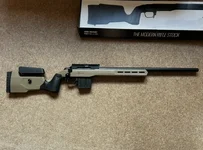
US Military adopts 6.5 Creedmoor

Firstly the Grendel is a completely different round to the creedmoor. The only similarity is the diameter of the bullet.

Secondly I am dubious of the idea effectivness is determined on tumbling bullets. Given that FMJ is used under the Geneva Convention over expanding bullets. The idea being they want a complete over penetration. The reason is to limit the inflicted damage caused by small arms.

They are only different until the bullet leaves the barrel and then they are exactly the same; ie a 6.5 mm projectile in flight so given the same velocity it will have the same effect on the target.

You are labouring under a serious misunderstanding about FMJ. True expanding bullets are banned (under the Hague Convention of 1899 not the Geneva Convention), but it is a total fallacy that the military want a bullet that penetrates stright through with no other energy dumped into the target. That is a military old wives tale, admittedly one I did hear in the mid-80s in Germany where I was stationed at the time; but it was told to us in the context of rules of war not military effectiveness. Even if it were true and we only issued weapons that would wound 'to take his buddy out of the fight too' it would only be true if we were retreating and leaving the enemy's wounded for them to deal with. If you are advancing you get to treat their wounded using up your resources.

The truth of the matter is that we spend a great deal of time trouble and effort selecting the most effective bullets possible for a stated application that stay within the rules of war and several models exist to try and scientifically quantify the incapacitation potential (for example Kokinakis and Sperreza - Google them) and while I mentioned tumbling the 5.56mm NATO also fragments if the velocity is high enough (below 720 m/s wounding potential of the 5.56mm drops markedly) but staying with tumbling for a moment the old .303 British round had an aluminium tip (under the copper jacket) in order to cause it to tumble and become more effective as a direct result of expanding ammunition being banned. See the attached link for pictures of a selection of wound profiles but please pay particular attention to the 5.56 NATO. Terminal Ballistics
 
A large part of the 6,5x55 factory ammunition is loaded down to be able to be fired in older rifles. If you use the wrong type, your MV will be to low to ensure proper expansion... or wrong bullet for intended game.

There are however ammunition loaded to modern specs as well ( not sure what is sold in Irland ).. but here in Norway/Sweden the 6,5x55 is used from largest to smallest game, with tens of thousands of Moose shot each year with more of Red deer, reindeer.


I personally use my 6,5x55 only on Fallow deer and smaller..
 
They are only different until the bullet leaves the barrel and then they are exactly the same; ie a 6.5 mm projectile in flight so given the same velocity it will have the same effect on the target.

You are labouring under a serious misunderstanding about FMJ. True expanding bullets are banned (under the Hague Convention of 1899 not the Geneva Convention), but it is a total fallacy that the military want a bullet that penetrates stright through with no other energy dumped into the target. That is a military old wives tale, admittedly one I did hear in the mid-80s in Germany where I was stationed at the time; but it was told to us in the context of rules of war not military effectiveness. Even if it were true and we only issued weapons that would wound 'to take his buddy out of the fight too' it would only be true if we were retreating and leaving the enemy's wounded for them to deal with. If you are advancing you get to treat their wounded using up your resources.

The truth of the matter is that we spend a great deal of time trouble and effort selecting the most effective bullets possible for a stated application that stay within the rules of war and several models exist to try and scientifically quantify the incapacitation potential (for example Kokinakis and Sperreza - Google them) and while I mentioned tumbling the 5.56mm NATO also fragments if the velocity is high enough (below 720 m/s wounding potential of the 5.56mm drops markedly) but staying with tumbling for a moment the old .303 British round had an aluminium tip (under the copper jacket) in order to cause it to tumble and become more effective as a direct result of expanding ammunition being banned. See the attached link for pictures of a selection of wound profiles but please pay particular attention to the 5.56 NATO. Terminal Ballistics


Can a Grendel launch a 140 grain 6.5 bullet at 2850fps? (saw a homeloaded CM reach that last week with zero pressure signs).

From Wiki:

6.5mm Grendel[TABLE="width: 600"]
[TR="class: ztXv9"]
[TH="align: left"]Bullet mass/type[/TH]
[TH="align: left"]Velocity[/TH]
[TH="align: left"]Energy[/TH]
[/TR]
[TR]
[TD]90 gr (6 g) Speer TNT[/TD]
[TD]2,880 ft/s (880 m/s)[/TD]
[TD]1,658 ft⋅lbf (2,248 J)[/TD]
[/TR]
[TR]
[TD]108 Scenar (moly)[/TD]
[TD]2,790 ft/s (850 m/s)[/TD]
[TD]1,866 ft⋅lbf (2,530 J)[/TD]
[/TR]
[TR]
[TD]120 gr (8 g) Norma FMJBT[/TD]
[TD]2,700 ft/s (820 m/s)[/TD]
[TD]1,942 ft⋅lbf (2,633 J)[/TD]
[/TR]
[TR]
[TD]123 gr (8 g) Sierra Matchking[/TD]
[TD]2,650 ft/s (810 m/s)[/TD]
[TD]1,917 ft⋅lbf (2,599 J)[/TD]
[/TR]
[/TABLE]


6.5mm Creedmoor
[TABLE="width: 600"]
[TR="class: ztXv9"]
[TH="align: left"]Bullet mass/type[/TH]
[TH="align: left"]Velocity[/TH]
[TH="align: left"]Energy[/TH]
[/TR]
[TR]
[TD]120 gr (8 g) AMAX[/TD]
[TD]3,020 ft/s (920 m/s)[/TD]
[TD]2,430 ft⋅lbf (3,290 J)[/TD]
[/TR]
[TR]
[TD]143 gr (9 g) Hornady ELD-X[/TD]
[TD]2,710 ft/s (830 m/s)[/TD]
[TD]2,283 ft⋅lbf (3,095 J)[/TD]
[/TR]
[/TABLE]


There would appear to be quite a significant advantage to CM in terms of MV. Not sure that it is at all a fair comparison drawing conclusions on the 6.5 CM based on the terminal ballistics of the slower round.
 
Last edited:
In addition to Scotch Egg's comments, I think the content of that conversation very out of context for the "effectiveness" of the 6.5 CM. "Tumbling" is a concept which might have been important for the diminutive 5.56, and slightly counter intuitive to the aim of non-lethality for the purposes of taking out more than one soldier on the battlefield (ie wounding with intent to cause others to come to the aid of a shot comrade). Due to concerns over the 5.56 penciling through and being far less effective than the pretty conclusive outcome of being shot with a 7.62 x 51, an FMJ with CoG that encourages tumbling upon contact ensures a greater wound channel and therefor enhances lethality...or so the story goes. Accurate shooter has an article on some of the early 5.56 bullet designs which did just this.

The one thing is for certain and that's that a 6.5CM starts out with way more energy than any 5.56 at similar velocity so to draw conclusions on suitability based on lethality of wound channel is entirely dependant upon bullet design and velocity. Any FMJ can have specific CoG built into the design to either encourage greater penetration or tumbling but since there isn't currently any military FMJ 6.5 round that I am aware of in current use with NATO, no conclusions surely can be drawn to suitability? It just seems rather odd to draw any conclusions on the basis of ?????? It would be interesting to know what ammunition/bullet design was used in their Grendel trials. Grendel is a completely different kettle of fish to CM anyway with a way smaller case capacity (35gr H20) and much reduced velocity potential. It is a medium range round at best so seems entirely unsuitable for any military application where higher velocity would be surely a requirement?

Further to my reply to Scotch Egg; the 6.5 may well start out with more energy than the 5.56 but unless it leaves it in the target then it is a moot point. The 5.56 NATO does an excellent job of leaving energy in a target at short range (when its velocity is above 720 m/s) as range increases its ability to tumble/fragment decreases along with its wounding potential which is where the 7.62 takes over; yes, I am saying in military form the 5.56 is better than the 7.62 at short range. This is what NATO thinks of it: https://ndiastorage.blob.core.usgovcloudapi.net/ndia/2010/armament/WednesdayLandmarkBPerArvidsson.pdf. That is why we have a mix of 5.56 rifles along with 7.62 sharpshooter rifles and GPMGs in British service. That is not going to change anytime soon. The period of penetration of the 7.62 should be thought of as time rather than distance. It tumbles after approx 2 milliseconds and at range that is a shallower penetration.

As for the context of the conversation; how would you know? It was a sidebar to a module of a course covering munitions and target response and covered small arms rounds extensively; I did specifically ask whether a change of design of the round (to something similar to the SS109) would alter the effect and the answer came back 'it will still penetrate 8 inches before the effect takes place'. If you disagree on this please do so, I am always happy to be educated but I will need your evidence. One thing I did not ask and will follow up on is 'does the 6.5 behave like the 7.62 and yaw/fragment sooner as range increases.

You are correct that there are no 6.5mm rounds in NATO service but the trial I was referring to was to test the suitability for the 6.5 Grendel for UK service. Think about that. If Alexander Arms, who have been hawking the Grendel as a military round for years had the opportunity to get the UK on board do you not think they might have put some effort into selecting the best round available? The fact the round was unsatisfactory does not give me confidence that any money spent on developing it would be worthwhile. This does have a bearing on the 6.5 Creedmoor. Unless it does become more effective at range I suspect they are wasting their time unless they are seeking a weapon for a very precise purpose. In which case I doubt they are going to let on what that is.
 
OK...badly worded perhaps but I still am of the opinion that a 6.5 CM can't be as useless as you seem to suggest and it would take some convincing to persuade me otherwise but then again I have not been party to the data that you have. Velocity does matter so to keep going on about a round that clearly performs well short of the CM I don't think is a moot point. My background is military by the way and I have used both 7.62 which was my first service weapon and the 5.56 (Mk1 SA80, the disaster that that particular weapon was....not so much the Mk2). None of my colleagues at the time were of the opinion that the L1A1 was less effective than the 5.56 at short range in any way shape or form...and pardon me for being blunt but I don't buy that at all. I'll park it there because theorising about it or arguing over it won't alter any outcomes and military procurement does not have a blemish free history of getting things right based on performance and seem more influenced by economies and political motives. It will be interesting though to see where this one eventually goes and what the UK powers that be decide longer term. I am not a fan of the 5.56 and never was.
 
You are correct that there are no 6.5mm rounds in NATO service but the trial I was referring to was to test the suitability for the 6.5 Grendel for UK service. Think about that. If Alexander Arms, who have been hawking the Grendel as a military round for years had the opportunity to get the UK on board do you not think they might have put some effort into selecting the best round available? The fact the round was unsatisfactory does not give me confidence that any money spent on developing it would be worthwhile. This does have a bearing on the 6.5 Creedmoor. Unless it does become more effective at range I suspect they are wasting their time unless they are seeking a weapon for a very precise purpose. In which case I doubt they are going to let on what that is.

While I agree with much of what you say, remember the whole point about the Grendel (or more precisely Alexander Arms' pre-Grendel milspec version) was for it to be compatible with the M4 platform (ie AR-15 dimensionally) with its severe limitations on case-head diameter and an upper COAL limit of a mere 2.26 inches. The Creedmoor is a substantially larger, longer, and higher performance cartridge which in selective fire platform needs something in the order of the generic AR-10 / SR25 actions and magazines to be handled.

The pre-Grendel Alexander Arms 6.5 (in essence a 6.5mm PPC or necked-down Soviet 7.62X39mm M43 with a few 'special' bells and whistles) was one of the contenders for US Special Forces for M4 carbines and still further cut-down (to 10 inches or less) barreled variants where short barrels had allegedly so degraded 5.56mm performance that the weapons and ammunition system were claimed to be no longer fit for purpose - in essence the standard M855 62gn bullet which is very terminal velocity sensitive in order to tumble and break-up 'in-target' no longer did so except in the shortest range firefights. The 77gn Sierra MK loaded Mk262 special purpose round partly overcame this deficiency, and the latest 5.56mm EPR (Enhanced Performance Round) which is replacing the M855 has allegedly overcome the M4's 14-barrel length created terminal effect deficiencies for more general issue. Nevertheless, the 6.8mm Rem SPC was adopted as a short-term expedient to rectify this identified weakness, but had its own serious problems initially and by the time things settled down, not only had the 6.8 been downloaded substantially from the original claimed MVs, but US forces were being pulled from the Middle East fighting zones and the need was therefore being reduced or eliminated.

The US SOCOM looked at three calibres in the bullet weights that could be handled by an M4 compatible (ie very small) cartridge at their likely MVs (relatively low) - 6.5, 6.8, and 7mm. 6.5mm gave the best external ballistics (Alexander Arms' claims even today - better than M180 7.62 in SAWs and suchlike never mind 5.56mm, out to extensive ranges according to Bill Alexander - but was poorer than the other two in terms of perceived 'knock-down', wound channel creation, and terminal energy. (Don't ask me what the testers used, presumably ballistic gelatin blocks.) 6.8mm (0.277") didn't win anything outright, but was regarded as the best overall option in the inevitable compromise. (Ironically, that was what the British War Office 'Ideal Calibre Panel' came up with during 1945-46 and what became the 280/30 British prototype assault rifle cartridge was initially a 270 rather than a seven albeit with heavier bullets than used in the 6.8 SPC.)

However, by adopting the Creedmoor (if that is really happening - I never believe any of these stories until actual purchase and issue to troops occur) this is obviously not for use in the AR/M4 platform and therefore the entire intention and use must be different. So far, although I've seen no end of rumours about this adoption, I've yet to see a definitive statement of use / type of weapon. Given the 6.5's inherent and substantial external ballistics advantage over 7.62 at long ranges - just ask anyone who has switched from 308 to 6.5 Creedmoor in the budget Ruger PR or other similar rifle about the results in a nice day on Bisley's Stickledown Range shooting paper at 800-1,000 yards - conventional sniping on a bolt-action would seem possible, or even likely. ....... but who knows?

In any event, it is unlikely to be used in the role of a direct competitor to 5.56mm and the Grendel is a complete red herring in this issue as two different size / weight platforms are by definition involved and MVs/MEs will be much higher for any Creedmoor adoption.
 
The reason the M249 SAW is 249 is that M248 was an experimental LMG chambered in 6mm AR ( .244 105-gr bullet in a necked down 6.5 Grendel case at 2,700 fps ).

To me, the H&K M28 rifle for the 6.5 Creedmoor takes the wind out of its sails with its short, 16.5 inch barrel - just as the M4, SA90 and AUG do with the 5.56 NATO vs the full size M16A2. I expect to see an FN SCAR in 6.5 CM a with 20 inch barrel in the mix before long. When the M28 is actually put to use alongside the M14 in 6.5 CM, the Army will get some real feedback.
 
The reason the M249 SAW is 249 is that M248 was an experimental LMG chambered in 6mm AR ( .244 105-gr bullet in a necked down 6.5 Grendel case at 2,700 fps ).

To me, the H&K M28 rifle for the 6.5 Creedmoor takes the wind out of its sails with its short, 16.5 inch barrel - just as the M4, SA90 and AUG do with the 5.56 NATO vs the full size M16A2. I expect to see an FN SCAR in 6.5 CM a with 20 inch barrel in the mix before long. When the M28 is actually put to use alongside the M14 in 6.5 CM, the Army will get some real feedback.
did you mean the SA80? both that and the Steyr AUG have 20" barrels as standard the same as the M16A2
 
did you mean the SA80? both that and the Steyr AUG have 20" barrels as standard the same as the M16A2

Yes, SA80. Some AUGs are 20 inch, some shorter, though I don't see why, in a bullpup. We can still buy them in the USA again. Of course, there have been M16 variations with barrels as short as 10 inches, since Vietnam. It never made any sense to me to chop the barrel and then put on a 6 inch flash hider. My point is not about the SA80, AUG or M16 shorties, but about how they indicate the loss of performance to be expected when chopping a 6.5 CM from 24 or 22 or 20 down to 16.5. The 6mm AR seems worth a field trial, as it fits into the standard AR-15 receiver, instead of the larger AR-10 / HK M28 platform. There is nothing that says the infantry rifle can't be 6mm and the long range rifles and LMGs 6.5.

The point of my original post is that this may be of interest to deer hunters who own a 6.5 CM or are considering the purchase. I enjoy all the feedback from owners and non-owners, fans and scoffers.
 
Overall at our normal stalking distances a 308/3006 is a much better choice than any 6.5 for deer and it seemed to prove itself in Ireland over time.

I don't understand that you have difficulties understanding that if one chooses a slow heavy bullet that refuses to expand properly in a small deer you will most likely dump less energy into the chest compared to a faster expanding 223 for example. You might even dump more energy with a hornet. The heart shot deer (several) we found with 156 lapua mega seemed to have zero expansion and cal sized exit wound. The bullet was designed to penetrate deep into flesh and possibly exit in moose, to make up lacking energy with penetration. For a while that was just all we were able to get apart from target bullets in Ireland.

Also for military I don't think anyone complained about the stopping power of the 308 at shorter ranges, they are only looking to improve the longer range performance with the CM. Therefore they will possibly sacrifice a bit of short range stopping power.
edi

I think you're missing my point, the 6.5 calibre has more than one bullet available and yet you seem hung up on heavy bullets for moose and judging the calibre on that, when there are dozens of other choices out there.

In creedmoor I load 85 gr varmint bullets at 3350 for fox and 140 Sierra soft points for deer at 2650 on small deer out of the same cartridge, both do their job well because 6.5 is an excellent calibre.
 
While I agree with much of what you say, remember the whole point about the Grendel (or more precisely Alexander Arms' pre-Grendel milspec version) was for it to be compatible with the M4 platform (ie AR-15 dimensionally) with its severe limitations on case-head diameter and an upper COAL limit of a mere 2.26 inches. The Creedmoor is a substantially larger, longer, and higher performance cartridge which in selective fire platform needs something in the order of the generic AR-10 / SR25 actions and magazines to be handled.

The pre-Grendel Alexander Arms 6.5 (in essence a 6.5mm PPC or necked-down Soviet 7.62X39mm M43 with a few 'special' bells and whistles) was one of the contenders for US Special Forces for M4 carbines and still further cut-down (to 10 inches or less) barreled variants where short barrels had allegedly so degraded 5.56mm performance that the weapons and ammunition system were claimed to be no longer fit for purpose - in essence the standard M855 62gn bullet which is very terminal velocity sensitive in order to tumble and break-up 'in-target' no longer did so except in the shortest range firefights. The 77gn Sierra MK loaded Mk262 special purpose round partly overcame this deficiency, and the latest 5.56mm EPR (Enhanced Performance Round) which is replacing the M855 has allegedly overcome the M4's 14-barrel length created terminal effect deficiencies for more general issue. Nevertheless, the 6.8mm Rem SPC was adopted as a short-term expedient to rectify this identified weakness, but had its own serious problems initially and by the time things settled down, not only had the 6.8 been downloaded substantially from the original claimed MVs, but US forces were being pulled from the Middle East fighting zones and the need was therefore being reduced or eliminated.

The US SOCOM looked at three calibres in the bullet weights that could be handled by an M4 compatible (ie very small) cartridge at their likely MVs (relatively low) - 6.5, 6.8, and 7mm. 6.5mm gave the best external ballistics (Alexander Arms' claims even today - better than M180 7.62 in SAWs and suchlike never mind 5.56mm, out to extensive ranges according to Bill Alexander - but was poorer than the other two in terms of perceived 'knock-down', wound channel creation, and terminal energy. (Don't ask me what the testers used, presumably ballistic gelatin blocks.) 6.8mm (0.277") didn't win anything outright, but was regarded as the best overall option in the inevitable compromise. (Ironically, that was what the British War Office 'Ideal Calibre Panel' came up with during 1945-46 and what became the 280/30 British prototype assault rifle cartridge was initially a 270 rather than a seven albeit with heavier bullets than used in the 6.8 SPC.)

However, by adopting the Creedmoor (if that is really happening - I never believe any of these stories until actual purchase and issue to troops occur) this is obviously not for use in the AR/M4 platform and therefore the entire intention and use must be different. So far, although I've seen no end of rumours about this adoption, I've yet to see a definitive statement of use / type of weapon. Given the 6.5's inherent and substantial external ballistics advantage over 7.62 at long ranges - just ask anyone who has switched from 308 to 6.5 Creedmoor in the budget Ruger PR or other similar rifle about the results in a nice day on Bisley's Stickledown Range shooting paper at 800-1,000 yards - conventional sniping on a bolt-action would seem possible, or even likely. ....... but who knows?

In any event, it is unlikely to be used in the role of a direct competitor to 5.56mm and the Grendel is a complete red herring in this issue as two different size / weight platforms are by definition involved and MVs/MEs will be much higher for any Creedmoor adoption.

Laurie,

I totally agree with everything you have said, but for the record I never sought to compare the Grendel with the CM; only to point out that they both fire 6.5mm projectiles and, for a given velocity, they will perform identically in a target. The Grendel is the only 6.5 for which I have seen the results of firing into ballistic gellatin but it is a valid comparison with the CM for that velocity. The other issue that must be considered is that a bullet's KE is only of interest if it can dump it into the target and in FMJ guise the 6.5 is poor.

BTW, also for the record I think the 6.5 CM is an excellent round and will probably own one at some point when my wife relaxes her hold on the purse strings and my 6.5x55 is shot out, but my interests are mainly deer with the odd range day and I match the bullets accordingly.
 
Laurie,

I totally agree with everything you have said, but for the record I never sought to compare the Grendel with the CM; only to point out that they both fire 6.5mm projectiles and, for a given velocity, they will perform identically in a target. The Grendel is the only 6.5 for which I have seen the results of firing into ballistic gellatin but it is a valid comparison with the CM for that velocity. The other issue that must be considered is that a bullet's KE is only of interest if it can dump it into the target and in FMJ guise the 6.5 is poor.

BTW, also for the record I think the 6.5 CM is an excellent round and will probably own one at some point when my wife relaxes her hold on the purse strings and my 6.5x55 is shot out, but my interests are mainly deer with the odd range day and I match the bullets accordingly.

If ammunition was limited to the a poorly performing FMJ design and CM velocity was the same as Grendel velocity then I agree with you here and it would stand to reason that your argument holds water. What I'm trying to fathom here is why you keep insisting on using a comparison where they perform at equal velocities when clearly, they do not. Genuinely, am I missing something in the argument? CM performs at higher velocity....significantly higher in some cases, depending on projectile weight. Isn't that a bit like trying to compare 30 Blackout with .308W? Forgive me if I'm missing something. If for example we take the example of terminal energy of 123gr bullets at 400m, then a zippy Grendel MV of 2650 ft/sec for this round will have a terminal velocity of about 2012fps/1106 ft-lbs. If the same bullet was fired from a CM the MV would be closer to 2900ft/s (conservative as I have seen over 3000fps from a 24 inch barrel with this bullet) which at 400 yds equates to about 2230ft/sec and 1355ft-lbs so considerable more energy retained. Like any other ballistic comparison or field trial, harnessing the right bullet design and firing it at the right (required) velocity are the keys. CM or 260Rem for that matter would seem to have a pretty hefty potential performance advantage over Grendel. It's all just a bit of fun debating these things but Laurie's concluding paragraph I think sums it up nicely.
 
Chester what is possibly meant is that the slower Grendel will have a different distance window as the CM. Terminal Bullet performance will be similar with 100 or 200yd difference. Don't think the Grendel was planned as a 1000yd cartridge fired from an AR. Bit like a 22-250 will give you ~100yds extra over a 223. Same bullet different launch speeds.
edi
 
Before people are too influenced by what one UK armaments tech says tests showed, there is of course more than a little actual military use and results to draw upon as several countries adopted 6.5mm service cartridges in the main move to smokeless 'small-bore' designs between the mid 1890s and 1905. Most of them, like the Scandinavian countries, avoided involvement in any wars so their rifles punched little more than paper, but one 6.5mm adopter was one of the most militarily aggressive - and successful - nations going, Imperial Japan.

The little semi-rimmed 6.5X50mm 'Arisaka' was used from the Russo-Japanese war through to Japan's formal surrender on the USS Missouri in 1945 and although attempts were made to replace it with a more powerful 7.7mm (.303" Calibre) 30-06 size design, remained the primary military cartridge for both rifles and light MGs throughout.

The ballistics of the cartridge are 'modest' even in the very long-barrel Type 38 rifle - a 139gn FMJBT at 2,500 fps MV, less in carbines and MGs (where a downloaded lower pressure variant was used). I've read many times of how the average US GI understimated his Japanese equivalent and IJA weapons and equipment including the 'under-powered quarter-bore rifle cartridge'. They (and their British Commonwealth equivalents in Burma, Singapore, Papua New Guinea and the South West Pacific Theatre') were soon to learn otherwise, that the old relatively weak 'Arisaka' round was deadly in actual combat, that which counts.

Here's what Wikipedia says on the issue:

The round was criticized for being underpowered compared to other, more powerful, American and European cartridges such as the .30-06, .303 British, 7.92×57mm Mauser, and 7.62×54mmR. For this reason it was later replaced by the more powerful 7.7×58mm cartridge. Despite being smaller and less powerful, the 6.5×50mm cartridge held some advantages, since the larger rounds were significantly overpowered in engagements during the First and Second World Wars, which were mostly short-ranged taking place at less than 300 meters, and also generated more recoil in automatic weapons. A 6.5 mm round with the Type 38 pointed bullet loading still had good ballistics and terminal effectiveness with rapid yaw on impact causing severe wounds. Larger calibers were optimized for machine guns to use for long-range firing, and rifles were often made to chamber them in the interest of logistics, however Japan had the 7.7 mm cartridge in use only by machine guns for years before developing a rifle for the round.[SUP][2] [/SUP]

[my italics on wound effects]

As a matter of interest on the same subject but at the opposite ends of the energy / knock-down scale, I've been rereading Terry Wieland's book Dangerous Game Rifles and Cartridges 2nd edition which has a large and fascinating chapter on the principles, history, construction and field performance of large calibre game bullets. Wieland doesn't give two cents for results in ballistic gel - OK for pistol cartridges and bullets but useless and misleading for rifle bullet performance.
 
Laurie wins in the 10th by TKO!

As always, these debates are highly informative, the determination to promote a point of view, or sometimes score a win over someone else, usually yields more than would otherwise be learnt.
 
Before people are too influenced by what one UK armaments tech says tests showed, there is of course more than a little actual military use and results to draw upon as several countries adopted 6.5mm service cartridges in the main move to smokeless 'small-bore' designs between the mid 1890s and 1905. Most of them, like the Scandinavian countries, avoided involvement in any wars so their rifles punched little more than paper, but one 6.5mm adopter was one of the most militarily aggressive - and successful - nations going, Imperial Japan.

The little semi-rimmed 6.5X50mm 'Arisaka' was used from the Russo-Japanese war through to Japan's formal surrender on the USS Missouri in 1945 and although attempts were made to replace it with a more powerful 7.7mm (.303" Calibre) 30-06 size design, remained the primary military cartridge for both rifles and light MGs throughout.

The ballistics of the cartridge are 'modest' even in the very long-barrel Type 38 rifle - a 139gn FMJBT at 2,500 fps MV, less in carbines and MGs (where a downloaded lower pressure variant was used). I've read many times of how the average US GI understimated his Japanese equivalent and IJA weapons and equipment including the 'under-powered quarter-bore rifle cartridge'. They (and their British Commonwealth equivalents in Burma, Singapore, Papua New Guinea and the South West Pacific Theatre') were soon to learn otherwise, that the old relatively weak 'Arisaka' round was deadly in actual combat, that which counts.

Here's what Wikipedia says on the issue:

The round was criticized for being underpowered compared to other, more powerful, American and European cartridges such as the .30-06, .303 British, 7.92×57mm Mauser, and 7.62×54mmR. For this reason it was later replaced by the more powerful 7.7×58mm cartridge. Despite being smaller and less powerful, the 6.5×50mm cartridge held some advantages, since the larger rounds were significantly overpowered in engagements during the First and Second World Wars, which were mostly short-ranged taking place at less than 300 meters, and also generated more recoil in automatic weapons. A 6.5 mm round with the Type 38 pointed bullet loading still had good ballistics and terminal effectiveness with rapid yaw on impact causing severe wounds. Larger calibers were optimized for machine guns to use for long-range firing, and rifles were often made to chamber them in the interest of logistics, however Japan had the 7.7 mm cartridge in use only by machine guns for years before developing a rifle for the round.[SUP][2][/SUP]

[my italics on wound effects]

As a matter of interest on the same subject but at the opposite ends of the energy / knock-down scale, I've been rereading Terry Wieland's book Dangerous Game Rifles and Cartridges 2nd edition which has a large and fascinating chapter on the principles, history, construction and field performance of large calibre game bullets. Wieland doesn't give two cents for results in ballistic gel - OK for pistol cartridges and bullets but useless and misleading for rifle bullet performance.


Laurie,

Thanks for the information on the Ariska; the US Army Medical History website (http://history.amedd.army.mil/booksdocs/wwii/woundblstcs/chapter1.htm)has this to say about it: The 6.5 mm. (0.256 in.) (fig. 9) bullet, especially one made with a gilding metal (an alloy of copper and zinc) jacket, when it hit a target had an explosive effect and tended to separate, leaving the entire jacket in the wound while the bullet went on through. Small globules of lead scattered through the wound and embedded themselves elsewhere in the flesh. This condition was the result of the fact that the rear-section walls of the bullet jacket, which was filled with a lead core, were thinner than the forward walls. The sudden stoppage of the high-velocity bullet when it hit an object produced a tendency to burst the rear walls causing an "explosion." The lead core, which had a greater specific gravity, penetrated, leaving behind the relatively lighter jacket from which it had been discharged. The bullets made with cupronickel jackets had more of a tendency to retain their lead cores because of the greater tensile strength of the alloy when compared with the strength of the gilding-metal-jacketed bullet.
The unusually large exit wound openings often found with this caliber bullet were due to the natural instability of the bullet and possibly to its being fired from inferior weapons. Similarly, there were elliptic entry wounds, a result of the "keyholing" effect of bullets hitting with their sides.


So it would appear to be an effective round for the period but it would suggest that it would not penetrate any form of body armour. They do not state why the bullet keyholed before striking the man but in the jungle it is likely that striking vegetation would cause this effect.

John George's excellent book "Shots fired in anger"(Shots Fired in Anger: A Rifleman's Eye View of the Activities on the Island of Guadalcanal, in the Solomons, During the Elimination of the Japanese Forces there by the American Army under General Patch Whose Troops Included the 132nd Infantry of the Illinois National Guard, a Combat Unit of the American Division in which Organization the Author Served while Encountering the Experiences Described Herein. : George, John B., 1915- : Free Download, Borrow, and Streaming : Internet Archive pg 323) states that the 6.5 was "humane and clean killing" but does not expand further except to say that even at close range a man had a chance of surviving being hit by a 6.5mm rifle but would usually be killed by the 6.5 machine gun due to the multiple hits usually encountered. Note: this book has some detailed review of the weapons of the period so well worth a read if you are into that sort of thing.

As for ballistic gel; I do not know how Wieland used gel to form is opinion but in order to make any sense of this sort of trial you need a large body of data to refer to. For example NATO currently uses Sturdivan's methodology developed in 1975 and measures velocity degradation in 20% gel and then uses the data, with derived equations for discrete areas of the body, to give an overall probability of incapacitation. There is a school of thought that other percentages of gel give a better representation of the body but 20% remains in use because of the body of evidence we have with it. In short using it once might be fun but it is meaningless and only shows how big a hole the round will make in gel; you need the body of repeatable evidence to back it up and then you only have a probability. For Wieland I would guess the probability of stopping a charging Buffalo would not be terribly comforting so his rejection of gel is not surprising.

BTW (Dodgyknees) I hope this is not coming across a desire to promote a particular point of view or score points; I am just following this to its logical conclusion and if, ultimately, I shown to be wrong i am more than happy to accept that. I am an engineer by profession and that is just the way we think, the facts of the matter are what they are but sometimes they need to be clarified; especially on a forum where nuance is all too easily lost.
 
BTW (Dodgyknees) I hope this is not coming across a desire to promote a particular point of view or score points; I am just following this to its logical conclusion and if, ultimately, I shown to be wrong i am more than happy to accept that. I am an engineer by profession and that is just the way we think, the facts of the matter are what they are but sometimes they need to be clarified; especially on a forum where nuance is all too easily lost.

All good Buggad, I was pulling multiple legs, my own included as I am a sucker for a good debate! Was hoping you'd come back with a riposte, and what an interesting it was too!
 
My understanding was that the CM at the moment is more in a special role, they want to use the long range potential, lower weight cartridge and low shooter fatigue advantage. Any lower performance cartridge like the Grendel/Ariska will just be that, lower performance especially at longer ranges. The right balance between performance and barrel life is what the mil is looking for. A lot of water has passed under the bridge since the Ariska/8x57 etc. Training is completely different and of course body armour has improved. Rifles are much more accurate especially from the special forces, optics better. Often the targets engaged are further out and or smaller. The high sectional density might be a disadvantage for some deer at closer range but can be a mil advantage at longer ranger to penetrate Kevlar/steel etc. apart from better bc. The CM might replace the 308 in some roles but not the 300wm 338lap... recon everybody knows that.
edi
 
Yes, I agree with that edi; It would seem logical that a 6.5 might be slotted in at platoon or section level as a replacement for .308 for exactly the reasons you mention, but would be realistically out-classed past 1200 yards compared with 338 or 300wm. It would though have a considerable edge on the .308 between 800 and 1200 yds as well as coming in no heavier in terms of platform, and retaining short action. Ammo would be slightly lighter but as the case size is pretty similar to .308 no more would likely be carried. I wonder just how much of this has been influenced by action in Iraq and Afghanistan or whether that figures at all?
 
I belive all of it is because of Afghanistan.. much longer ranges then what the military was used to.

I remember years ago, at least the US military where expecting most of its "sniper" engagement at 5-600 yards in built up areas.
The 800+ yard shot was very rare up until Afghanistan.. In the 6-800 range the 308 works perfectly with barrels lasting 8-10.000 rounds.


With ranges at 1000 yards at platoon level, is much better to contain and rain mortar fire in on enemy.
Does not work well when Enemy mix in with civilians though.
 
Last edited by a moderator:
Back
Top