
You are using an out of date browser. It may not display this or other websites correctly.
You should upgrade or use an alternative browser.
You should upgrade or use an alternative browser.
Would anyone be interested in an affordable, UK made induction annealing machine?
- Thread starter HandB
- Start date

There's a lot of "interested" posts, now I'd do a poll, asking people at what price they'd actually "buy" ???
Done properly, I think it's a great idea
Done properly, I think it's a great idea

Thanks yes once my pal has built a prototype annealer with the key features in place he will put a video on YouTube of it in action, I will paste the video into a thread here and people can critique the design and discuss the likely market value to them. If it's less than parts and labour then he won't be able make them. If people are willing to pay the same price as an AMP annealer (approx £1,416) then I would suggest people should go ahead buy an AMP annealer AMP Annealer -MARK II - MARCH Scopes . But I can't afford an AMP so am hoping he can make them for somewhere between £300 and £500 as that is what I can afford to pay for an annealer.There's a lot of "interested" posts, now I'd do a poll, asking people at what price they'd actually "buy" ???
Done properly, I think it's a great idea
Thanks yes once my pal has built a prototype annealer with the key features in place he will put a video on YouTube of it in action, I will paste the video into a thread here and people can critique the design and discuss the likely market value to them. If it's less than parts and labour then he won't be able make them. If people are willing to pay the same price as an AMP annealer (approx £1,416) then I would suggest people should go ahead buy an AMP annealer AMP Annealer -MARK II - MARCH Scopes . But I can't afford an AMP so am hoping he can make them for somewhere between £300 and £500 as that is what I can afford to pay for an annealer.


Because I am rather cack handed he is planning to make it super simple to operate. It will go something likes this. Plug the machine into the wall. Turn on power. Put cartridge case in coil. The machine automatically anneals it the right length of time and a trap door drops it into a tray when done. Put next case into coil etc. etc. He may make an autofeeding hopper to add on top of the machine if people want one.If he is able to make something akin to a prometheus Id also be interested in that !
I'd be very interested in something in the £300-500 range, I'm in the middle of a reloading room renovation and it would be a definite buy for me if it worked wellThanks yes once my pal has built a prototype annealer with the key features in place he will put a video on YouTube of it in action, I will paste the video into a thread here and people can critique the design and discuss the likely market value to them. If it's less than parts and labour then he won't be able make them. If people are willing to pay the same price as an AMP annealer (approx £1,416) then I would suggest people should go ahead buy an AMP annealer AMP Annealer -MARK II - MARCH Scopes . But I can't afford an AMP so am hoping he can make them for somewhere between £300 and £500 as that is what I can afford to pay for an annealer.
Yes I will crash test the prototype due to my natural clumsiness and also price test it due to my impecunious situation. If I can afford it and don't manage to break it then it should hopefully be a goer for at least some of the wider SD community.I'd be very interested in something in the £300-500 range, I'm in the middle of a reloading room renovation and it would be a definite buy for me if it worked well
I hoping this works out for you and, as I said previously, i'm more than willing to help, but I have to admit to having serious doubts about:
a. The size of the potential market. In the UK it's very small (most potential buyers are on here) and exporting is not easy can can be expensive
b. The price point. I fear the component and build costs plus a sensible profit margin may well result in a price which many will find too high
c. Safety and liability issues with any electrical product being sold to the public
Cheers
Bruce
a. The size of the potential market. In the UK it's very small (most potential buyers are on here) and exporting is not easy can can be expensive
b. The price point. I fear the component and build costs plus a sensible profit margin may well result in a price which many will find too high
c. Safety and liability issues with any electrical product being sold to the public
Cheers
Bruce
Thanks Bruce, fortunately my pal makes his living from building electronic apparatus for the scientific research sector so he is familiar with the process of making and selling electronics. He is also familiar with budgeting builds. If it works out that the cost of parts and labour cause the price of his annealer to be too high for people to afford then he won't bother producing them for sale.I hoping this works out for you and, as I said previously, i'm more than willing to help, but I have to admit to having serious doubts about:
a. The size of the potential market. In the UK it's very small (most potential buyers are on here) and exporting is not easy can can be expensive
b. The price point. I fear the component and build costs plus a sensible profit margin may well result in a price which many will find too high
c. Safety and liability issues with any electrical product being sold to the public
Cheers
Bruce
"The machine automatically anneals it the right length of time"Because I am rather cack handed he is planning to make it super simple to operate. It will go something likes this. Plug the machine into the wall. Turn on power. Put cartridge case in coil. The machine automatically anneals it the right length of time and a trap door drops it into a tray when done. Put next case into coil etc. etc. He may make an autofeeding hopper to add on top of the machine if people want one.
This is the part that will be difficult. Unless he's already figured out a hitherto unreported method. Maybe he's thinking of say using an infra-red thermometer to try to measure the temperature reached, and time, in a few fractions of a second. Or some other non-contact method. If he can crack that challenge, he could be onto something. If he can do that, please put me on the list for one.
The AMP AZTEC method seems pretty straightforward. Blast the test case until it starts to melt, detect that probably by the way the induction source changes resonant frequency slightly, and/or current consumption. Apply some rule of thumb to the time it took for that to happen, then back it off. Call that the calibration setting. Maybe program up an Arduino or similar to do all that, display the test result then control the machine for the rest of the batch of identical cases.
To sell such an electronic device, some standards must also be satisfied, electrical safety, EMC conformance, as well as reliability and serviceability by the owner (if skilled), or the supplier. Spares and service backup. It is easy enough to make an experimental device using one of the basic induction heater modules and a power supply, really very easy if you have electronic engineering skills, but taking that to the next level and semi-commercialising it could be much harder. It's not worth doing unless you think you can make some money from it, even if the business plan is sketched out rudimentarily.
I can completely see why the AMP costs what it does. And why it has the one-at-a-time loading setup, giving precise positioning of each case, dangling in the coil at the right position to concentrate the flux around the neck and shoulder, for consistency.
Sorry if this seems rather negative, really not so. If he can crack the "automatically anneals it the right length of time" he will be onto a winner and should protect his method worldwide.
If not, a simple inexpensive device, pop in a case, set timer for so many seconds, press button, could be about as useful as a rotary blowtorch flame thing. By inexpensive, I mean induction module, power supply, control processor, other electronics, display, casing, wiring loom, knobs, buttons, switches, precisely wound coil, mechanisms to handle case insertion and removal, thermal management. This all adds up, very quickly. Plus of course the R+D costs, starting from scratch. If you count all that.
Maybe some sort of measurement like the AZTEC principle, to calibrate it with a sacrificial case could be a USP, if the automatic self sensing works with anything and gets it right, one by one, concept doesn't work out. Assuming that AMP have not protected the way they do it.
But really, if I was thinking of designing and selling such a thing I would be doing it with my own PCBs (very straightforward to lay out and procure nowadays), sourcing the electronic components from one of the big companies (again very accessible nowadays), getting them put together by a subcontractor, having the casing made, finished (painted, markings done, etc. etc.) by a specialist sheet metal company.
Building a few replicas of a good prototype in your own "spare" time could quickly turn into a challenge. Particularly if relying on sourcing modules from who knows where.
That said, I think there could be potential here, with say SD members used for a soft-launch of a MK1 device, to get the word out to a larger marketplace.
Now that you've brought it up!With the price of electricty, I'd much prefer a gas model as well.
 www.facebook.com
Thanks Sharpie, yes the automatic annealing function is key. I am not interested in melting cases then working backwards to find the ideal pre-melt annealing run time for the induction coil for each batch of brass as I know I would end up burning the house down or some other tomfoolery. My pal thinks he has got a workable method to automate the process for a more affordable cost than the likes of AMP (my budget is around £300 to £500). If he has then he will make a plug and play annealing machine for me and anyone else who likes it. If he hasn't then he won't."The machine automatically anneals it the right length of time"
This is the part that will be difficult. Unless he's already figured out a hitherto unreported method. Maybe he's thinking of say using an infra-red thermometer to try to measure the temperature reached, and time, in a few fractions of a second. Or some other non-contact method. If he can crack that challenge, he could be onto something. If he can do that, please put me on the list for one.
The AMP AZTEC method seems pretty straightforward. Blast the test case until it starts to melt, detect that probably by the way the induction source changes resonant frequency slightly, and/or current consumption. Apply some rule of thumb to the time it took for that to happen, then back it off. Call that the calibration setting. Maybe program up an Arduino or similar to do all that, display the test result then control the machine for the rest of the batch of identical cases.
To sell such an electronic device, some standards must also be satisfied, electrical safety, EMC conformance, as well as reliability and serviceability by the owner (if skilled), or the supplier. Spares and service backup. It is easy enough to make an experimental device using one of the basic induction heater modules and a power supply, really very easy if you have electronic engineering skills, but taking that to the next level and semi-commercialising it could be much harder. It's not worth doing unless you think you can make some money from it, even if the business plan is sketched out rudimentarily.
I can completely see why the AMP costs what it does. And why it has the one-at-a-time loading setup, giving precise positioning of each case, dangling in the coil at the right position to concentrate the flux around the neck and shoulder, for consistency.
Sorry if this seems rather negative, really not so. If he can crack the "automatically anneals it the right length of time" he will be onto a winner and should protect his method worldwide.
If not, a simple inexpensive device, pop in a case, set timer for so many seconds, press button, could be about as useful as a rotary blowtorch flame thing. By inexpensive, I mean induction module, power supply, control processor, other electronics, display, casing, wiring loom, knobs, buttons, switches, precisely wound coil, mechanisms to handle case insertion and removal, thermal management. This all adds up, very quickly. Plus of course the R+D costs, starting from scratch. If you count all that.
Maybe some sort of measurement like the AZTEC principle, to calibrate it with a sacrificial case could be a USP, if the automatic self sensing works with anything and gets it right, one by one, concept doesn't work out. Assuming that AMP have not protected the way they do it.
But really, if I was thinking of designing and selling such a thing I would be doing it with my own PCBs (very straightforward to lay out and procure nowadays), sourcing the electronic components from one of the big companies (again very accessible nowadays), getting them put together by a subcontractor, having the casing made, finished (painted, markings done, etc. etc.) by a specialist sheet metal company.
Building a few replicas of a good prototype in your own "spare" time could quickly turn into a challenge. Particularly if relying on sourcing modules from who knows where.
That said, I think there could be potential here, with say SD members used for a soft-launch of a MK1 device, to get the word out to a larger marketplace.
What about using Reasonance Frequency Analysis (Impact Excitation) to check the case hardness after annealing? Basically you strike one end of the case with an impactor and place a microphone at the other end. The hardness of the brass will affect the reasonance frequency. Match the resonance frequency to the ideal hardness and you're home and dry.
CH
CH
Thanks - sounds plausible although I am not an engineer.What about using Reasonance Frequency Analysis (Impact Excitation) to check the case hardness after annealing? Basically you strike one end of the case with an impactor and place a microphone at the other end. The hardness of the brass will affect the reasonance frequency. Match the resonance frequency to the ideal hardness and you're home and dry.
CH
Case hardness varies with position along the case with the brass being harder at the case head and along most of the body and softer at the neck
You don't want the annealing process to make those harder areas softer, you only want to affect the hardness at the case neck
Impact excitation is going to give you a single hardness value for the whole case and that value can be affected by the actual case dimensions as well as it's hardness.
If this new annealing machine has some sort of detection and control system to get the time right for any given cartridge size and make, then the results need to be validated by hardness testing - and preferably Vickers Microhardness testing.
That means getting a materials testing laboratory involved to measure the hardness of case necks that have been annealed in the new machine, and some new cases as a reference
Only when the new machine can repeatably and reliably anneal cases to a hardness level close to that of new brass will it be technically viable.
Cheers
Bruce
You don't want the annealing process to make those harder areas softer, you only want to affect the hardness at the case neck
Impact excitation is going to give you a single hardness value for the whole case and that value can be affected by the actual case dimensions as well as it's hardness.
If this new annealing machine has some sort of detection and control system to get the time right for any given cartridge size and make, then the results need to be validated by hardness testing - and preferably Vickers Microhardness testing.
That means getting a materials testing laboratory involved to measure the hardness of case necks that have been annealed in the new machine, and some new cases as a reference
Only when the new machine can repeatably and reliably anneal cases to a hardness level close to that of new brass will it be technically viable.
Cheers
Bruce


He‘s on UKV…..You have another link for this please.....I dont do facebook. cheers
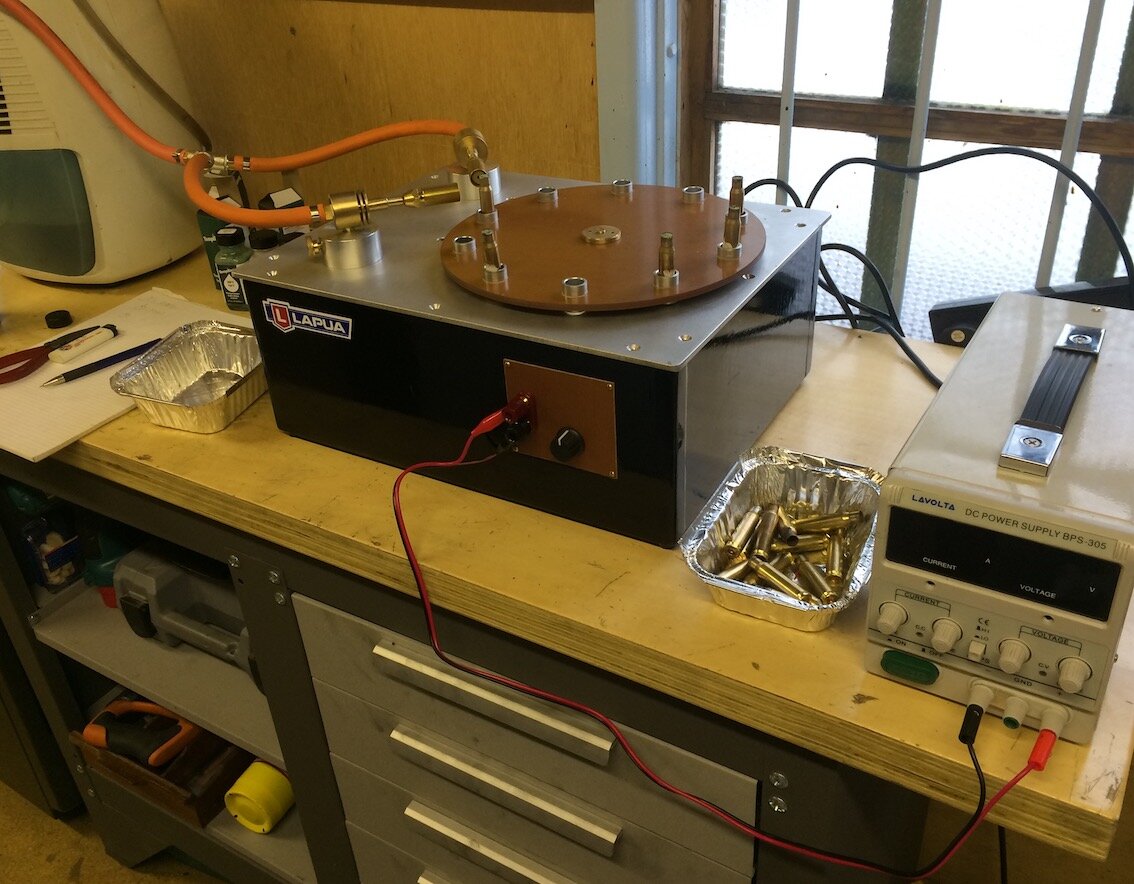
Annealing Machine
The machine is made of stainless steel. It is very simple to operate and performs very well. The disc plates holding the cases are interchangeable for the different calibers and are replaced by removing couple of thumb screws on top. The annealing time could be set simply by turning a potentiomet...
ukvarminting.com


Similar threads

- Replies
- 84
- Views
- 19K

- Replies
- 7
- Views
- 2K


