
One of our club members was annealing for 10p a case.Interesting project, but the reality is it's unnecessary when the alternative is as follows.
Contact Bruce. Post brass to Bruce. Pay Bruce. Brass is returned, annealed perfectly, from Bruce.
You are using an out of date browser. It may not display this or other websites correctly.
You should upgrade or use an alternative browser.
You should upgrade or use an alternative browser.
Would anyone be interested in an affordable, UK made induction annealing machine?
- Thread starter HandB
- Start date

Yes - one can never have too many options. If Bruce has the capacity to anneal for others that is brilliant. If anyone wants to anneal their own brass and is loaded then I suggest getting an AMP. If anyone is like me and lacks the funds for an AMP then my buddy's machine may be an option. If he can get a working design at a sensible price, which will be decided in due course.Interesting project, but the reality is it's unnecessary when the alternative is as follows.
Contact Bruce. Post brass to Bruce. Pay Bruce. Brass is returned, annealed perfectly, from Bruce.


kenbro
Well-Known Member
Is that a good idea, asking the end user to set the the manufacturers price?There's a lot of "interested" posts, now I'd do a poll, asking people at what price they'd actually "buy" ???
Done properly, I think it's a great idea
K.

I told him my budget is between £300 and £500 so he will aim to build one for me at that price. If it turns out to be uneconomic then he won't be building any more.When you say affordable what's the ball park ££ delivered to mainland UK


Do you have a parts list please?Does not mains operated electrical equipment have to be CE certified prior to sale?
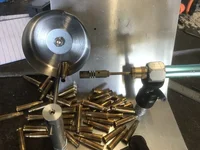
With the help of a model engineer friend parts etc from the bay, cost around £15 works for me, .17hornet.

Treedave
Well-Known Member
Is that an induction annealer? Looks like a gas torch to me.Does not mains operated electrical equipment have to be CE certified prior to sale?
With the help of a model engineer friend parts etc from the bay, cost around £15 works for me, .17hornet.
yep gas powered, but was simple and cheap to build, works for me when converting .22hornet cases to .17hornet and then annealing as required the 17hornet and .223rem cases.Is that an induction annealer? Looks like a gas torch to me.
used a 12vdc little geared motor plus speed controller, pencil type gas torch which could be improved as needs regular refills. Stainless steel bowl/cup, universal ball joint, and bits of metal, washers my friend had in his workshop.
Far from sophisticated but gets the job done for my needs. May be improve the gas torch some time.
There are a few of these coming out. There is a South African outfit which have one - I think it may retail for about £500
Nope, they appear to retail in SA for 19,500 Rands. Which is about £950. I think I can see what they have done, quite nicely. But no cleverness regarding determining annealing parameters on a case-by-case basis, or even calibrating to a test case, destructively (AMP) method, or by some other means.
Seems to be a nicely packaged device, well thought out, but, basically, you dial in a time determined somehow (I don't know, maybe by looking in the top and waiting until you see a dull red glow).
I am pretty sure that now I know how AMP determine their annealing parameter, based on frequency shift as the case melts, maybe also some current measurement too, in their catch-all rather dubious US patent. Not really new.
Yes. But there are ways of self certifying for really serious designers who have all the test equipment necessary. It does help if the bit you plug into the mains first, the power supply, is already CE approved. CE BTW is just one of many other approvals necessary if wanting to sell elsewhere. And covers more than just EMC, whatever, but also things like bits that get too hot to touch, burn injury, fire hazard, safety in all failure modes, etc. etc.Does not mains operated electrical equipment have to be CE certified prior to sale?
Then there are fundamentals, such as these induction things, to heat brass (not steel cooking pans) typically operate at frequencies around 100 kHz. Which is well into radio frequency, propagation. Have the coil external to a shielded enclosure as some of these do (not the AMP), and you are into another can of worms as to the legalities. BTW an induction driver and coil can deliver some life threatening voltages and currents under some conditions. These are not toys, just because the may seem to run off only say 36V from the PSU, as per the simple cheap ebay generic ZVS modules.
Sure, we, at least those of us with knowledge, can assemble prototype/concept proving things that can work nicely. But commercialising them is a whole different kettle of fish.
Sure. Power supply. Induction driver. Induction coil. Control electronics. Thermal management arrangements. Bespoke enclosure, wiring harness, controls and display. Mechanical handling and alignment of the target object.Do you have a parts list please?
The lBOM (bill of materials) for that is likely to be considerable.
Just the basics of that is going to cost several hundred £, unless you have some already in your bits box to re-purpose for a one-off experiment. And your time and effort is discounted.
This is before we get onto the fundamental point, that this thing is supposed to automagically cook whatever is dropped into it to perfection, one at a time. Which would be neat and worth more than £300-500.
I have some fancy ideas of my own about how to do that, but almost certainly will never progress them. I'm not going to mention them in public, not because I want to be secretive, but because if someone else does turn them into something real, then protect their technique somehow, as applicable to cartridge brass annealing (honestly there is plenty of prior art around induction heating and monitoring) then I wouldn't want to spoil that for them. Though TBH, if they can pull off that trick they might be better off simply licensing it to e.g. one of the big US reloading equipment manufacturers.
They must have got greedy and raised their prices. Last I looked several months ago it was around the £500 mark. The rand is volatile but not that volatile.Nope, they appear to retail in SA for 19,500 Rands. Which is about £950. I think I can see what they have done, quite nicely. But no cleverness regarding determining annealing parameters on a case-by-case basis, or even calibrating to a test case, destructively (AMP) method, or by some other means.
I suspect that was a sort of kickstarter price. Seems they have sold over 100 now though.They must have got greedy and raised their prices. Last I looked several months ago it was around the £500 mark. The rand is volatile but not that volatile.
QUICK ANNEAL ANNEALER - Brothers Arms
So, how do they determine anneal time ? Like I said, look in the top and catch it when it glows red. Triffick, how sophisticated is that ?
people have been using tempilaq with flame annealers - can't see why it would not work with this.I suspect that was a sort of kickstarter price. Seems they have sold over 100 now though.
QUICK ANNEAL ANNEALER - Brothers Arms
So, how do they determine anneal time ? Like I said, look in the top and catch it when it glows red. Triffick, how sophisticated is that ?
HonestJohn
Well-Known Member
What do you want an annealer for ? To extend case life, sure. Consistency, well you be the judge of that. Must it be added to your case prep. routine (maybe already a little OCD) every time ?
To get deep into the weeds of long range precision, a-la Eric Cortina, well maybe. but his tests of flame vs. induction were to my mind, inconclusive.
Seriously, analyse wants and needs. Twirling brass around in a flame can still do the job adequately. For most.
Much as I like techy stuff and know how to make such things, it is not a rabbit hole that I consider worth my time exploring. Sometimes adequate is all that's needed.
Of course the fascination factor can be compelling, and I am not immune to that
To get deep into the weeds of long range precision, a-la Eric Cortina, well maybe. but his tests of flame vs. induction were to my mind, inconclusive.
Seriously, analyse wants and needs. Twirling brass around in a flame can still do the job adequately. For most.
Much as I like techy stuff and know how to make such things, it is not a rabbit hole that I consider worth my time exploring. Sometimes adequate is all that's needed.
Of course the fascination factor can be compelling, and I am not immune to that
Similar threads

- Replies
- 84
- Views
- 19K

- Replies
- 7
- Views
- 2K


