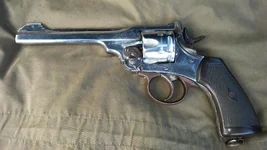
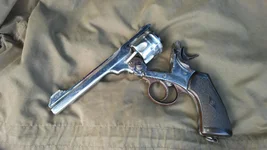
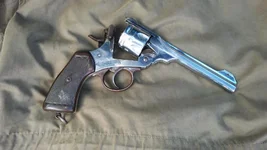
Webley MKVI. Happy to have it - but should I try and restore it?

LeftHandGuy

Well-Known Member
One of the nice freedoms that I am able to enjoy as a "legal alien" here in the USA, and still something of a novelty for a Brit (or "Redcoat" as my friends are pleased to call me) is to able to own and use handguns - without even having to explain myself - although like almost everyone else I associate with my carry permit was justified on the grounds of "self defense"...

Although I'm now working in a safe, comfortable IT job, I spent most of 2016 working as a shooting instructor (really it's too funny) at an outdoor shooting range in the Pocono mountains. As a sort-of leaving present from the range in November, I ended up with a Webley MKVI and some Fiocchi MK 2 .455 to run through it. (Properly transferred to me by an FFL who conducted the appropriate background check - I might add).

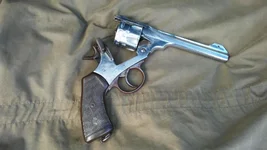
I love the gun, it's now a centenarian, and it must have been fairly cheap. At least I hope so. Problem is, some unthinking, uncaring bugger has applied a poor nickel finish to it. It shoots nicely enough, very little felt recoil despite the 265 gn bullet. 455 Webley dies will be on my shopping list once I can buy fun things again - project for the future is to try a duplicate a MKIII loading - but that's way off the radar just now.

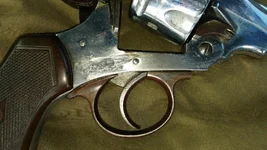
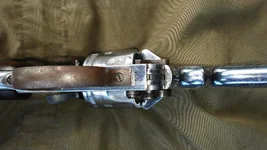
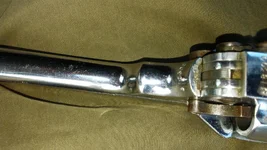
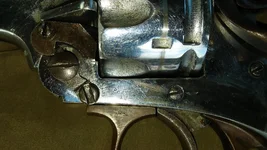
Thing is, should I try and get this horrible shininess removed and replaced with a historically correct finish? Any advice would be gratefully received. As can be seen from the photos, the finish is coming away in places anyway, and someone has scratched off some of the original markings. The cylinder hasn't been shaved though, so at least it hasn't had overpressure 45 Auto through it.

Anyway - what do you all think? It's had its finish butchered once already - I wouldn't want to lose the markings that remain - but I kind of feel that it deserves to be returned to something closer to its proper appearance (which I think would have been parkerized?)

Guy
20161207_132313.webp20161207_132321.webp20161207_132332.webp20161207_132346.webp20161207_132355.webp20161207_132416.webp20161207_132432.webp20161207_132443.webp20161207_132514.webp
 
Last edited:
that may actually be the original finish, Webley made a "Navy" version that was nickel plated and they were horrible looking! so you may have something quite rare for being in the states
 
that may actually be the original finish, Webley made a "Navy" version that was nickel plated and they were horrible looking! so you may have something quite rare for being in the states

That would be an interesting turn-up for sure! I think though that it looks like the finish has been applied over the top of some fairly heavy wear - see the pitting on the outside of the cylinder on the first picture for example.

I don't mind the wear - it's a 1917 gun from the "busy" period of WWI - but I do hate what appears to be wanton abuse. E.g. look at the frame above the right side of the trigger. I *think* that's where it should have the calibre marked, and it looks very much as though it's been filed/scraped/scratched away....
 
No. It's not original. The pistol is dated so it's a military contract pistol. None of which were factory nickel. I've seen the original Webley factory day books and registers and all the MkVI entries. The last one was sold in 1957 to Nigeria BTW.

Webley did offer factory nickel. That's true. But you'll see a lot...the factory books list them...returned as WWI settled to trench warfare to be "de nickel and black" re finished. Nickel was very much pre WWI and for the same reasons Colt and S & W offered nickel options. Corrosion resistance in humid climates.

In fact I think there's not even a half a dozen, maybe even only a single MK VI commercial...or "private" as they were listed as nickel.

Most were finished "VMC" against the serial number. Meaning vulcanite (grips) metal coloured (black). Else on some very very few "private" guns were polished blue with wood grips. Yes, there were commercial or "private" Mk VI revolvers fitted with wood grips.

Also noteworty were contract guns that failed Government inspection listed as "sold as private". In other words sold commercially by Webley.

The interwar period sees many 6" barrel Mk VI revolvers converted to 4", re-blacked and re-numbered. These have a shiny dark black and were Irish Contract RUC Mk VI.
 
Last edited:
I'm on a mobile so impossible to keep your images "still" to view. I'll look when on a decent large screen monitor. Commercial guns are calibre marked on the barrel just in front of the holster guides. Mk VI revolvers usually .450/.455 like that. Not .455 on its own. On the frame halfway up between the cylinder stirrup and the rear trigger guard screw Canadian contract guns had a "C" in a rectangle. Can't remember if there was or wasn't a /l\ though. I think not?

Australian guns, from memory, D /l\ D and South African a /l\ inside U for "Union of South Africa.

Correct military finish is metal coloured...like the slate grey you see on some drill bits. And the stirrup, trigger, trigger guard with what looks like a thin "wash" of very diluted Suncorite over the to of that metal colour.

Commercial grips, also, won't be lettered. Military contract grips will be an S or an M. L military grips are rare...never seen any...but they are wood...not vulcanite.
 
Last edited:
I am a huge webley fan, REAL webleys, not the newTurkish/chinese junk with the name webley stamped on. Really envious of you Lefthandguy, living in a free country like the USA. To be honest i think webleys, and most classic revolvers look terrible with nickle or chrome on them. How much is the fiochhi .455 costing you ? Last time i priced it, it was nearly 50 euros a box.
 
Works out about $40 per box of 50. Not too bad for a dinosaur calibre, mostly I am valuing it for the brass though, as I plan to craft some loads of my own.
 
I'm on a mobile so impossible to keep your images "still" to view. I'll look when on a decent large screen monitor. Commercial guns are calibre marked on the barrel just in front of the holster guides. Mk VI revolvers usually .450/.455 like that. Not .455 on its own. On the frame halfway up between the cylinder stirrup and the rear trigger guard screw Canadian contract guns had a "C" in a rectangle. Can't remember if there was or wasn't a /l\ though. I think not?

Australian guns, from memory, D /l\ D and South African a /l\ inside U for "Union of South Africa.

Correct military finish is metal coloured...like the slate grey you see on some drill bits. And the stirrup, trigger, trigger guard with what looks like a thin "wash" of very diluted Suncorite over the to of that metal colour.

Commercial grips, also, won't be lettered. Military contract grips will be an S or an M. L military grips are rare...never seen any...but they are wood...not vulcanite.

Thanks. Grateful for any insight! Must admit that I've assumed it was milsurp simply from year of manufacture....
 
Works out about $40 per box of 50. Not too bad for a dinosaur calibre, mostly I am valuing it for the brass though, as I plan to craft some loads of my own.

I know a number of Webley shooters and they have tried repeatedly to get Starline or other case manufacturers to do a production run of 455, but to no avail, even offering to purchase a run of 50,000. Guard your spent brass like a loved child!
 
Norma made the last stuff sold under the Kynoch label. The boxes tell us "Made in England from Swedish Components". Nox Hornady did list in the last few years. But whose was that?
 
If all military it will have the same "CROWN OVER B" on the cylinder and on the frame AFAIR. Also a broad arrow /I\ on the stirrup and all other parts, trigger, cylinder, barrel and etc. I don't have access to them at the moment but have two, three, Mk VI revolvers that I can look at to advise on what should be marked where. But that won't be now until the end of the month.
 
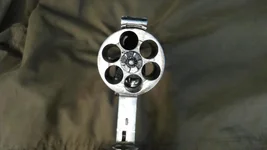
Interesting. It does have the Crown over B in the trigger guard, and just about visible on the face of the cylinder. I don't see any broad arrows though. The SN on upper and lower frame match.

I don't suppose there's any hope that some markings might have been obscured by the nickel plate and could be revealed by its removal?
 
From memory there should be a broad arrow on the cylinder at six o'clock to the "B" mark. But I may be mistaken. The cylinder numbers should be around the cylinder like the milling or letters on the edge of a coin at the rear, breech, end. There should also be the broad arrow on the breech shield. That's the bit that slides into the frame. From as fitted this would be from the factory a straw yellow colour from the hardening temperature.

If there are no numbers around the rear circumference of the cylinder two possibilities. Either a replacement cylinder. That's perfectly possible. Or the rear face was milled to take .45 ACP in clips or cut down .45 Colt cases. In either case I'd reckon that the stamped "B" would have been lost in that process. So, if no numbers, maybe a replacement cylinder?
 
I've seen nickel plate Colt .455 New Service revolvers...done later...and the markings remained well clear and visible. Also if not India the nickel plate seems to have been popular in Canada where it was just wet and snowy...like presently.
 
Very interesting, and brings back memories of my first handgun, a Webley .455 which I purchased at age twelve, in the days of mail order, no background check. I would trade this or that. I could get ammunition for it the same place as for my .303 Jungle Carbine: an old sporting goods store downtown (17 miles from the farm ), with the finish worn off the floors and cabinets, a wood stove for heat, very high ceilings with an old fan for the summer heat, dusty heads of wild boar, lion, cape buffalo, wooden crates of odd lot ammunition stripped out of magazines, two cents a round.

You should see if you can find a .38 Webley at a gun show or private sale, as some of those came in a decade back, from Canada, and in good condition.
 
Coming from Canada is something I hadn't even thought of, but makes perfect sense.

My guess, and it is purely a guess, is that the gun was probably fairly well beaten up before it was plated. The plating job looks poor to me, but I am no expert on how well these things should last.

I asked at one local gun store about the possibility of re-finishing, and all he wanted to talk about was sandblasting - but surely nickel plate is applied electrochemically - so presumably could be removed the same way?
 
Very interesting, and brings back memories of my first handgun, a Webley .455 which I purchased at age twelve, in the days of mail order, no background check. I would trade this or that. I could get ammunition for it the same place as for my .303 Jungle Carbine: an old sporting goods store downtown (17 miles from the farm ), with the finish worn off the floors and cabinets, a wood stove for heat, very high ceilings with an old fan for the summer heat, dusty heads of wild boar, lion, cape buffalo, wooden crates of odd lot ammunition stripped out of magazines, two cents a round.

You should see if you can find a .38 Webley at a gun show or private sale, as some of those came in a decade back, from Canada, and in good condition.

Funnily enough, same LGS where I asked about re-finishing has a 38 Webley, has the bobbed hammer (No2?), and he wants far too much for it! (By which I mean he wants more than I am willing/able to pay, not necessarily that he's greedy).

I like guns with a feel of history - and I don't mind taking the time and trouble to feed them. Finding a a bullet to replicate a MkIII load is going to be a challenge though 220ish gn all lead .455 HB HP.... *That* is long grass project!
 
Century International, which sits in New York, just across the water from Canada, brought in Webley revolvers, Inglis Browning High Power pistols, Savage-built Enfields No.4 Mk1, and C1A1s which had been refurbished after the Falklands (with their older barrels, stocks, slings, complete lower receivers, firing pins, etc, as take off ). They refinished some of the Webleys and blackened them, so the walnut hull blasting cut down some of the markings. But you might give them a call about how they did it, and spare parts.

With all the .45 ACP and .45 Colt shooters in the USA, there are plenty of sources for cast and swaged bullets, from 200 to 265 grains. And there are lots of bullet molds and sizing dies, too.

These bullets are hand cast from the RCBS mold 45-265-RN-HB (item #RCB57920) out of 20-1 Alloy and lubed with SPG. Get that 455 Webley shooting.
.455" Webley Bullets|Webley Cast Bullets
[SUB][SUP]
[/SUP][/SUB]
 
Last edited:
Century International, which sits in New York, just across the water from Canada, brought in Webley revolvers, Inglis Browning High Power pistols, Savage-built Enfields No.4 Mk1, and C1A1s which had been refurbished after the Falklands (with their older barrels, stocks, slings, complete lower receivers, firing pins, etc, as take off ). They refinished some of the Webleys and blackened them, so the walnut hull blasting cut down some of the markings. But you might give them a call about how they did it, and spare parts.

With all the .45 ACP and .45 Colt shooters in the USA, there are plenty of sources for cast and swaged bullets, from 200 to 265 grains. And there are lots of bullet molds and sizing dies, too.

These bullets are hand cast from the RCBS mold 45-265-RN-HB (item #RCB57920) out of 20-1 Alloy and lubed with SPG. Get that 455 Webley shooting.
.455" Webley Bullets|Webley Cast Bullets
[SUB][/SUB]

Thanks for the link - I'll look into that when I have some dies. I have the brass, I have CCI small pistol primers, and I have a 1lb of Unique - which looks like a suitable candidate powder. At least to begin with. What I won't be doing is casting. Not because wouldn't want to, but I have to be realistic about about how many subdivisions I can devote to my hobby at the moment.

To go back to my original question - am I being absurdly quixotic even considering trying to have the nickel-plate removed/replaced? And, is there a sensible way of returning it to something more like the "factory" appearance described by enfieldspares above?
 
I know i asked this before, but can .45 lc brass not be adapted ? Someone said the rim is too thick on the colt brass, but an hour or two on a model makers lathe and you would thin the rim down on scores of them.
 
Back
Top