Too much stropping?

Triggermortis

Well-Known Member
So you've spent ages sharpening your favourite stalking knife as far as you can on a stone of your choice, now it's time to strop it for the final finish, so how much to strop and when to stop?
come to that what do you use to strop with?
i recon to strop till it will cut paper and shave hairs on me arm, do you think a knife can be over sharpened?
To strop my knives i have a piece of leather glued to a piece of corrian worktop and impregnated with car engine valve grinding paste, its dirt cheap and works better than anything else on the market
 
So you've spent ages sharpening your favourite stalking knife as far as you can on a stone of your choice, now it's time to strop it for the final finish, so how much to strop and when to stop?
come to that what do you use to strop with?
i recon to strop till it will cut paper and shave hairs on me arm, do you think a knife can be over sharpened?
To strop my knives i have a piece of leather glued to a piece of corrian worktop and impregnated with car engine valve grinding paste, its dirt cheap and works better than anything else on the market

That sounds very coarse for stropping. I am only only looking to burnish off the wire edge rather than any grinding at that stage, so I use a polishing abrasive rather than a grinding one.

I have an old cut throat razor strop, with a hook at one and a handle at the other...the sort with one side leather and one side canvas. I use Autosol polish on it for stropping.

Alternatively for a real mirror strop, I use Menzerna P175 on a buffing wheel.... that is rated at Cut Factor 1 and Gloss factor 9.5.

The basic Tripoli polishing compound is rated at Cut Factor 6 and Gloss Factor 5, so your valve grinding paste must be off the scale for Cut Factor, and with 0 Gloss factor.

Alan
 
Last edited:
tried metal polish, lapping compound, jewlers rouge, honing paste, diamond paste, scouring cream,and even toothpaste

If none of those were effective it would appear that your final sharpening stone is too coarse.

I only use any gunk on the leather to keep that lubricated and just refine the edge/surface with a little polish. The strop is really about taking off the feather or wired edge produced by sharpening stone by flexing it back and forth. My furniture maker father always used to strop his chisels and plane blades on the palm of his hand.

Alan
 
That sounds very coarse for stropping. I am only only looking to burnish off the wire edge rather than any grinding at that stage, so I use a polishing abrasive rather than a grinding one.

I have an old cut throat razor strop, with a hook at one and a handle at the other...the sort with one side leather and one side canvas. I use Autosol polish on it for stropping.

Alternatively for a real mirror strop, I use Menzerna P175 on a buffing wheel.... that is rated at Cut Factor 1 and Gloss factor 9.5.

The basic Tripoli polishing compound is rated at Cut Factor 6 and Gloss Factor 5, so your valve grinding paste must be off the scale for Cut Factor, and with 0 Gloss factor.

Alan

how do you measure the cut and gloss factor, what device, method, scale or instrument do you use?
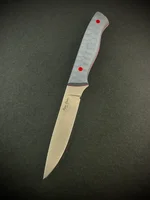
all i can say is this knife shaves my arm on the first stroke and the edge is very shiney but i have to say i use it to cut things not to check i've combed my hair straight.
IMG_0845.webp
 
You could argue that the right use of staged stones will negate the need to strop at all but in practice, it does help to refine the surface area of the bevel that the stone has created, as well as removing any minor burrs that less than perfect sharpening has left behind.

I don't think there is right and wrong really. Whatever suits the application, the type of knife, what it will be used for etc.

For example, I don't use stones or sharpening systems for a scandi grind. I use graduated grits of sandpaper duck taped to a raised piece of granite. I stop at 2500 grit which is getting close to a shiny mirror finish but not quite. It is very very sharp though. I don't strop a scandi as unless you pay attention, it is quite easy to put the tiniest micro bevel on the edge you have just spent so long perfecting. That goes against the point of a scandi.

My chef knife rarely sees a stone for touch up but just is given a good few strokes on my bare leather strop after cleaning/drying and also just prior to use. That keeps it perfect for its use. Every so often I damage it hitting a bone by mistake or something like that which requires some recover work, so out come the stones. A cheapo coarse stone to fix the damage and then working through 1000, 3000 and 6000 grit. Apart from that, bare leather suffices for months at a time. I don't need anymore abrasion than the leather provides but that is just the way I do it.

Very small blades with a hilt or bolster that I find get in the way of easy sharpening on a stone, I tend to use a little Gatco system for sharpening. It is easy to do and puts a good enough edge on any blade without the hassle and mess of stones. As satisfying as it is, I don't need to drop the blade through paper, so these just remain usable for what I need. Namely everyday tasks or hocking rabbits legs or opening a box or just stuff that need a basic reliable edge.

So I suppose there is no real answer. Just what suits the application for the individual user.
 
how do you measure the cut and gloss factor, what device, method, scale or instrument do you use?
all i can say is this knife shaves my arm on the first stroke and the edge is very shiney but i have to say i use it to cut things not to check i've combed my hair straight.
View attachment 101158

Personally I don't use anything to grade it...'tis just the manufacturer's rating...and I don't know what they use, presumably it is a combination of grit size and the reflectivity/refraction of a standard material surface.

The final polish can make a large difference to the cut...you might find that as you are still needing to use a grinding paste as final pass to get it sharp with your current set up, the edge would be even better with a second/subsequent strop using one of the finer grade polishing compounds you tried and rejected previously.

But as I suggested earlier, a finer grade sharpening stone would probably remove the need for the grinding paste stage altogether.

Alan
 
Very interesting what you say about putting a micro bevel on an edge Cottis, maybe then what i use and the way i sharpen at the minute is enough for what i need?
maybe that i dont need to go any further, so this begs the question, can you have a knife "too sharp" in that the sharper it is the easier it is to loose the edge and the quicker you need to re strop it?
Think i'll have a go and see if i can get away with just stropping as you suggest and see how long the edge lasts?
 
As you say if it is sharp enough for your purpose and you can get there efficiently what more could you want?

For our kitchen knives I use a DMT triangular Diamond Sharpener. Which has a blue 325 mesh/µ45 face, a red 600 mesh/µ25 face and then a ceramic µ7 face for polishing...most of the knives are fine for even soft tomato slicing if just left from the red face, but some of the softer steel ones are improved by stropping.

My Mora knives for gralloching I wipe over with the red, ceramic and then either strop or buff after every use/outing.

Alan
 
1000, 4000, 6000 waterstones followed by leather strop for my scandi blades. [No polish or anything added to strop, but regular use appears to have improved its ability to deliver a clean edge. I guess there is a build up of some super fine abrasive clag in the leather from repeated use]
 
I suppose what I was trying to get at is that if you are using such a coarse abrasive as valve carborundum it is not what is usually understood as "stropping"...it is still more of a grinding process. The fact that the abrasive is held by the leather rather than on emery paper, cloth or in a solid stone form doesn't make it a stropping process...which usually describes the removal of the wire edge and refining the ground surface by polishing. Maybe just semantics, I guess strop comes from strap, so the use of leather may trump the actual degree or type of effect on the metal.

Alan
 
I've had a lifetime of stropping all sorts of larger edge tools on the palm of my hand and that works just fine without any abrasive.

For small knives I use an old piece of leather stuck on a paddle board for ease. One side has a bit of industrial green polishing compound or Dialux hard metal compound or some Starkie Sharp honing compound. The other side of the paddle board has another piece of the same leather without any compound. I find that in general my field knives are finished on 4000 grit stones with a waterstone paste applied which makes it more like 5000 or even 6000, then compound impregnated paddle board then plain leather paddle board. Some knives are only paddle boarded for a whole year without ever touching a stone unless they are nicked. These knives are sharp, very sharp, I use them to shave any dead skin off my feet (yes it does sound disgusting but it works and keep my feet nice!). For a finer finish I have some old superfine stones for razors which take it up a level and the stop is only bare leather (no compound) to maintain the edge accuracy on the scandi.
 
So you've spent ages sharpening your favourite stalking knife as far as you can on a stone of your choice, now it's time to strop it for the final finish, so how much to strop and when to stop?
come to that what do you use to strop with?
i recon to strop till it will cut paper and shave hairs on me arm, do you think a knife can be over sharpened?
To strop my knives i have a piece of leather glued to a piece of corrian worktop and impregnated with car engine valve grinding paste, its dirt cheap and works better than anything else on the market

Sounds to me as if your doing something wrong.
Knives should come off the stone sharp enough to cut paper or shave your arm.
Stropping should be used to sharpen a slightly dulled edge after use.

Neil.
 
Oops. I'm on the wrong thread. When I first read the title I thought you were all talking about my wife . . . . :scared: :coat:
 
how do you measure the cut and gloss factor, what device, method, scale or instrument do you use?
all i can say is this knife shaves my arm on the first stroke and the edge is very shiney but i have to say i use it to cut things not to check i've combed my hair straight.
View attachment 101158

Sharpness is tested with machines that are designed and calibrated to do so but obviously most would never need to use one. They use the BESS or Brabacher Edge Shapness Scale which is measured by the blade cutting a pre-calibrated wire on the machine in order to give the sharpness.

If you want to do a few simple tests for sharpness the levels.

Before stropping just shine a light along the edge, if you can see light reflected it is still dull and needs work done before stropping.

Try photocopier paper, if it cuts that without dragging it is sharp. Then as your go further the knife would be able to shave tiny slivers off the edge of the paper. Next if it can cut a receipt paper it is very sharp and finally Rizla papers, if your cutting that it is shaper than a Gillette razor which is achievable with the best quality super fine steels which hold the edge when it is that thin, about .1 of a micron and under.

Most times it should only take a few passes over a strop to achieve a good edge on a pre-sharpened knife ie. a stone or sharpening system. Lots of stropping tends to be counter productive and 9 times out of 10 those few stropping passes with do the trick. Experiment with the pressure, normally just the weight of the knife is needed.

As already mentioned there of stropping compounds such as bar polish compounds of various grade which are good but sometimes difficult to apply but this can be made easier by a drop of baby oil on the surface of the strop. Autosol as mentioned is good and I sometimes use this. For general purpose and harder steels Chromium Oxide which comes in powder forms, paste and bar is good. Finally diamond compounds cut fast and available in some extremely fine grades, I am using .5 micron at the moment and just bought some 5 and .25 to try as well.
 
Last edited:
One of the products we had running in my previous jobs were ceramic knives. We also had the last sharpening process similar to what stropping does. Looking very closely at blade cross-sections one can measure the angle change in a blade at the cutting edge. In our case we went from around 28-29deg to over 50deg. Too much "stopping" and the blade lasted longer but did not seem as sharp. Without that step the blade was too sensitive. Recon on a steel blade one has to very careful that the stropping is not done in such a way that the curve of the "leather" due to too high pressure can run cross ways over the cutting edge.
For my hunting knives I shape the blade on a grinder, then use an Aluminium oxide rod which has to be cleaned every now and then. My final stage is a sintered silicone carbide tube that is extremely fine. This material seems like magic to blades and the knives will shave no problem.
edi
 
I'd consider changing a floppy strop to a strop-on-a-paddleboard so you can hold the angle the same as you did on the stones - but the strokes towards the edge obviously. The whole valve grinding paste has me baffled, I can only suggest the knife was not sharp and stone honed before the strop process is started.
 
Back
Top