DIY Annealer - the journey begins...

zambezi

Well-Known Member
Reloading is an addictive hobby. I did not realise that until too late. If you love shooting in any form, being able to prep the cartridges that are going to improve your performance is attractive.

And now that I have almost exhausted all my once-fired brass, I need to start thinking about case longevity, safety and consistency of neck-tension for accuracy as I re-use them again. Annealing will be in that mix. Wonderfully there is a wealth of info on both SD and YT. On SD, search for posts by Alantoo amongst others.

On YT there are many DIY annealer projects. Some crude, some elaborate, and some craftable via very moderate DIY skills. I plan to build one from the latter category.

A speed regulated DC motor is the centerpiece of the rotary drum designs. It is a simple concept: adjust the time it takes to complete one revolution to match the optimum time a piece of brass should sit in a flame to reach your target temperature.

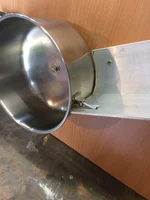
A little while back I bought a hobbyist's belt sander for fine metalwork. It has a variable speed DC motor to drive the belt. I reckon I can modify that bit of kit so that it can perform annealing duties when not in use as a belt sander. The "drum" will be a re-cyled pot my wife discarded years ago [she thinks things she throws out go up the dump. lol. Mostly things go into a holding pattern in my allsorts hopper in the garage], and a piece of ally angle will supply the loading ramp.

IMG_4170.JPG IMG_4171.JPG
 
I'm looking forward to seeing how this progresses. I really enjoy projects such as this. Good luck with it! :thumb:
 
Looking forward to see how you get on.. The rotary pan, popularly know as the "Skippy annealer" has been around a good while and is a proven design with hundreds of good homebuilds working well.
Personally I would buy a dedicated motor rather than use your belt sander motor. There is very little power needed to drive the drum, a 12v DC geared motor is less than a tenner and a PWM DC motor speed controller only about a fiver.

Here are a couple of my annealers made in my home workshop.


I like the simplicity of the Skippy annealer concept. However it isn't easy to adjust for extremes of case length without swapping the pan,,,,, other than making the pan deep enough for the longest cases and inserting packing rings to deal with the shorter cases.
Have fun developing it.
Ian
 
First attempt at marrying the belt sander motor to the rotary drum illustrated something that was not initially apparent: the radial speed of the motor [even at its slowest setting is too quick. The directly mounted drum whips round. My guess is that I would need a minimum ¼ VR adjustment to that spindle speed, so the motor pulley would need to drive a drum pulley whose diameter is about 12cm diameter. A pulley wheel of those dimensions will not fit the belt sander chassis.

So I think I will park the belt sander modification strategy and go with dedicated hardware per 1066's advice above. One other up-cycle idea I saw on YT is the use of the motor in a microwave oven. I like the idea of re-use of discarded hardware and will take a look next I am up the tip.

IMG_4174.webp IMG_4175.webp IMG_4176.webp

it isn't easy to adjust for extremes of case length without swapping the pan

Yorric, I had hoped to cut the drum so one-size-fits-all. How I intended that to work is by canting the drum backward. Given that the heaviest part of any case is the head end, a canted drum should support all lengths of case even where only ½ the length of the case is supported. In that way, I should be able to run 6.5x55 to .375 all in same pan.

If all my plans come to nought, how much do you want for the top unit in your post 1066? ;)
 
With a direct drive to the pan, you will need a motor/gearbox with an adjustable speed of around 5 to 15 rpm. This is easily achieved with something like this:

The speed controller, with or without a digital readout for the speed could be something like this:


I would also suggest a square bottom pan, I think the cases would tend to walk up the curve a little in "hunting" mode and give inconsistent annealing with a rounded base.

Something like this from your local discount store would fit the bill:
 
suggest a square bottom pan, I think the cases would tend to walk up the curve a little in "hunting" mode and give inconsistent annealing with a rounded base

First up, thanks for the links.

With regard to the pot profile, I had given thought to the possibility that the curve might promote some hunting and the solution in my mind's eye was to either have a chamfered guide at the end [bad drawing below] of the stay bar and/or rotate the case nearer the 4 o'clock position on the drum in which position the case is cradled in a V between stay and pan. Alternatively, I could drop a plywood insert to sit 4mm above the pot base to ensure a 90˚ profile where the case head rests.

But having drilled the pot already, I will first trial it as-is.

a.webp
 
First up, thanks for the links.

With regard to the pot profile, I had given thought to the possibility that the curve might promote some hunting and the solution in my mind's eye was to either have a chamfered guide at the end [bad drawing below] of the stay bar and/or rotate the case nearer the 4 o'clock position on the drum in which position the case is cradled in a V between stay and pan. Alternatively, I could drop a plywood insert to sit 4mm above the pot base to ensure a 90˚ profile where the case head rests.

But having drilled the pot already, I will first trial it as-is.

That looks like it will do ok. The case stop rod will be in the flame the whole time so stainless steel would be better to cut down on heat transfer.
 
This fella has sold a good number on ukvarminting he gets good reports and the price looks reasonable. his username is
raptor calls


There's a couple of issues with these. Firstly, you need a few discs for different calibers, which ups the cost. Secondly, there is no timer, so it's always a case of best guess every time it's used. If you can get a display to feedback precise dwell times it makes repeating the process easier, although for real precision and repeatability there also needs to be pressure gauge on the gas supply.
 
There's a couple of issues with these. Firstly, you need a few discs for different calibers, which ups the cost. Secondly, there is no timer, so it's always a case of best guess every time it's used. If you can get a display to feedback precise dwell times it makes repeating the process easier, although for real precision and repeatability there also needs to be pressure gauge on the gas supply.

maker says it has adjustable timer.
The machine is made of stainless steel.

It is very simple to operate and performs very well.

The disc plates holding the cases are interchangeable for the different calibers and are replaced by removing couple of thumb screws on top.

The annealing time could be set simply by turning a potentiometer and varies between 2 and 16 seconds, depending on your certain requirements.

During the process, the case is being moved in front of the flame and lands on a base, which spins it to an 80 RPM, ensuring even and fast heating of the neck.


I believe most people order the appropriate calibre discs at the time of purchase, to save costs.
the reviews seem to suggest happy customers.
 
As long as you just need for one caliber it's okay. Although the point about the timer is, if you have a feedback (display) in seconds, rather than an arbitrary number, or in this case, nothing, it makes the job easier.

For the money they're okay though.

I anneal 17 hornet, 22 hornet, 223, 243, 260, 308, 25-06, 45-70, 338 all on the same turntable, no disc change. You can see why I made my own!
 
Last edited:
OK...after a brief detour to make a knife, I am back to fabricating the annealer. I do not yet have a preferred motor/controller solution but realise that is the final step. Perfecting the hopper, drum and single shell dispenser can take place before considering any of that.

Here's the idea. Please bear with the poor drawing skills. What differentiates this design from many seen on YT is the means by which one case is released to the drum from the hopper per rotation. I plan to use a cam actuated seesaw operating a high and low gate on the feeder ramp. So gate one rises through the ramp and separates the lowest case from all others. Shortly after, the high gate rises far enough to let that case proceed to the drum.

DIY_plan.webp

IMG_4530.webpThe bearing for the drumIMG_4534.webpIMG_4534.webp
IMG_4533.webp

IMG_4531.webp
 
Hears mine, 17hornet made whilst in lockdown, may as use the time usefully.
Not shown in photo is a simple cheap 12v dc motor speed controller, very cheap to make and so far looks to be working well.
 

Attachments

  • 9813F00E-35CB-49A1-94D2-0A9549E32AE0.webp
    9813F00E-35CB-49A1-94D2-0A9549E32AE0.webp
    196.8 KB · Views: 51
Dog dish?

One of the wife's old saucepans. The handle disintegrated/got burnt. Either way she chucked it out a while back. As with so much she throws out, this was retrieved from the bins and placed in the "possibles" bin in my garage. :) The handle fixing point has a captive nut which plays into my bolt-as-adjustible-cam lever actuator.
 
I built one of the same a while back, ended up giving it to a mate in Yorkshire,

I use a drill and a torch with a set of long sockets for both the 6mmbr 20 tac and 243.

bob.
 
Back
Top