Hi all,
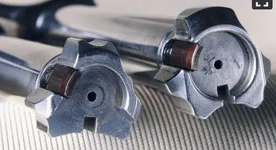
I'm sure the title of this thread will shock many, but when looking at the former flagship models of Sako I can see why they came out with the new S20.
First, a bit of history. The 75 (debut 1996) and 85 (debut 2006) rifles are named after the anniversary years of SAKO, the legendary Finnish rifle manufacturer.
Both rifles have a good reputation, but having studied some literature (S Otterson & J Carmichel) that took rifle design into account, I looked at the strengths and flaws of each action. In summary, the old Sako's don't hold up to the 'crossover' expectations that modern consumers have. This is evident when you look at the marketing of the S20 which presents itself as being both hunting and range capable (although Hunter and Precision stocking options are available).
I understand that the title of this thread is provocative, and many 75 and 85 owners (I don't own either but have used both) will be up in arms. My objective here is a factual evaluation of the features of these rifles with short comparisons between all three (75, 85 and S20). I have not seen, handled or used an S20, so please consider this evaluation to be theoretical.
1. The bolt
All of these actions pride themselves on the three lug rotating bolt, a feature which is carried by the TRG line as well.The principal benefits of the three lug design over two lug variants are are a lowered bolt lift (60 vs 90 degrees, although this is reduced on some two lug designs) and theoretical increase in safety if a locking lug was to fail. Whilst these are benefits, they come at a cost as the third lug is required to ride through the top of the receiver, increasing the amount of machining required and theoretically reducing the overall rigidity of the action.
The bolt design of 85 deviates in a major way from the 75 and S20 as it features a pseudo controlled round feed. See the photo and video below.
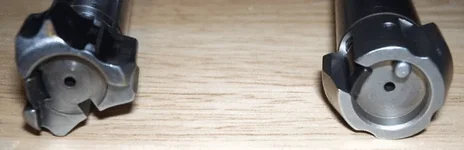
The 85 bolt face on the left and 75 on the right.
Why would I claim it is not a 'real' controlled round feed? Firstly, it lacks the principal feature which is often touted as the cornerstone of CRF reliability, an oversize, non-rotating claw type extractor which is seen on the Mauser 1898, more recent iterations of this design can be seen on the CZ 527 and Ruger M77 MKII actions. Furthermore, unlike a true CRF action, the bolt of the 85 still pushes the round forward and out of the magazine before the extractor clips onto the extraction groove of the case. Whilst this is not necessarily bad (the pre-64 Model 70 uses the same concept), it does not provide full control over the case throughout the bolt's range of motion.
The principal flaw of the 85's bolt is the 6 o'clock fixed ejector position. This ejects the case upwards, which is not problematic in itself until a scope is mounted over the receiver bridge. Under certain conditions this can cause the case to fall back into the action, requiring it to be cleared before another round can be cycled. This issue is particularly prevalent with the 'long action' lengths (M,L and XL). The telltale sign of this occurring is a mark on the underside of the scope and dented case mouths and necks.
The 75 and S20 feature a plunger style ejector which is positioned to eject cases to the side of the action.
The S20 is notable in design as it now features a removable/interchangeable bolt handle ala the Sako Quad. No doubt this has been done to alleviate the need for permanent modification of the bolt handle which was required if an aftermarket bolt knob was to be fitted to the 75 or 85 which have integral handles.
2.The receiver
2.1- Action sizing
Both the Sako 75 & 85 offered a variety of action lengths. These were usually grouped within categories (small rifle, short action, long action and magnum) effectively providing the user with an ideal bolt travel and magazine size. However, from a manufacturing perspective, you are effectively making four variants of the design which have different stock and bolt lengths, and thus increasing costs. I believe the S20 has eliminated this feature and now comes in one length only.
2.2- Scope Mounting & loading
The 75 and 85 actions are both 'open topped' receivers with integral tapered dovetails. These were designed to mate with the Optilock mounts offered by SAKO which are by no means a bad mounting system. The principal benefit of the 'open top' is the ability to load cartridges into the magazine directly when the bolt is open, without having to remove the magazine. However, this feature has been eliminated on the S20 with its 'closed top' design. This was done to allow for an integral picatinny interface on the top of the receiver, but unfortunately the implementation of this concept seems flawed as there is still an 'open' portion between the interfaces, a better direction would have been to utilise the continuous integral dovetail as seen on the TRG or Tikka T3 series of rifles, removing the need for a base and allowing for direct mounting of the scope.
See below for the S20 mount which still features a 'base', the opportunity to include a scope tube levelling system ala Sphur or Tier One has also been lost.
2.3- Magazine
Both the 75 and 85 series feature a flush fit, all metal, double stack, double feed type magazine, which is required for effective 'top loading' of the action. The 75 offered a 'Deluxe' variant which replace the magazine with a floorplate, I am unsure if the 85 did the same. The 85 will divide opinions again as its magazine retention system is perhaps too effective in certain situations, making it unnecessarily difficult to release.
The S20 is a marked departure as it is no longer a flush fit due to a single feed, single stack design. It also appears to be of plastic/polymer construction.
3.Bedding
The 75, 85 and S20 all take different directions in bedding, with the S20 being perhaps the most effective of the three as the designers have opted for an aluminium bedding block with three screws instead if the traditional 'recoil lug' design. This 'chassis' style interface has been popularised by aftermarket options from KRG and MDT, making it an obvious choice for ease of manufacture and consistency.
I won't comment too much on the bedding of the 75 & 85, but having removed each from the stock (wood and synthetic for the 85, synthetic only for the 75) I was not particularly impressed with either configuration. The recoil lug of the 75 is incredibly close to the action screw, whereas the 85 features an unnecessarily complex recoil lug interface/assembly along with a metal section in the rear tang area.
Conclusion
I have omitted the discussion of triggers here as I do not feel I can provide a suitable discussion and critique, not to mention that Sako's design of the trigger as a single unit allows for them to be removed with a single screw, and hence replaceable if so desired (and also at the users own risk!).
The release of the S20 was met with derision in some quarters, a feeling I shared until the current situation prompted me to look into the design of bolt actions with the hope of being able to identify beneficial design characteristics. The S20 fulfils several shortfalls of the 75 & 85 designs whilst creating some of its own, there will never be a 'perfect' action as the notion of perfection is a subjective concept. However, I do believe we can identify features that will be ideal for certain applications and hence beneficial to the user.
I hope you have enjoyed reading this and appreciate any feedback or criticisms of this piece. If I have omitted something or included an inaccurate statement pleas let me know.
Cheers!
I'm sure the title of this thread will shock many, but when looking at the former flagship models of Sako I can see why they came out with the new S20.
First, a bit of history. The 75 (debut 1996) and 85 (debut 2006) rifles are named after the anniversary years of SAKO, the legendary Finnish rifle manufacturer.
Both rifles have a good reputation, but having studied some literature (S Otterson & J Carmichel) that took rifle design into account, I looked at the strengths and flaws of each action. In summary, the old Sako's don't hold up to the 'crossover' expectations that modern consumers have. This is evident when you look at the marketing of the S20 which presents itself as being both hunting and range capable (although Hunter and Precision stocking options are available).
I understand that the title of this thread is provocative, and many 75 and 85 owners (I don't own either but have used both) will be up in arms. My objective here is a factual evaluation of the features of these rifles with short comparisons between all three (75, 85 and S20). I have not seen, handled or used an S20, so please consider this evaluation to be theoretical.
1. The bolt
All of these actions pride themselves on the three lug rotating bolt, a feature which is carried by the TRG line as well.The principal benefits of the three lug design over two lug variants are are a lowered bolt lift (60 vs 90 degrees, although this is reduced on some two lug designs) and theoretical increase in safety if a locking lug was to fail. Whilst these are benefits, they come at a cost as the third lug is required to ride through the top of the receiver, increasing the amount of machining required and theoretically reducing the overall rigidity of the action.
The bolt design of 85 deviates in a major way from the 75 and S20 as it features a pseudo controlled round feed. See the photo and video below.
The 85 bolt face on the left and 75 on the right.
Why would I claim it is not a 'real' controlled round feed? Firstly, it lacks the principal feature which is often touted as the cornerstone of CRF reliability, an oversize, non-rotating claw type extractor which is seen on the Mauser 1898, more recent iterations of this design can be seen on the CZ 527 and Ruger M77 MKII actions. Furthermore, unlike a true CRF action, the bolt of the 85 still pushes the round forward and out of the magazine before the extractor clips onto the extraction groove of the case. Whilst this is not necessarily bad (the pre-64 Model 70 uses the same concept), it does not provide full control over the case throughout the bolt's range of motion.
The principal flaw of the 85's bolt is the 6 o'clock fixed ejector position. This ejects the case upwards, which is not problematic in itself until a scope is mounted over the receiver bridge. Under certain conditions this can cause the case to fall back into the action, requiring it to be cleared before another round can be cycled. This issue is particularly prevalent with the 'long action' lengths (M,L and XL). The telltale sign of this occurring is a mark on the underside of the scope and dented case mouths and necks.
The 75 and S20 feature a plunger style ejector which is positioned to eject cases to the side of the action.
The S20 is notable in design as it now features a removable/interchangeable bolt handle ala the Sako Quad. No doubt this has been done to alleviate the need for permanent modification of the bolt handle which was required if an aftermarket bolt knob was to be fitted to the 75 or 85 which have integral handles.
2.The receiver
2.1- Action sizing
Both the Sako 75 & 85 offered a variety of action lengths. These were usually grouped within categories (small rifle, short action, long action and magnum) effectively providing the user with an ideal bolt travel and magazine size. However, from a manufacturing perspective, you are effectively making four variants of the design which have different stock and bolt lengths, and thus increasing costs. I believe the S20 has eliminated this feature and now comes in one length only.
2.2- Scope Mounting & loading
The 75 and 85 actions are both 'open topped' receivers with integral tapered dovetails. These were designed to mate with the Optilock mounts offered by SAKO which are by no means a bad mounting system. The principal benefit of the 'open top' is the ability to load cartridges into the magazine directly when the bolt is open, without having to remove the magazine. However, this feature has been eliminated on the S20 with its 'closed top' design. This was done to allow for an integral picatinny interface on the top of the receiver, but unfortunately the implementation of this concept seems flawed as there is still an 'open' portion between the interfaces, a better direction would have been to utilise the continuous integral dovetail as seen on the TRG or Tikka T3 series of rifles, removing the need for a base and allowing for direct mounting of the scope.
See below for the S20 mount which still features a 'base', the opportunity to include a scope tube levelling system ala Sphur or Tier One has also been lost.
2.3- Magazine
Both the 75 and 85 series feature a flush fit, all metal, double stack, double feed type magazine, which is required for effective 'top loading' of the action. The 75 offered a 'Deluxe' variant which replace the magazine with a floorplate, I am unsure if the 85 did the same. The 85 will divide opinions again as its magazine retention system is perhaps too effective in certain situations, making it unnecessarily difficult to release.
The S20 is a marked departure as it is no longer a flush fit due to a single feed, single stack design. It also appears to be of plastic/polymer construction.
3.Bedding
The 75, 85 and S20 all take different directions in bedding, with the S20 being perhaps the most effective of the three as the designers have opted for an aluminium bedding block with three screws instead if the traditional 'recoil lug' design. This 'chassis' style interface has been popularised by aftermarket options from KRG and MDT, making it an obvious choice for ease of manufacture and consistency.
I won't comment too much on the bedding of the 75 & 85, but having removed each from the stock (wood and synthetic for the 85, synthetic only for the 75) I was not particularly impressed with either configuration. The recoil lug of the 75 is incredibly close to the action screw, whereas the 85 features an unnecessarily complex recoil lug interface/assembly along with a metal section in the rear tang area.
Conclusion
I have omitted the discussion of triggers here as I do not feel I can provide a suitable discussion and critique, not to mention that Sako's design of the trigger as a single unit allows for them to be removed with a single screw, and hence replaceable if so desired (and also at the users own risk!).
The release of the S20 was met with derision in some quarters, a feeling I shared until the current situation prompted me to look into the design of bolt actions with the hope of being able to identify beneficial design characteristics. The S20 fulfils several shortfalls of the 75 & 85 designs whilst creating some of its own, there will never be a 'perfect' action as the notion of perfection is a subjective concept. However, I do believe we can identify features that will be ideal for certain applications and hence beneficial to the user.
I hope you have enjoyed reading this and appreciate any feedback or criticisms of this piece. If I have omitted something or included an inaccurate statement pleas let me know.
Cheers!


 as they are obviously no good