
Neil, have a google for Maldon and District air rifle club (MAD ARC), Rich the guy who runs it normally has loads of used equipment for sale at good prices, might be worth a shot.
You are using an out of date browser. It may not display this or other websites correctly.
You should upgrade or use an alternative browser.
You should upgrade or use an alternative browser.
Pcp air rifle. How are you filling?
- Thread starter trucraft
- Start date

Brittany boy
Well-Known Member
Who does the retest on the bottle every five years, and certifies the bottle safe and any idea how much it costs ?

bobthedug
Well-Known Member
My last 2 tests have been carried out at a diving equipment place called K dive in Coatbridge, LanarkshireWho does the retest on the bottle every five years, and certifies the bottle safe and any idea how much it costs ?
Guy that runs it is pro shooter and opens up at anti social hours. Well, before covid he did.
I'm sure my last test, certification and fill was around £45 ish.
Brittany boy
Well-Known Member
Ideal I’m in Ayrshire so take it any dive place should be able to do it if not I’ll look up yer man thanks. A lot 

Sonicdmb73
Well-Known Member
There’s a bit more to it than has been mentioned so far.Ideal I’m in Ayrshire so take it any dive place should be able to do it if not I’ll look up yer man thanks. A lot
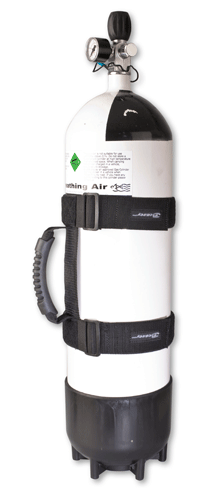
As far as testing goes it depends on what type of bottle you have. Or more precisely what valve. Dive bottles don’t have a gauge (it’s on the fill hose) and require testing every two and a half years. One is a hydro test, bottle is tested in a water tank for expansion. The other is a visual, the tester inspects the bottle but without the pressure test. If you have a bottle with a gauge fitted ie surface only (airgun) bottle test is every five years.
I prefer to have my bottles filled at a dive shop. The air is breathable quality therefore cleaner than many gunshop compressors put out.

diverdave
Well-Known Member
Having owned a dive company for a couple of decades and having a few scuba cylinders lying about i used them initially, then moved to a wee compressor. They are really sound units, just keep them cool, dont let them get too hot, that will kill them, they dont have a main bearing as such, so will burn themselves out if they get hot. However, a big compressors bearings cost more than this compressor, so no big deal i guess. They have a pressure release valve, and so really wont go bang, if they fail they will almost certainly just fizz angrily. They dont have a large container of high pressure air, so there is little to explode, the rifle cylinder would be far more risk. That said i am probably fairly relaxed about the little thing as my main compressor was a tad bigger and had a 10 cylinder bank, 10 x 84 L at 300 bar from memory, that would have made a fair old pop if it went. I did have a scuba cylinder blow its valve out once, that was unpleasant. The pressure wave blew all the finger tips out of a display of divers gloves, and burst all the light bulbs, how we laughed and laughed (not). It was so loud none of us heard it, if that makes sense, all we heard was all the ceiling tiles falling down and noise of the cylinder passing from the filling room into the office. Luckily the safety features kicked in. The filling room / area was baffled, all the safety doors blew open and the cylinders were secured. Though the security chain snapped it sapped all the energy. It was caused by a dodgy customer fitting , from memory an m25 valve into an mpt thread, or the other way round and then decanting a little air in, so the chap filling them had no way of knowing it was a bodged job. Anyway, the auto pressure cut out of the wee compressor is accurate, but it fills my hw 100 so quickly its not worth wondering off, i just fill it, let it cool, re fill and away i go. Filling a scuba cylinder is a slower process, and i fill it till the temp guage gets to 35 degrees and then let it cool and repeat, it would take a long time to top up a scuba cylinder, so i dont bother now. I dont tend to take 100's of shots when out anyway, so no big deal. Its not designed for that and a compressor made for filling scuba cylinders is 4-6 times more minimum. Hope this helps.

Friendly Boar
Well-Known Member
I use a dive bottle. Have to get it tested every 2 years for my SCUBA VALVE (5 years with a rifle fill valve) - cost £8 a refill that last long time.
my take on why i use a bottle is that if you’ve got an expensive set up ( I use mine for my FAC air rifle) that the air going into the rifles cylinder is dry. A compressors air or a manual pump won’t be dry/ as dry. The cylinder may not last as well and if you’ve got 220psi in it is it as secure/ safe. I may be out of touch but that’s my take on it and why I prefer the bottled divers air refill. Each to their own.
my take on why i use a bottle is that if you’ve got an expensive set up ( I use mine for my FAC air rifle) that the air going into the rifles cylinder is dry. A compressors air or a manual pump won’t be dry/ as dry. The cylinder may not last as well and if you’ve got 220psi in it is it as secure/ safe. I may be out of touch but that’s my take on it and why I prefer the bottled divers air refill. Each to their own.

It was the report of the moisture and oil filter threads stripping that I was thinking of. But I looked at and felt mine carefully and they seemed well engaged. My little compressor does have a brass disc blow off valve but I wouldn’t want to replace that every time I used the machine. The £20 extra for the adjustable pressure valve version seemed well worth it.
Alan
Alan
When I bought my first PCP there were only two options. A pump, or a dive bottle. I got on very well with the pump.
Chinese ones were not available back then.
Then I did a lot more shooting so "invested" in a steel cylinder with an airgun valve. Which I could get filled up, and when necessary retested, by a dive shop that was on my commute. No problem, apart from having to wait awhile when it was sent away for retest. The pump kept me going meanwhile.
When I bought my cylinder, there were only two viable options for 300 BAR. 7 litre or 12. Even then the dive shop rarely gave a full fill to 300 BAR.
The 7L was manageable to carry around, by car. The 12L, which I thought would be best, seemed not. So I have a 7L
There seems to have been a massive increase in interest in in PCPs in the USA, most of which is far from any coastline so has little if any infrastructure for serving divers. Hence their interest in compressors, and the flood of one basic design, from China, in its many variants.
If starting again, I would still do as I did, with a pump.
Then, if more serious, either a cylinder, if there was a local shop that could look after it, or a compressor. Most of which are not portable and ISTM of variable quality.
None of my rifles can manage more than about 100 shots before needing to be re-filled, fully, which soon goes by if plinking. Or taking somewhere to play with. This is when a cylinder is IMO still the best solution.
IMO a small compressor, not portable, is of limited application, except for home users.
If wanting to top up a dive bottle with it, then yes it might also do that, but I am a precautious person. And aware of how much damage an exploding cylinder could do. No, sheltering behind a garage door, or even a breezeblock wall, will not necessarily protect you much.
So, I continue to get my steel one filled and tested as and when needed. No reputable outfit will fill one up which is not in test. If buying second-hand, I would only ever choose one with a recent test. Which, last time cost me about £50, for five years. If topping up from a compressor I would still carry on getting it re-tested, for my own peace of mind. If the compressor blows, no big deal. But if the cylinder went, that could be very nasty.
Nowadays light weight composite ones are available, thin aluminium liner wrapped in some mix of carbon/kevlar/glass fibres, but they have a finite life, maybe 15 years from manufacturing date, before officially they must be scrapped. There are probably good reasons for this. Steel ones have no such limitation on life.
Chinese ones were not available back then.
Then I did a lot more shooting so "invested" in a steel cylinder with an airgun valve. Which I could get filled up, and when necessary retested, by a dive shop that was on my commute. No problem, apart from having to wait awhile when it was sent away for retest. The pump kept me going meanwhile.
When I bought my cylinder, there were only two viable options for 300 BAR. 7 litre or 12. Even then the dive shop rarely gave a full fill to 300 BAR.
The 7L was manageable to carry around, by car. The 12L, which I thought would be best, seemed not. So I have a 7L
There seems to have been a massive increase in interest in in PCPs in the USA, most of which is far from any coastline so has little if any infrastructure for serving divers. Hence their interest in compressors, and the flood of one basic design, from China, in its many variants.
If starting again, I would still do as I did, with a pump.
Then, if more serious, either a cylinder, if there was a local shop that could look after it, or a compressor. Most of which are not portable and ISTM of variable quality.
None of my rifles can manage more than about 100 shots before needing to be re-filled, fully, which soon goes by if plinking. Or taking somewhere to play with. This is when a cylinder is IMO still the best solution.
IMO a small compressor, not portable, is of limited application, except for home users.
If wanting to top up a dive bottle with it, then yes it might also do that, but I am a precautious person. And aware of how much damage an exploding cylinder could do. No, sheltering behind a garage door, or even a breezeblock wall, will not necessarily protect you much.
So, I continue to get my steel one filled and tested as and when needed. No reputable outfit will fill one up which is not in test. If buying second-hand, I would only ever choose one with a recent test. Which, last time cost me about £50, for five years. If topping up from a compressor I would still carry on getting it re-tested, for my own peace of mind. If the compressor blows, no big deal. But if the cylinder went, that could be very nasty.
Nowadays light weight composite ones are available, thin aluminium liner wrapped in some mix of carbon/kevlar/glass fibres, but they have a finite life, maybe 15 years from manufacturing date, before officially they must be scrapped. There are probably good reasons for this. Steel ones have no such limitation on life.
Brittany boy
Well-Known Member
Having read diverdave’s post I think I’ll keep my air bottle in the garage. The bottle I have came with the AA510 second hand and I didn’t get a test cert. and took it that it was less than 5 years old. I’ve just checked the bottle manufactured 01/2016 so I take it next time I go for a refill I would be refused and need to get it tested first?
Sonicdmb73
Well-Known Member
I think you’re missing a digit or using the wrong unit for pressure.I use a dive bottle. Have to get it tested every 2 years for my SCUBA VALVE (5 years with a rifle fill valve) - cost £8 a refill that last long time.
my take on why i use a bottle is that if you’ve got an expensive set up ( I use mine for my FAC air rifle) that the air going into the rifles cylinder is dry. A compressors air or a manual pump won’t be dry/ as dry. The cylinder may not last as well and if you’ve got 220psi in it is it as secure/ safe. I may be out of touch but that’s my take on it and why I prefer the bottled divers air refill. Each to their own.
Are you filling to 220bar? Or 2200psi perhaps?
I fill my rifle with 180bar and refill at 150bar it gives me the most accurate fifty or so shots (5p piece at 45yards).
Yes you will need a test. I bought my bottle secondhand I didn’t get a certificate. It was more than five years old and the label showing the last test was damaged. So nobody would fill it. At the time there was a local guy however he has closed his dive business. Sold the compressor and testing kit. Just had some secondhand bottles and a few bits of dive gear left to sell. Didn’t help me with my bottles though.Having read diverdave’s post I think I’ll keep my air bottle in the garage. The bottle I have came with the AA510 second hand and I didn’t get a test cert. and took it that it was less than 5 years old. I’ve just checked the bottle manufactured 01/2016 so I take it next time I go for a refill I would be refused and need to get it tested first?
Fortunately the local RFD filled my smaller bottle wouldn’t do the larger one as his gear is upstairs. H&S apparently, but hey ho I do at least have enough charge to deal with some pigeons round the building’s.
I use a dive bottle. Have to get it tested every 2 years for my SCUBA VALVE (5 years with a rifle fill valve) - cost £8 a refill that last long time.
my take on why i use a bottle is that if you’ve got an expensive set up ( I use mine for my FAC air rifle) that the air going into the rifles cylinder is dry. A compressors air or a manual pump won’t be dry/ as dry. The cylinder may not last as well and if you’ve got 220psi in it is it as secure/ safe. I may be out of touch but that’s my take on it and why I prefer the bottled divers air refill. Each to their own.
Ahem, you may be thinking of BAR, not PSI. Multiply approximately 14.5. So 220 BAR is 3190 PSI. That is 1.6 tons per square inch.
Put it another way, My 7 litre Faber steel cylinder is, according to a quick Google, about 24" long by 5.5" diameter. That is very approximately 570 square inches of surface, resisting a bursting force of about of 1,100 tonnes at 300 BAR. If it lets go, at wherever is the weakest point, that is never going to end happily.
Think on't that.
Likewise air rifle tubes and bottles. And some other things made of cheap aluminium. Which fatigue. Far more so than good steel. However steel can rust internally, which is why dive cylinders with dive valves that have maybe had a few wet fills, get an internal visual inspection every 2.5 years, and if necessary a shot blast, at extra cost. Also why dive valves have an extension so that, even if the cylinder has some water in it, that might not get into the regulator, whatever their position.
Persons topping them up with cheap compressors with little if any filtering, might, just might, run into similar problems. But, hey ho, stand them upside down, open an airgun valve to blow out any such water (not possible with a dive valve), and call it good.
FWIW, a proper test will be be ground onto the cylinder at the top then punched with the date, and test house identification. Not on a sticker. No paper certificate needed (never had one either). A reputable re-filler will just take a look at that, then accept or reject.
Of course these things could also be forged. Another reason to just buy new.
Last edited:
Friendly Boar
Well-Known Member
Ahem, you may be thinking of BAR, not PSI. Multiply approximately 14.5. So 220 BAR is 3190 PSI. That is 1.6 tons per square inch.
Put it another way, My 7 litre Faber steel cylinder is, according to a quick Google, about 24" long by 5.5" diameter. That is very approximately 570 square inches of surface, resisting a bursting force of about of 1,100 tonnes at 300 BAR. If it lets go, at wherever is the weakest point, that is never going to end happily.
Think on't that.
Likewise air rifle tubes and bottles. And some other things made of cheap aluminium. Which fatigue. Far more so than good steel. However steel can rust internally, which is why dive cylinders with dive valves that have maybe had a few wet fills, get an internal visual inspection every 2.5 years, and if necessary a shot blast, at extra cost. Also why dive valves have an extension so that, even if the cylinder has some water in it, that might not get into the regulator, whatever their position.
Persons topping them up with cheap compressors with little if any filtering, might, just might, run into similar problems. But, hey ho, stand them upside down, open an airgun valve to blow out any such water (not possible with a dive valve), and call it good.
FWIW, a proper test will be be ground onto the cylinder at the top then punched with the date, and test house identification. Not on a sticker. No paper certificate needed (never had one either). A reputable re-filler will just take a look at that, then accept or reject.
Of course these things could also be forged. Another reason to just buy new.


I filter my cheap compressor using water separators filled with molecular sieve Type 3A. Can't say how effective it is but least I've considered the issue.Likewise air rifle tubes and bottles. And some other things made of cheap aluminium. Which fatigue. Far more so than good steel. However steel can rust internally, which is why dive cylinders with dive valves that have maybe had a few wet fills, get an internal visual inspection every 2.5 years,
Persons topping them up with cheap compressors with little if any filtering, might, just might, run into similar problems. But, hey ho, stand them upside down, open an airgun valve to blow out any such water (not possible with a dive valve), and call it good.
I used to own a Weihrauch HW100 - a beautiful piece of kit that I eventually sold to buy my first centrefire. I bought it second hand and it came with a dive bottle. Unless you are shooting a LOT, you won't need to refill the dive bottle often and when you do, it only costs a few quid. The recertification of a dive bottle was around £30 when I was using that rifle.
However, how hard can a stirrup pump be, especially if you have a 14-year old to use it? It may take a little time, but it is dirt cheap and one fill will last a good number of shots.
My advice (FWIW) is to seek a deal (new or second hand) that comes with a bottle. If you can't get a good deal, go for a stirrup pump (and get your 14-year old to use it!).
PS A decent PCP is very accurate, and a great deal of fun to use. You can get similar accuracy from a springer, but it would need to be a high end springer that has probably been fettled and the shooter would need to be skilled. I still own a Weihrauch springer which doesn't get out of the gun cabinet often nowadays. It has been fettled and is a fantastic piece of kit, but it's far harder to shoot accurately than the HW100. When you get a PCP, you'll love it!
However, how hard can a stirrup pump be, especially if you have a 14-year old to use it? It may take a little time, but it is dirt cheap and one fill will last a good number of shots.
My advice (FWIW) is to seek a deal (new or second hand) that comes with a bottle. If you can't get a good deal, go for a stirrup pump (and get your 14-year old to use it!).
PS A decent PCP is very accurate, and a great deal of fun to use. You can get similar accuracy from a springer, but it would need to be a high end springer that has probably been fettled and the shooter would need to be skilled. I still own a Weihrauch springer which doesn't get out of the gun cabinet often nowadays. It has been fettled and is a fantastic piece of kit, but it's far harder to shoot accurately than the HW100. When you get a PCP, you'll love it!
How about a gas strut break barrel? No maintenance, accurate and dependable. Cheaper to buy and cheaper to run.
[/QUOTE]
I bought a brand new Weihrauch HW90K with the gas ram when they first came out and I was very disappointed with it. Rattled two scopes to bits and would not hold zero. Don't know if they have moved on since then, but I wouldn't buy a gas ram air rifle ever again.
Settled for an AirArms S410 and I could honestly say it's the best air rifle I have ever owned in 40+ years.
The 10 shot magazine is a real bonus. I use a divers bottle to fill it up. Have bought one of the £14 stirrup pumps from Amazon. Have yet to try it out in earnest, but first impressions is that it is good value for money
[/QUOTE]
I bought a brand new Weihrauch HW90K with the gas ram when they first came out and I was very disappointed with it. Rattled two scopes to bits and would not hold zero. Don't know if they have moved on since then, but I wouldn't buy a gas ram air rifle ever again.
Settled for an AirArms S410 and I could honestly say it's the best air rifle I have ever owned in 40+ years.
The 10 shot magazine is a real bonus. I use a divers bottle to fill it up. Have bought one of the £14 stirrup pumps from Amazon. Have yet to try it out in earnest, but first impressions is that it is good value for money
Firstly my apologies, and another way of looking at an estimate. 220 BAR is "only" 0.98 imperial tons per square inch. Or one metric tonne. I made a mistake in the conversion.
300 BAR is 1.94 imperial tons PSI. For a sphere (the ideal shape) of volume 7 litres, the surface are inside is 1770 cm^2, or 274 in^2. Making the total force being resisted inside it 532 tons. A cylinder such as mine has a larger surface area inside.
Further reading matter:
 www.airgunmagazine.co.uk
Apologies for lifting the following photos from there.
This is what a bottle test stamp looks like. It becomes part of the bottle. Month and year. This is what matters.

Here is what it might look like with a sticker on it to remind the owner of the date for retest. Observe that it has both the permanent stamp, and a sticker.

The sticker is simply there as a reminder for the owner to easily understand when the next re-test date is due without needing to understand the technicalities. Stickers can be peeled off and replaced , the stamp cannot. Any competent re-filler will look at the latest actual stamp.
If it is a bottle that has never been re-tested, it will still be stamped with the manufacturing date, which is the start point of the cycle. Stickers are for information only. My cylinder has never had one applied after testing. And never been refused. If buying new, be sure to get a reasonably new production item. Not one that might have been sitting on the shelf for a few years.
What you do at home with a compressor is your own business. But if something goes wrong, an injury occurs, or damage to property, expect your insurers to walk away if they establish that the cylinder was out of test.
300 BAR is 1.94 imperial tons PSI. For a sphere (the ideal shape) of volume 7 litres, the surface are inside is 1770 cm^2, or 274 in^2. Making the total force being resisted inside it 532 tons. A cylinder such as mine has a larger surface area inside.
Further reading matter:
Bottle testing – Hydrotech - Airgun Magazine
The rules and regulations surrounding the testing of scuba tanks are confusing, to say the least. With a steer from the Hydrotech Test Centre, Simon Everett helps give you a more comprehensive understanding…
www.airgunmagazine.co.uk
Apologies for lifting the following photos from there.
This is what a bottle test stamp looks like. It becomes part of the bottle. Month and year. This is what matters.
Here is what it might look like with a sticker on it to remind the owner of the date for retest. Observe that it has both the permanent stamp, and a sticker.
The sticker is simply there as a reminder for the owner to easily understand when the next re-test date is due without needing to understand the technicalities. Stickers can be peeled off and replaced , the stamp cannot. Any competent re-filler will look at the latest actual stamp.
If it is a bottle that has never been re-tested, it will still be stamped with the manufacturing date, which is the start point of the cycle. Stickers are for information only. My cylinder has never had one applied after testing. And never been refused. If buying new, be sure to get a reasonably new production item. Not one that might have been sitting on the shelf for a few years.
What you do at home with a compressor is your own business. But if something goes wrong, an injury occurs, or damage to property, expect your insurers to walk away if they establish that the cylinder was out of test.
I cannot advise what would be a suitable grade, or particle size. You might find some information here:I filter my cheap compressor using water separators filled with molecular sieve Type 3A. Can't say how effective it is but least I've considered the issue.
Molecular Sieves
Molecular sieves are crystalline metal aluminosilicates having a threedimensional interconnecting network of silica and alumina tetrahedra. Natural water of hydration is removed from this network by heating to produce uniform cavities which selectively adsorb molecules of a specific size.
You can buy the stuff that Coltri dive compressors with refillable filters use, from e.g. Molecular Sieve Refill 1Lt
On that page they have a photo of the instructions on how calculate when to replace their disposable cartridge filters. Which might be of interest, if they are similar in size to yours.

Hi Sharpie. Type 3A was chosen after quite a bit of research so I'm confident it is fit for purpose. I'm just not sure of the efficiency of the set up regards how many separators to chain together. Given the total volume of air passed through them is only 150 litres per top up and I use freshly regenerated 3A sieve each time I'm probably OK.I cannot advise what would be a suitable grade, or particle size. You might find some information here:
Molecular Sieves
Molecular sieves are crystalline metal aluminosilicates having a threedimensional interconnecting network of silica and alumina tetrahedra. Natural water of hydration is removed from this network by heating to produce uniform cavities which selectively adsorb molecules of a specific size.www.sigmaaldrich.com
You can buy the stuff that Coltri dive compressors with refillable filters use, from e.g. Molecular Sieve Refill 1Lt
On that page they have a photo of the instructions on how calculate when to replace their disposable cartridge filters. Which might be of interest, if they are similar in size to yours.
View attachment 198152
ATB
You are well ahead of me there. It sounds sensible and well considered.Hi Sharpie. Type 3A was chosen after quite a bit of research so I'm confident it is fit for purpose. I'm just not sure of the efficiency of the set up regards how many separators to chain together. Given the total volume of air passed through them is only 150 litres per top up and I use freshly regenerated 3A sieve each time I'm probably OK.
ATB
My knowledge of compressors is entirely theoretical based only on my own research, out of curiosity, since I have as yet, not needed to consider getting one myself.
I have studied the manual for the Daystate professional ones, £2,500, based on Coltri dive compressors, which I found interesting. They deliver air of breathable quality. A gunshop or club using one of these, changing the filter regularly, and maintaining it as required would be a substitute for a full on dive shop installation.
They repeat the same information on filter cartridge change intervals, e.g. nominally every 35 hours running at 100l/min. intake volume, running from room temperature air. Presumably that is assuming worst case 100% relative humidity. I think the Chinese ones are usually rated at around 50L per minute, if that is to be believed, so might be expected to run for 70 hours on one such cartridge, which is I think a lot. It might be interesting to take a look at an expired one if someone would give you one, to see how it compares with your arrangement, and the quantities of material inside.
I observe that even the nice looking Hill home compressor, does not have any air dryer, only a water and oil trap. What goes on inside, and might it be different from the simple Chinese things, I would not know, and they aren't telling. They say that their design is good enough for none breathing air. So maybe the absolute need for additional drying of their output, on the pressure side, is "overblown".
I've even seen that they supply an intake side one in some markets, using drypack granules, but that seems not to be marketed in the UK. Perhaps they consider it unnecessary, and do not wish to create FUD here.
The results of intake air filtering on their handpumps are interesting, seems to good job. And much safer than doing it on the high pressure side.
This thing:

Description
Protect your Air Venturi 4500 psi Compressor from potentially harmful moisture with the Air Venturi Dry Air Intake Filter by Hill. The Dry Air Intake filter removes moisture from the air as it enters your compressor. This significantly reduces the chance of moisture entering your tanks or PCP cylinders when you fill them. Easily installs onto the Air Venturi 4500 psi compressor in just minutes. Includes a stand, hose, and enough Hill Dry Pac media to fill the filter.
Do NOT set your Filter on top of the compressor while running. The vibration could cause the filter media to break and turn into dust which can clog the filter and damage your compressor.
Wouldn't be difficult to rig up something yourself I think, maybe using a small domestic water filter with the centre of the filter element packed with molecular sieve, which I pretty sure the little sachets of drypack media, are. Use an activated carbon filter cartridge and you might even benefit from that too. The same would apply to fitting something to the intake of a Chinese unit
The Hill has many interesting features, designed and made in the UK, is a three stage design with separate lubrication for the pressure parts and the crankcase, using different oils, software controlled, and is entirely air cooled,. And prefer to support a British company that has clearly invested heavily in their unique design, backup and customer service.
But of course, if you get a good Chinese one it may be solid, as Diverdave has reported, and last for a reasonable time. Adding on external filters, traps, hoses, connectors etc. if you choose to do so, might quickly increase the overall cost, complexity, operational inconvenience etc. not to mention setting up and dismantling it every time, as I would have to. And I'd always be wary of topping up a cylinder from it. Hill say that theirs can, and the software automates the process, shutting down and restarting when necessary to prevent overheating. But are vague about what sort of size cylinders it can cope with, referring only to topping up "small bottles", size unspecified. Though doubtless some will do, as with the Chinese ones.
Anyway, it is an interesting option to consider, and comparable in price to a quality midmarket air rifle. Just as a Chinese compressor price is comparable to that of a new cylinder with airgun valve etc.
I'll duck out now, having probably bored most of you to tears long ago. No practical knowledge. And exhausted the little theory that I have.
Cheers.
Similar threads

- Replies
- 15
- Views
- 3K


- Replies
- 1
- Views
- 374

- Replies
- 4
- Views
- 284


