The future is electric

Electric cars may have a place as short distance vehicles but I can't see them catching on for serious use where any distance is involved.
At the moment, i'd tend to agree.
Round trip journeys up to around 200 miles can easily be done in most of the electric cars on sale at the moment
If you are a travelling salesman who does 60,000 miles a year up and down motorways, then the electric cars on the market at the moment would not be a the best choice.
But the average daily journey by car is less than 20 miles, so for the majority of people an electric car works perfectly well
Also, given the increasing use of the internet for selling, how many travelling salesman are there doing 60,000 miles a year.
Electric vehicle range is increasing and will continue to increase.
Mercedes and Chinese car company NIO have both announced that they will shortly be selling electric vehicles with up to 1000km of range

Cheers

Bruce
 
The big question really shouldn't be total range, but how far do you drive without stopping.

I can't drive 200 miles without stopping, so an EV works for me as I stop for a pee, stretch and a drink, get back to the car and its recharged and I'm back on my way.
Ah, as long as there is a charging point available when you need it. Imagine when the takeup is say 30% of new vehicles and a lot of them want to go off on their staycation at the same time (foreign travel being forbidden in the new C-19 world) , little Johnny will give you some earache after a five hour wait in a hot car at Watford Gap.
 
Despite nobody really making them any more, fossil fuelled cars will be around for the next 20 years or so before they all start to look like old American cars in Cuba. So given the average age and expected driving life span of the Stalking Directory membership, worrying about electric cars and their good and bad points is largely academic.
 
The big problem for motorists of either type of vehicle is that soon there will occur a crunch where the availability of fuel supply for both electric cars and normal cars will be inadequate. The uptake of electric cars will precede the development of sufficient effective infrastructure to charge them. Indeed, it is quite likely that good infrastructure for electric cars will NEVER be built. Because most energy will be drawn from home chargers, it is very unlikely that a network of "super -charging points" will ever be built because it makes no sort of economic sense at all to ever do so.
At the same time the market for fossil fuels will contract leading to a collapse, and sharp increase in price, of the number of petrol stations.
 
Ah, as long as there is a charging point available when you need it.

Myth buster - yes sometimes chargers are in use...but more are coming online all the time and charging times generally aren't that high...plus you can see if they are in use before you pull off the motorway. There is also an app to contact other users to say your waiting, so they know to return and move their car as soon as its full.

Not perfect, but it's developing.

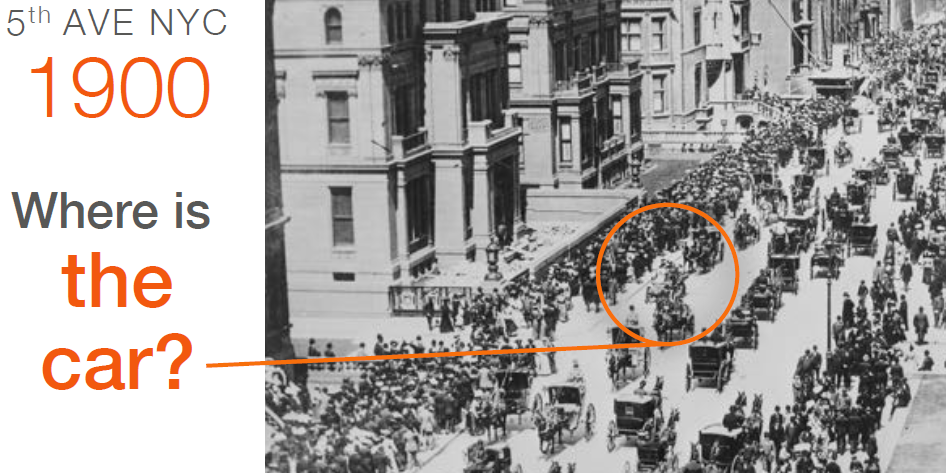
There's a photo of NY set 10yrs apart. One is mostly horses and one car. The other was mostly cars and one horse. They had to install a network of petrol stations and delivery services for a band new fuel type. Electricity is a lot easier, has some infrastructure and known technology.
 
Horses to cars - a disrupted decade

 
I worked for 3 months at Tesla in Fremont which is near San Francisco at the end of 2014 visas issues made it a no no to return in 2015 a very interesting time it was too. Strange to see they are still banging out the model S with no visible changes outside as far as I know, it looks a little dated now with its draped bodywork and overwide build but it was developed for the US market first off. The model 3 I have not looked at one yet and the Y is nowhere to be seen. Lets not even mention the Falcon rear doors on the X model which was my baby. I cannot visualise longevity as they were so complex to make far to many parts were needed and more parts equals just more tat to go wrong after the warranty period has expired.
 
Ah, as long as there is a charging point available when you need it. Imagine when the takeup is say 30% of new vehicles and a lot of them want to go off on their staycation at the same time (foreign travel being forbidden in the new C-19 world) , little Johnny will give you some earache after a five hour wait in a hot car at Watford Gap.
Installing EV chargers is much quicker and simpler and safer than digging big holes in the ground and putting fuel tanks with thousands of gallons of highly inflammable liquids into them.
If you want to see what can be done and is being done, just look at the EV charging infrastructure in Norway.
As has been said, there are apps which show which chargers are within the current range of your EV and also how many chargers are free at those charging locations.
In practice, most evs will rarely, if ever, use charging stations because most ev owners will charge their vehicle at home using cheap (sometimes free, off peak electricity.

Cheers

Bruce
 
So back to the original point, where will all the electricity come from to charge these vast numbers of EVs, we haven't much/any spare capacity now and have to import the shortfall from France and Norway?
 
Mine costs about 50p (1p per mile of range) to charge from ‘virtually empty’ (low voltage), and takes up a bit less road space, nor is parking a problem; there are, however some downsides, not least for any passenger and/or dog…

C9C70DA1-7563-4E7C-9921-EEAFEE19C63D.webp
 
  • Like
Reactions: Oly
Myth buster - yes sometimes chargers are in use...but more are coming online all the time and charging times generally aren't that high...plus you can see if they are in use before you pull off the motorway. There is also an app to contact other users to say your waiting, so they know to return and move their car as soon as its full.

Not perfect, but it's developing.

There's a photo of NY set 10yrs apart. One is mostly horses and one car. The other was mostly cars and one horse. They had to install a network of petrol stations and delivery services for a band new fuel type. Electricity is a lot easier, has some infrastructure and known technology.
Horses to cars - a disrupted decade


This is all pretty facile stuff. McKinsey was out by two orders of magnitude because the question they were asked is very different from the outcome in 2020. Put simply, they are asked about mobile telephony and the outcome was something altogether different. If you actually looked for the number of subscribers in the USA to cell phones (as opposed to smartphones - mobile internet multi-purpose devices), then you are likely to have a number which is not far off the prediction. The unexpectedly large numbers of subscribers is the result of bundling multiple services - telephony, navigation, photography, computing, information, ticketing, banking and so on, and not some extraordinary boom driven by the single technology. We still largely use landline telephony for the majority of call time too - again, not what the article was rather shallowly implying.

Cars and mobile phones are fundamentally different from the electricity networks because they are not physically connected entities. They were able to scale up extremely fast because they were not limited by the need to wait for an intensive physical infrastructure to support them. Electric vehicles aren't alike that. We all presume that they will need physical connections to nearly every home, whereas for cars or cellphones, we only needed one piece of infrastructure in an area which was capable of serving very large numbers of users.

The argument that the infrastructure for electric vehicles will be easier, cheap and as quick as that for petrol is dependent on some incorrect assumptions. Firstly, we do not already have a grid capable of doing this effectively. Secondly, it is much easier to install petrol stations because they are not a network - there is no physical connection required between points of supply. All that was required was to develop "stations". Supplying those stations, initially required nothing more than the use of well-developed existing technology (carts and barrels at the most elementary level) to do so.
Developing EV infrastructure requires digging up half the country, replacing large parts of the electricity grid, and installing extremely high power cabling.

The proof that this is different from the transition between cars and horsepower is the fact that it has already taken at least one decade of Teslas - perhaps the first really viable battery EV, and EVs are still very much the minority even in cities. Electric vehicles have been used for over 120 years
 
Installing EV chargers is much quicker and simpler and safer than digging big holes in the ground and putting fuel tanks with thousands of gallons of highly inflammable liquids into them.
If you want to see what can be done and is being done, just look at the EV charging infrastructure in Norway.
As has been said, there are apps which show which chargers are within the current range of your EV and also how many chargers are free at those charging locations.
In practice, most evs will rarely, if ever, use charging stations because most ev owners will charge their vehicle at home using cheap (sometimes free, off peak electricity.

Cheers

Bruce
That's not what professionals have been saying about it. It seems to be prohibitively more expensive and difficult to install the same refuelling capacity in 300kW chargers as a motorway petrol station has - i.e. a stand of,say, 100 x 300kW chargers. We know this because none exist.
The fact that in practice most EVs will rarely use charging stations is not a plus. In fact, it makes the problems worse, because it removes the economic basis for developing charging stations in the first place. They will never break even, therefore representing yet another unnecessary energy-related permanent drain on the taxpayer. Worse still, they end the era of independent personal transport and gift the state full elimination of freedom of movement - oddly a principle which the large majority of EV enthusiasts considered extremely important barely five years ago.
The consequence therefore is that EVs become less viable, rather than more viable. Until battery EVs have real-world ranges of 6-800 miles at equivalent real-world cost, they are not a force for good.

The more one thinks about battery EVs, the worse an idea they become. Sadly, these days rational public debate is just shouted down by the left.
 
I would have thought that hydrogen fuel cells are the way to power EVs, introduce the hydrogen into petrol stations the same way as unleaded petrol was, 10 years time we could all have EVs that take minutes to fill up.
 
Just thinking about all those folks who have been without electricity for days after the recent storms. Presumably they have to rely on some sort of fossil fuel for heating and cooking and would probably have died of hypothermia in an all electric world!
 
I can see, perhaps not in my lifetime that Hydrogen fuel cell powered cars will be the way forward with a big campaign to demonise electric cars.
 
I would have thought that hydrogen fuel cells are the way to power EVs, introduce the hydrogen into petrol stations the same way as unleaded petrol was, 10 years time we could all have EVs that take minutes to fill up.
Eh, no
There is a hydrogen fuelling station in Aberdeen not far from where I live and a hydrogen fuelling station is nothing like a fuelling station for petrol and diesel
Have a look at this
Note the size and complexity of the hydrogen production and storage part of the set up
The station can produce 5Kg of hydrogen per hour or 130Kg per day
Cars are refuelled at a pressure of 700 BAR (over 10000 psi) and busses and trucks are refuelled at 350 BAR (over 5000psi)
There is only 50 Kg of 700 BAR storage and 100Kg of 350 BAR storage
A hydrogen fuel celled powered Toyota Mirai has a hydrogen capacity of 5.5 Kg, so simple maths says that if 10 Toyota Mirais came in for hydrogen one after another, only the first 9 would get fuel and the last one would have to wait for an hour while the system produced another 5 Kg of fuel
The bottom line is that for cars and light commercial vehicles, hydrogen is a non starter.
However, for large commercial vehicles it may be a solution since the size and weight of the battery pack needed to give a large commercial vehicle a usable range would adversely affect the amount of load it could carry.
Such a vehicle could potentially have a large , but comparatively lightweight hydrogen fuel tank that would give it decent range and still allow it carry a commercially viable weight of cargo.

Cheers

Bruce
 
The argument that the infrastructure for electric vehicles will be easier, cheap and as quick as that for petrol is dependent on some incorrect assumptions. Firstly, we do not already have a grid capable of doing this effectively.

On what basis is the assumption that the grid is not capable? The grid had LOADS of capacity available, its just about timing...which is where smart meters and time of use tariffs come into play as already trialed and evidenced.

Peoples routine charging at home will be lead by the £ signs...do you charge at the dirtiest and most grid stressed times of day (4pm to 7pm) for 35p/kwh, or charge at 5p/kWh between 1am & 7am.

The system goes even further to make our grid less stressed and cleaner with Vehicle 2 Grid technology.
 
Back
Top